Your quilt sandwich is loaded, your thread path is correct, and the tensioning looks right. Then the stitches start skipping, the thread shreds, or the seam puckers for no obvious reason. In a sewing room, that kind of problem often gets blamed on the machine first. Most of the time, the needle is the main culprit.
That's why understanding sewing machine needles types matters so much. The needle is the only part of the machine that pierces the fabric, carries the top thread through the layers, and helps the hook form a clean stitch. Get the wrong type, size, or condition of needle, and even a beautifully tuned machine can sew poorly.
The Unsung Hero of Your Sewing Room
A lot of frustrating sewing problems start small. You switch from piecing cotton blocks to hemming knit pajama pants. Or you move from a simple wall hanging to a dense, batting-heavy quilt on a longarm. The machine hasn't changed, but the material has. If the needle stays the same, stitch quality often drops fast.
In the shop, we see this every day. A sewist walks in convinced the bobbin casing is acting up, or that the top tension is suddenly off, or that the machine “just doesn't like” a certain thread. Then we ask one question. What needle is in it right now?
Very often, the answer is a universal needle that's been asked to do everything.
Practical rule: If the fabric, thread, or project changes, the needle choice should be reconsidered too.
That matters even more for specialized work. Quilting through layered cotton and batting is not the same as embroidery with delicate rayon or polyester thread. Sewing stable woven fabric is not the same as stitching modern athletic knits with a lot of stretch and recovery. The wrong point can damage fabric. The wrong eye can shred thread. The wrong scarf shape can cause skipped stitches that no amount of rethreading will solve.
Our team in McKinney, Texas, has tested these problems on home machines and Innova longarms, and the pattern is consistent. The cleaner the match between needle, thread, and fabric, the cleaner the stitch formation.
When you know the major sewing machine needles types, you stop guessing. You start diagnosing. That's when puckering, missed stitches, and rough penetration stop feeling random and start making sense.
Understanding the Parts of a Sewing Machine Needle
A sewing machine needle looks simple until you study how it works. Every part has a job, and each detail affects stitch formation, thread handling, and fabric penetration.

The shank, shaft, and groove
The shank is the top portion that fits into the machine. On domestic machines, that standardized shape is what lets you install the needle correctly and keep it aligned with the hook timing. If the needle isn't fully seated, stitch problems can show up immediately.
Below that is the shaft. This is the body of the needle, and its diameter is what changes from one size to another. A finer shaft works better on delicate fabrics and finer threads. A heavier shaft supports more force when you're sewing thicker materials.
The groove runs down the front of the needle. It protects the top thread as the needle descends through the fabric. If the groove is too small for the thread you're using, the thread rubs hard against the metal and can fray, flatten, or snap.
The eye, scarf, and point
The eye is more than a hole. Its size and shape have to match the thread and the task. Needles made for embroidery or topstitching often use a more generous eye so specialty threads can pass with less abrasion. That's why decorative threads usually behave better in a needle built for them.
The scarf is the shallow cutout above the eye on the back of the needle. This area gives the hook room to pass close to the needle and catch the thread loop. If the scarf design doesn't suit the fabric and thread combination, stitch formation gets inconsistent. That's one of the hidden reasons skipped stitches show up.
The needle doesn't just pierce fabric. It creates the exact conditions the machine needs to build a stable loop.
Then there's the point or tip. This feature makes needle type critical. A sharper point penetrates tightly woven fabrics cleanly. A rounded point pushes between knit fibers instead of slicing through them. That one difference can determine whether the fabric stays smooth or ends up with snags and holes.
Why anatomy helps with troubleshooting
When you understand needle anatomy, troubleshooting gets faster.
- Skipped stitches often point toward point style, scarf design, or wear.
- Thread shredding often points toward the eye, groove, or a damaged burr.
- Fabric damage usually points toward the wrong point style or a dull tip.
- Popping sounds during sewing often mean the point is no longer penetrating cleanly.
A good stitch depends on how all these parts work together. Once you see the needle as a precision part instead of a disposable accessory, your machine behavior starts to make a lot more sense.
How Do I Choose a Sewing Machine Needle Size
The numbers on a needle pack tell you two things. First, whether the needle will fit a domestic machine. Second, how fine or heavy the needle is. Once you know how to read those markings, selecting from different sewing machine needles types gets much easier.

What 130 705 H means
Most home sewing machines use the 130/705 H needle system. That standard established a common shank shape and length for domestic machines, not industrial ones, and it supports the familiar range of specialty needles used for different fabrics, including sharper Microtex/Sharp styles. Needle sizing is also standardized, with a typical range from 60/8 to 110/18, and a size 90 needle measures 0.9 mm in diameter, as outlined in this sewing machine needle reference.
That's the fit side of the label. If your machine is a standard domestic model, this marking is the first thing to check before you even think about fabric type.
How the size numbers work
Needle packs usually show two size numbers, such as 80/12 or 90/14.
The first number is the European size. The second is the U.S. size. The rule is simple:
- Smaller numbers mean a finer needle
- Larger numbers mean a heavier needle
So a 60/8 is much finer than a 110/18. Fine needles suit lightweight fabric and finer thread. Heavier needles support denser fabrics, thicker thread, and more resistance.
A practical way to think about it is this:
- Fine sizes help prevent oversized holes in lightweight fabric
- Mid-range sizes handle everyday sewing and quilting cotton well
- Heavier sizes help penetrate denim, canvas, layered seams, and dense quilt builds
How to match size to the project
If you're piecing quilting cotton, hemming a blouse, or sewing everyday woven fabric, you'll usually live in the middle of the sizing range. If you're working with bulk, loft, or heavier thread, you'll move up. If you're sewing delicate fabric, you'll move down.
The key is balance. A needle that's too fine may deflect, overheat the thread path, or struggle to penetrate. A needle that's too large can leave visible holes and distort the seam.
A quick visual walkthrough helps if you're more comfortable learning by sight.
A shop-floor way to decide
When someone asks what size to start with, I usually narrow it down with three questions:
-
What fabric are you sewing
Stable woven cotton behaves very differently from stretch jersey or coated canvas. -
What thread are you using
Finer thread wants a finer eye and less bulk. Heavier thread needs more room. -
How dense is the project
A single layer and a quilt sandwich don't ask the same thing of a needle.
If you want to browse options by application, Linda's has a needle category that makes it easier to compare sizes and styles before you start the project.
What Are the Different Types of Sewing Machine Needles
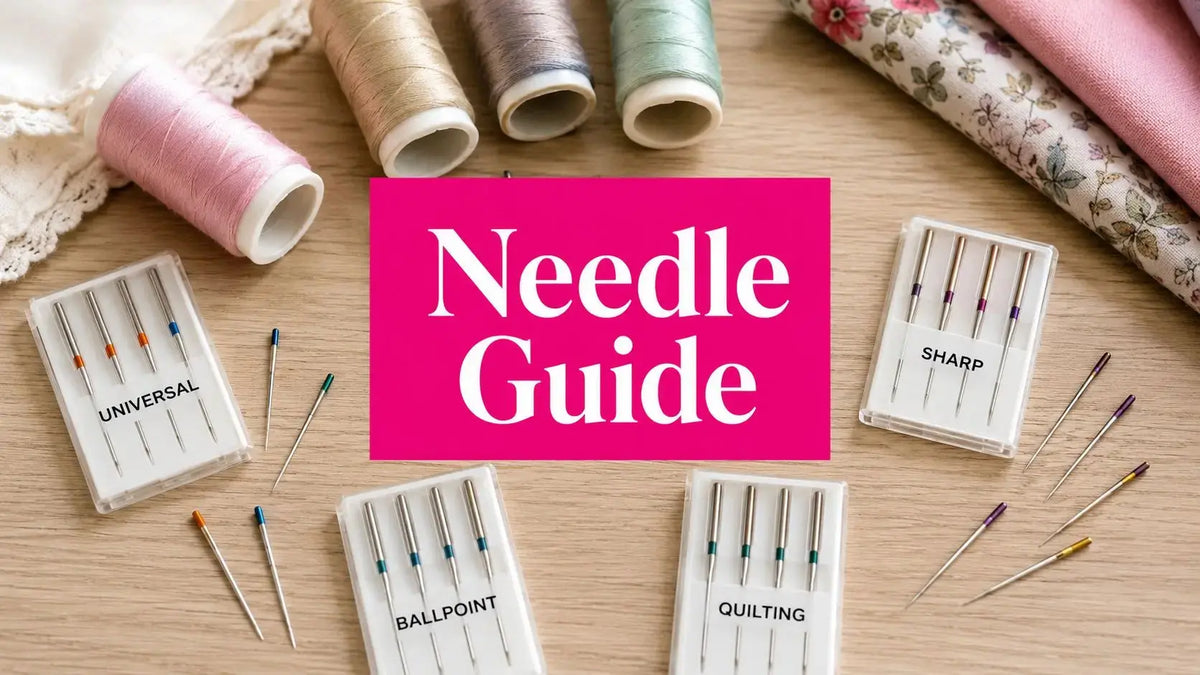
Needle size tells you how thick the needle is. Needle type tells you how the point, eye, and scarf are designed to behave in fabric. That's the difference that solves most stitch problems.
A universal needle might limp through several tasks, but it won't handle each one well. The point shape that works on quilting cotton isn't the same shape you want for jersey knit, dense denim, metallic thread, or heirloom stitching. Understanding these distinctions marks the start of comprehending sewing machine needle types.
Needle Type, Fabric, and Project Quick-Reference Chart
| Needle Type | Best For Fabrics | Common Projects |
|---|---|---|
| Universal | Stable woven fabrics and general sewing materials | Garment sewing, simple piecing, basic mending |
| Ballpoint | Knits and soft jersey fabrics | T-shirts, knit basics, children's wear |
| Stretch | High-stretch knits and activewear fabrics | Swimwear, leggings, sportswear |
| Sharp or Microtex | Fine wovens and tightly woven fabrics | Precision piecing, silk sewing, crisp topstitching |
| Quilting | Layered quilt materials | Piecing, machine quilting, quilt assembly |
| Embroidery | Embroidery fabrics with specialty thread | Machine embroidery, monograms, decorative motifs |
| Topstitch | Decorative or heavier threads on woven or knit fabrics | Visible topstitching, quilting, thread-heavy seams |
| Metallic | Metallic and delicate specialty threads | Decorative accents, embellishment stitching |
| Twin | Compatible fabrics that need parallel rows | Hems, pintucks, decorative double lines |
| Wing | Loosely woven fabrics for heirloom effects | Hemstitching, heirloom sewing, decorative openings |

Universal, sharp, and quilting needles
Universal needles have a slightly rounded tip rather than a full ballpoint. That makes them useful on many woven and stable materials, both natural and synthetic, but they can struggle on stretchy knits where skipped stitches or fabric damage become more likely, as discussed in this overview of universal needle behavior.
Sharp needles, often sold as Microtex/Sharp, are slimmer and sharper than universal needles. They excel when you want precise penetration on tightly woven fabrics and neat stitch definition. If you work with quilting cottons that vary by weave and finish, it helps to understand the fabric itself first. This summary of Dandylion Style's insights into cotton weaves is useful for seeing why one cotton behaves crisp and another feels softer or looser under the same needle.
Quilting needles are built for repeated penetration through layered material. In practice, they're a smart choice when you're crossing seams, sewing through batting, or trying to keep stitch formation clean across pieced tops and backings.
Ballpoint, jersey, and stretch needles
This is the area that trips up a lot of otherwise experienced sewists.
A sewing guide explains that sharp needles are intended for natural fibers such as cotton, linen, and wool, while ballpoint or jersey needles are recommended for man-made knits and mixed fabrics because they separate fibers more gently instead of cutting them. The same guide notes concrete use points such as No. 100 for denim, No. 110 for upholstery, canvas, leather, PVC, and vinyl, and No. 120 for thick denim and heavy canvas. It also lists common everyday sizes including 60/8, 70/10, 75/11, 80/12, 90/14, 100/16, 110/18, and 120/20, with 90/14 suited to quilting fabrics and 100/16 suited to denim, corduroy, canvas, and leather, as shown in this sewing machine needle guide.
Jersey needles have a slightly smaller ball tip than standard ballpoint needles, which lets them sew closely on knit fabrics with a medium stretch factor while helping prevent snagging or tearing, according to this needle design guide for garment sewing.
The critical distinction is between ballpoint and stretch needles. Standard ballpoints, often labeled Jersey, can cause skipped stitches on high-Lycra fabrics. Stretch needles are engineered with an enlarged scarf so the machine can properly form a stitch with thick, elastic threads used in activewear. That difference is especially important for swimwear and performance knits, as shown in this video explanation of stretch needle design.
If you're sewing leggings, swimwear, or modern four-way stretch fabric, “ballpoint” isn't always enough. Stretch needles solve a different problem.
Embroidery, topstitch, and metallic needles
Embroidery needles are designed to reduce stress on decorative thread. When rayon, polyester embroidery thread, or other delicate thread starts fuzzing at the eye, this is often the first needle type to try.
Topstitch needles are a favorite in quilting rooms because the larger eye and deeper groove give the thread more space and less friction. That matters when you're using decorative, silk, invisible, or heavier quilting threads. One practical option is #80/12 Titanium-Coated Topstitch Needles, which have a deeper groove, a larger eye, and a titanium nitride coating that is less than 5 microns thick. The product description also notes that an average human hair is 70 microns thick, which helps show how thin that coating is while still adding wear resistance.
Metallic needles help when metallic thread is the issue, not the machine. They're built to reduce abrasion on specialty thread that tends to twist, flatten, and shred under friction.
Twin and wing needles
Twin needles create two parallel rows of stitching from one shank. They're useful for hems, decorative lines, and pintucks, but they require a machine and stitch setting that won't drive the needle into the presser foot or plate.
Wing needles are niche, but valuable. Their widened sides push fabric threads apart to create decorative heirloom openings on suitable woven fabric. They're not an everyday choice, but when the project calls for them, no other needle gives the same look.
What works and what doesn't
Some combinations consistently behave well. Others don't.
-
Works well
Sharp or Microtex for crisp woven piecing, quilting for layered quilt construction, stretch for activewear, and embroidery for decorative thread. -
Usually fails
Universal on slippery technical knits, ballpoint on very high-stretch athletic fabric, or a fine needle paired with heavy decorative thread. -
Worth keeping on hand
A small range of universal, sharp, quilting, stretch, and topstitch needles will cover most home sewing, quilting, and embroidery work without much trial and error.
Which Needle Is Best for Quilting and Embroidery
For quilting and embroidery, the best needle is the one built for the stress of the job. General sewing advice often breaks down here because these projects push the machine harder, use more specialized thread, and punish weak needle choices much faster.

For quilting on domestic and longarm machines
Quilting needles are built to move through multiple layers with less resistance than a general-purpose needle. On a domestic machine, that improves control when you're piecing through seam allowances or quilting through batting. On a longarm, the demands are greater because speed and continuous operation expose wear sooner.
Our team in McKinney, Texas, tested this on an Innova longarm and found that generic “just use a universal” advice doesn't hold up for serious quilting. Layered cotton, batting loft, and sustained stitching create a tougher environment than ordinary garment sewing. The needle has to penetrate cleanly and keep the thread path stable at speed.
A longarm can hide a worn needle until the quilt starts showing the damage.
A topstitch needle can also be a strong quilting choice when you're using heavier quilting thread. The larger eye reduces friction, and the deeper groove helps protect the thread as it travels through the quilt sandwich. For thick quilts or heavier thread, the #100/16 size is especially useful because it's recommended for quilting with 30 wt. and heavier threads in the product snapshot for that needle family.
For machine embroidery
Embroidery needles solve a different set of problems. Decorative thread is often more delicate than standard sewing thread, and embroidery stitch patterns create dense, repeated needle penetrations in a concentrated area.
That's why embroidery needles use a shape that helps thread move more smoothly and reduces shredding. If you've ever watched beautiful embroidery thread start to fuzz at the needle while the design still has a long way to go, you already know how costly the wrong needle can be.
Pro tip from the machine side
Pro tip: If your quilting thread keeps breaking but your tensioning is already balanced, try changing the needle before changing the thread path. A larger eye often solves what looks like a tension problem.
General advice suggests changing a needle every 8 to 10 sewing hours, but that benchmark can be dangerously inaccurate for longarm machines. The high speeds and dense quilt sandwiches mean a longarm needle can wear out much faster, which leads to skipped stitches and fabric damage if it isn't changed more often, as noted in this needle replacement discussion for quilting machines.
For expensive quilts and specialized machines, task-specific needles aren't fussy. They're protective. They protect the thread, the fabric, the stitch quality, and the machine's consistency.
How Do You Know When to Change Your Sewing Machine Needle
A sewing machine needle is a consumable. It isn't meant to stay in the machine indefinitely, and waiting too long to change it creates problems that look bigger than they are.
The signs show up in the stitch first
A worn needle usually announces itself through stitch quality before you notice anything with the naked eye. The machine may start skipping stitches, making uneven loops, or leaving puckered seams where the fabric used to feed smoothly. Thread may begin shredding near the eye, especially if the eye has developed a tiny burr from impact or wear.
You can also hear it. A dull needle often makes a more pronounced punching or thumping sound as it enters the fabric. Instead of piercing cleanly, it forces its way through.
A simple replacement checklist
If any of these show up, change the needle first.
-
Skipped stitches
The hook may no longer be catching a reliable loop. -
Thread breakage
The eye or groove may be abrading the thread. -
Fabric snags or visible holes
The point may be dull, bent, or wrong for the fabric type. -
Louder machine sound
A healthy needle usually enters fabric more cleanly, with little noise. -
A recent collision
If you hit a pin, zipper, or bulky seam hard, replace the needle even if it still looks straight.
Change the needle before you start chasing tension problems. It's faster, cheaper, and often fixes the issue immediately.
For regular sewing, a proactive schedule works well. Replace the needle after 8 to 10 hours of active sewing or at the start of a major new project if the fabric or thread type has changed. That habit prevents a lot of avoidable troubleshooting.
If stitch problems continue after a fresh needle, then it makes sense to look deeper at cleaning, threading, and tensioning. For that next step, a related tutorial on solving thread tension issues can help isolate whether the problem is in the thread path rather than the needle.
Frequently Asked Questions About Sewing Needles
Can I use a universal needle for everything
You can use a universal needle for many woven and stable fabrics, but it won't handle every project well. It's a compromise needle. When the fabric stretches, the thread is delicate, or the project gets dense, a task-specific needle usually gives cleaner results.
What's the difference between a ballpoint and a jersey needle
In everyday conversation, people often lump them together. In practice, jersey needles have a slightly smaller ball tip that works well on medium-stretch knit fabrics. They're designed to separate fibers gently rather than cut them.
Why does my machine skip stitches on athletic knit
That usually points to using the wrong knit needle. High-stretch fabrics often need a stretch needle rather than a standard ballpoint or jersey style because stitch formation depends on the scarf design as much as the tip.
Should I throw away a needle if it still looks fine
Yes, sometimes. Needles wear in ways you can't always see. If the machine starts sounding harsher, the thread begins shredding, or the stitch line changes, replacing the needle is the first move.
How should I dispose of used needles
Don't drop loose needles into the trash. Put them in a labeled sharps container, a hard plastic bottle, or another puncture-resistant container first. That keeps everyone handling household waste safer.
When you're ready to finish a project without fighting skipped stitches and thread breaks, shop the needle selection at Linda's Electric Quilters. You'll also find thread, batting, and educational videos that help match the right consumables to the way you sew, quilt, and embroider.