
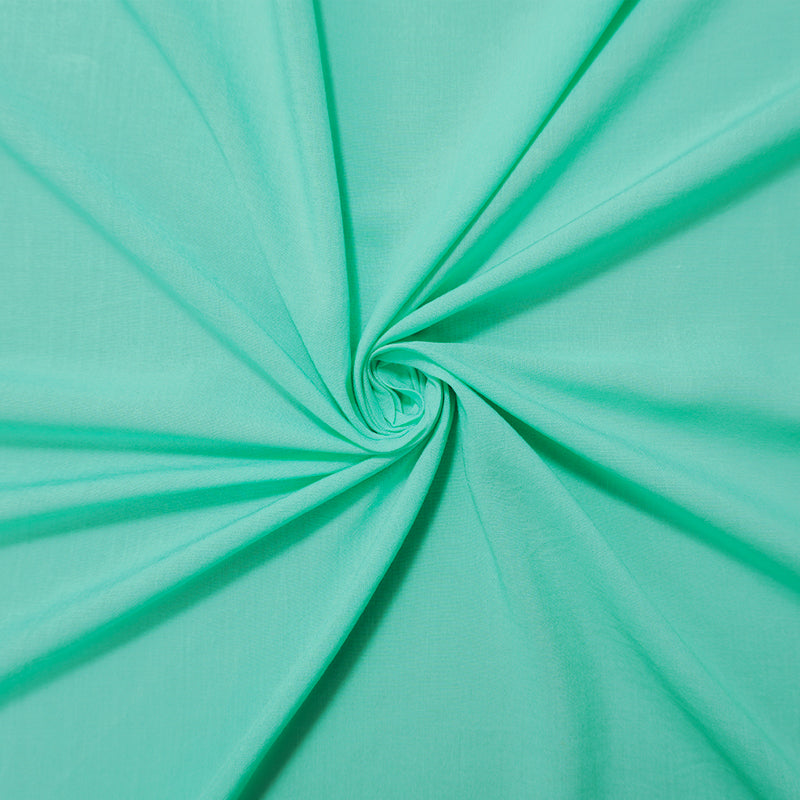
Rayon challis is a lightweight, plain-weave rayon with a fluid drape and a matte, slightly crepe-like hand. It suits garments that hang from the body rather than hold a shape: blouses, gathered or tiered dresses, wide-leg trousers, jumpsuits and loose scarves. It is a poor choice for tailored or structured garments, because it has almost no body and presses softly rather than crisply.
What rayon challis is
Challis is a plain weave, which means the yarns simply pass over and under each other in the simplest possible pattern. In rayon challis, those yarns are fine and smooth, so the finished cloth is soft, cool against the skin and unusually fluid for a woven fabric. The rayon challis fabrics stocked at Linda's are 100% rayon, listed as lightweight and semi-sheer with no stretch, low luster and "very good drape" — the specifications that drive every garment recommendation below. Common widths in the collection run from about 55 to 58 inches, which is generous for garment layouts.
Two behaviors follow from that structure. First, challis moves: it skims over the body instead of standing away from it, and it swings when you walk. Second, it does not hold an edge. Collars go soft, waistbands roll unless they are interfaced, and a sharp crease relaxes within minutes of pressing. Choosing garments that treat both behaviors as features — rather than fighting them — is the whole skill of sewing with challis.
Garments that suit challis, and why
Blouses and shirts. A blouse is the classic challis garment. Soft gathers at a yoke, a flowing sleeve and a placket that is lightly interfaced all play to the fabric's drape. Because challis is semi-sheer, plan on a camisole underneath or choose one of the more opaque prints for a standalone top.
Gathered and tiered dresses. Gathering is where challis earns its keep. The fabric compresses into soft, even gathers without the bulk that a stiffer cotton would add at a waist seam, so tiered skirts and peasant-style bodices fall in the fluid folds the style is meant to have.
Wide-leg trousers and jumpsuits. A palazzo cut needs a fabric that pours rather than stands, and challis does exactly that. The semi-sheer quality matters less in a lined or fuller trouser, and the cool hand makes challis a warm-weather staple. Elastic or drawstring waists suit the fabric better than rigid tailored waistbands.
Scarves and wraps. A simple hemmed rectangle shows the drape honestly and is the lowest-risk first project: no fit, no closures, and the fabric's movement is the entire point.
Loose tunics and caftans. Silhouettes that hang from the shoulders and rely on volume rather than shaping are natural challis territory, and they forgive the fabric's tendency to grow slightly on the bias as it is worn.
Garments to avoid, and why
Tailored jackets and fitted blazers. Tailoring is built on a fabric holding a pressed shape and supporting pad stitching and canvas. Challis does neither; lapels soften and fronts collapse no matter how much interfacing is added underneath.
Structured sheath dresses and pencil skirts. A garment whose design lines are its shape needs body. In challis, darts press poorly, seams grin under stress, and the silhouette reads as limp rather than clean.
Anything relying on crisp pleats or creases. Rayon relaxes. A knife pleat or a trouser crease that must survive a day of wear will not survive it in challis.
Heavy-duty or high-abrasion garments. Challis is a light fabric; workwear, children's play clothes that take kneeling wear, and bags are all better served by sturdier cloth.
Before you cut: the rayon rules
Rayon challis shrinks — noticeably, and mostly in length. Pre-wash every cut of challis before it goes under the scissors, using the care method you intend to use for the finished garment, and press it flat afterward. Skipping this step is the single most common reason a challis garment disappoints: the dress that fit at the final fitting does not fit after its first wash.
Handle the fabric gently between washing and cutting. Challis shifts on the cutting table and its edges curl, so cut in a single layer with a rotary cutter or sharp scissors, keep pattern pieces pinned or weighted, and stay-stitch necklines and other curved edges soon after cutting so they do not stretch out of shape. When you are ready to sew, the seams themselves need the same respect: the companion guide to seams and edge finishes for rayon challis covers French seams, serged finishes and hems in detail.
Choosing a challis from the collection
The main collection for this module is the rayon challis collection. Three verified options show the range:
- Light Green Rayon Solid Challis Woven Fabric — 100% rayon, 55 inches wide. A solid is the right first challis: the drape is easy to judge, there is no print to match at seams, and it makes a clean first blouse.
- Aegean Blue Rayon Solid Challis Woven Fabric — 100% rayon. The same dependable solid in a second colorway, for a gathered dress or tunic where the color does the work.
- Pink Rayon Stripe Slub Challis Woven Fabric — 100% rayon, 58 inches wide, with a slub texture and a woven stripe. The texture adds surface interest for tiered dresses; the stripe adds a layout decision, because stripes must run consistently from piece to piece.
Prices in this collection are per fractional-yard cut, so check the product page for the exact cut increments before comparing cost per yard.
Care and limitations
Follow the care guidance on the specific product page. In general, rayon challis is washed gently in cool water and dried flat or on a line; expect the shrinkage noted above and allow for it by pre-washing. This guide is a specification- and product-data-based comparison: no sample garments were sewn or photographed for it, and drape descriptions follow the fabrics' listed specifications.
Keep reading
More from Apparel Fabric School. Before you buy, work through the measurements in the fabric yardage guide so the width you choose converts to the right yardage. Next in this module: seams and edge finishes for rayon challis.


