
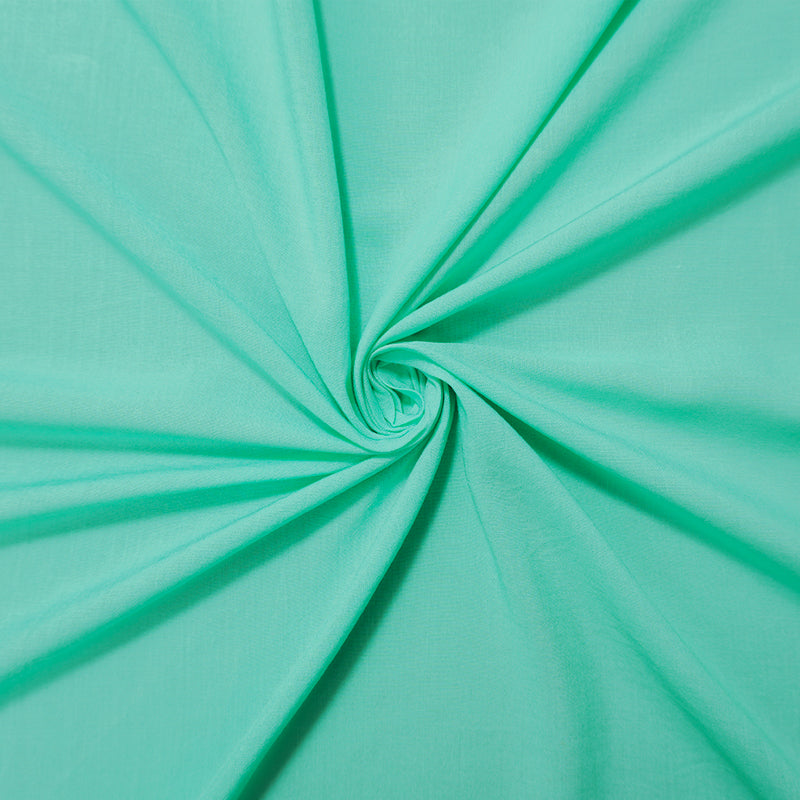
Rayon challis frays readily and its seams can slip under stress, so the reliable finishes are French seams on straight seams, a 3- or 4-thread serged finish where a serger is available, and a narrow machine-rolled or serged rolled hem on hems. Use a fine needle (microtex/sharp 70/10–80/12), a slightly shortened stitch length, and stay-stitch curved edges before handling.
This is a construction comparison written from seam-construction standards for fluid woven fabrics. It compares the four seam finishes and the main hem options on the criteria that matter in challis — fray control, bulk, and how each finish behaves on straight seams, curved seams and stressed seams — so you can pick per seam rather than defaulting to one finish for a whole garment. Settings first, then the finishes.
Machine settings for challis
Needle. A microtex/sharp needle in 70/10 or 80/12. Universal needles have a slightly rounded point that can push challis's fine yarns aside instead of passing between them, which shows up as skipped stitches and tiny runs in the fabric.
Thread. All-purpose polyester thread. It is slightly stronger and more elastic than cotton thread of the same weight, which matters in a fabric whose seams can be stressed by the garment's own fluid weight.
Stitch length. Shorten slightly from your default — about 2.0–2.2 mm instead of 2.5 mm. More stitches per inch distributes stress across more yarn and reduces seam slippage, the failure where yarns pull away from the stitching line and open a ladder in the fabric.
Seam allowance. Keep the pattern's standard ⅝ inch allowance. Challis is not a fabric to trim allowances aggressively: the extra width is your fray insurance, and French seams (below) are planned around it.
Stay-stitching. On any curved or bias edge — necklines, armholes, waist curves — sew a line of stitching a scant ⅛ inch inside the seamline, on a single layer, before the piece is handled or joined. Challis edges stretch out of shape under their own weight; stay-stitching locks the seamline length so two pieces still match when they meet.
Seam finish 1: the French seam
A French seam encloses the raw edges inside the seam itself, so nothing can fray — ever. It is the reference finish for challis on straight and gently curved seams.
Construction. With a ⅝-inch allowance, the math is ¼ inch plus ⅜ inch. Place the pieces wrong sides together and stitch ¼ inch from the edge. Trim the allowance to about ⅛ inch — close, but never into the stitching. Press the seam to one side, fold on the stitching line so the right sides are now together, and stitch again ⅜ inch from the fold, fully enclosing the trimmed edges. Press toward the back of the garment.
Where it works. Straight side seams, shoulder seams, centre-back seams, and any seam on a semi-sheer garment where the finish will be visible through the fabric — the French seam's neat double line looks intentional.
Bulk and limits. It adds a firm ridge of four fabric layers, so it is wrong for tight curves (the fold cannot ease around a small radius without puckering) and awkward where several seams intersect. On curves, use the serged finish instead.
Seam finish 2: serged (overlocked) edges
A 3- or 4-thread serged finish wraps the raw edge in thread, stopping fray and adding a slight elasticity that suits a fluid fabric. Stitch the seam on the sewing machine first, then serge the two allowances together — or separately, pressed open, where the seam needs to lie flat.
Where it works. Curved seams, armholes, seams that will be pressed open, and any seam under light stress. It is the fastest finish and the most forgiving on shapes a French seam cannot follow.
Bulk and limits. Serging adds almost no bulk, but the thread wrap is visible through semi-sheer challis as a textured line; on a blouse front, judge whether that matters. It also depends on having a serger — the next two finishes are the no-serger alternatives.
Seam finish 3: pinked and stitched
Stitch the seam normally, then trim the allowances with pinking shears and press open. The zigzag edge slows fraying rather than stopping it.
Where it works. Low-stress seams in garments that will be washed gently and not often — a loose scarf-neck top, for example. It is the lightest finish of all.
Limits. On a challis garment that will be laundered regularly or stressed at the waist or seat, pinked edges eventually shed yarn. Treat this as the minimum viable finish, not the standard.
Seam finish 4: bound seams
Wrap each allowance in a narrow strip of lightweight bias binding (a Hong Kong–style finish) and stitch it down. It is the slowest option and the most luxurious-looking through a sheer fabric — the binding becomes a design line.
Where it works. Unlined jackets and feature seams on better garments. Limits: it adds the most bulk and time of any finish here, and the binding fabric must be as light as the challis or lighter, or the seam turns stiff.
Hems for challis
Serged or machine-rolled narrow hem. The default. A serged rolled hem (differential feed eased slightly, woolly nylon in the loopers if you use it) finishes at about ⅛–¼ inch wide and lets a skirt hem move with the fabric. A machine narrow hem using a rolled-hem foot achieves a similar width without a serger; practise the foot on an offcut first, because challis feeds unevenly at the start of a seam.
Baby hem. Turn ¼ inch twice, stitching each turn. Slightly wider and flatter than a rolled hem — the better choice on a blouse hem that will be tucked in and seen.
Faced hem. A separate facing strip, turned to the inside, for hems on a curve or where the skirt needs a whisper of extra weight to hang well. The facing is cut from the same challis so nothing shows through.
Let any bias or circular skirt hang for at least 24 hours before hemming, whichever finish you choose: challis grows on the bias, and a hem levelled on the day of cutting will not be level on the day of wearing.
Pressing rayon challis
Press on a medium-low setting with a press cloth between iron and fabric; rayon scorches and glazes under a hot iron. Press seams from the wrong side where possible, and lift and lower the iron rather than sliding it — sliding drags a fluid fabric out of shape while it is warm. Test the setting on an offcut of the exact fabric first.
Fabric for practising these finishes
All three options are in the rayon challis collection:
- Light Green Rayon Solid Challis Woven Fabric (100% rayon, 55″ wide) and Aegean Blue Rayon Solid Challis Woven Fabric — solids, so every stitching line and finish is fully visible on the fabric; the honest way to compare finishes.
- Pink Rayon Stripe Slub Challis Woven Fabric (100% rayon, 58″ wide) — the slub texture and stripe make it the right candidate for hem practice, since a hem must run true against the stripe.
Prices in this collection are per fractional-yard cut; check the product page for the cut increments.
Care and limitations
Finishes differ in how they survive the wash: French and serged seams hold up best under gentle laundering, pinked edges least. Wash the finished garment the way you pre-washed the fabric (see the care notes in the challis garment guide below). Limitation: the roadmap this article answers called for photographed seam samples; none were produced, and this comparison is written from construction standards rather than from samples sewn for the article.
Keep reading
More from Apparel Fabric School. Prerequisite: rayon challis: which garments suit its structure and drape. Next: the same finish comparison for sheers — seams and edge finishes for chiffon and georgette.


