
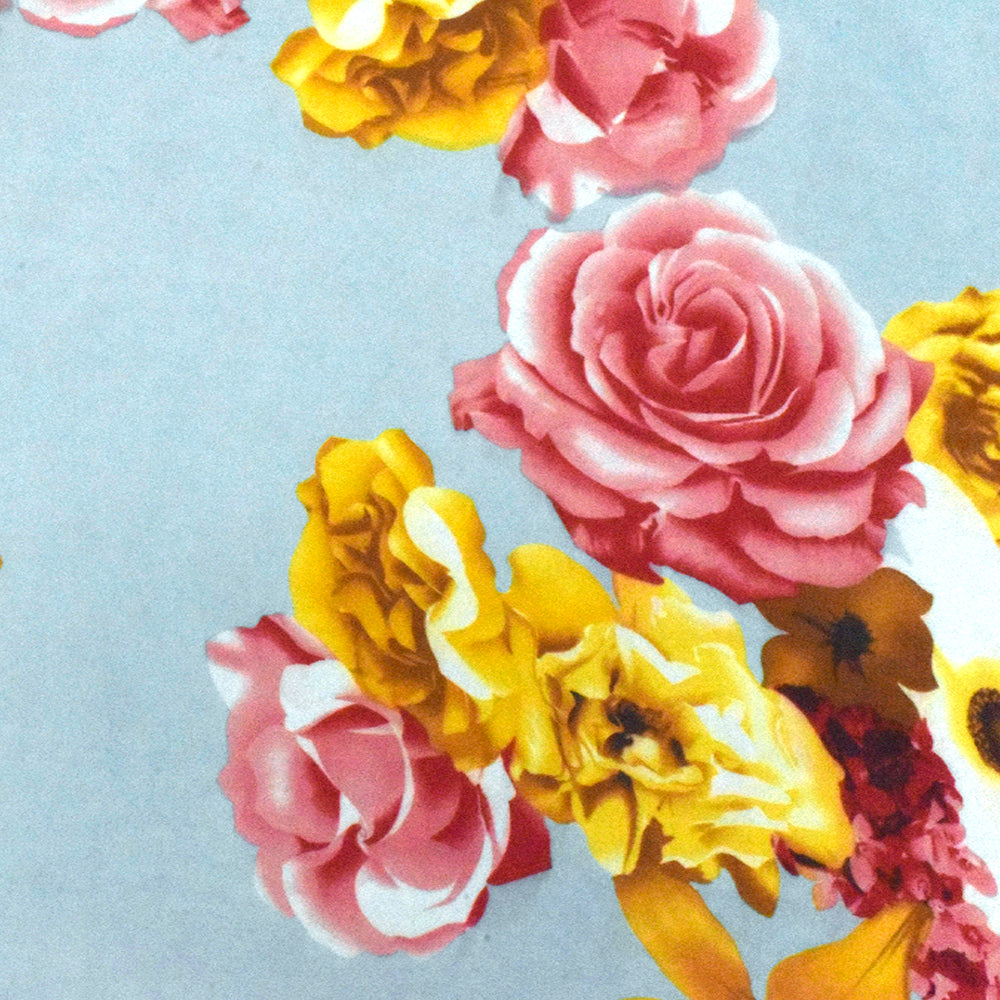
Chiffon is the lighter, smoother and more transparent of the two: it suits overlays, sheer sleeves, ruffles and floaty skirts, usually over a lining. Georgette is slightly heavier, more textured and more opaque, with a crisper drape that holds a blouse, dress or scarf shape better and is more forgiving to sew. Neither suits structured or tailored garments.
How the two fabrics differ
Both chiffon and georgette are sheer plain-weave fabrics, but they are built differently. Chiffon uses smooth, fine yarns, which give it a flat, slippery surface and the most transparent hand of the two. Georgette is woven from twisted crepe yarns, and that twist shows up as a slightly grainy texture, a springier feel and a drape with more snap to it. In practical terms: chiffon floats, georgette moves with a little more decision.
The specifications on the fabrics in Linda's chiffon collection make the contrast concrete. The printed polyester chiffon is 58 inches wide and listed as tissue-light and semi-sheer. The silk double georgette from Runway Silks is 45 inches wide, 16 momme, 100% silk — and its own product description states the rule of thumb this guide is built on: georgette is slightly heavier and more opaque than chiffon, with a springy quality from its twisted crepe fibers.
Side-by-side comparison
| Property | Chiffon | Georgette |
|---|---|---|
| Weight | Tissue-light; the lightest of the pair | Light, but noticeably more substantial; double georgette more so |
| Opacity | Semi-sheer to sheer; plan a lining or layer beneath | Less transparent; a single layer can work in darker colors |
| Drape | Floaty, liquid, clings as it falls | Crisper, springier, holds a shape a little longer |
| Surface | Smooth and slippery | Slightly textured, crepe-like |
| Sewing difficulty | Shifts and slides; the harder of the two | The texture grips a little; more forgiving |
| Typical fibers in stock | Polyester, cotton, viscose | Silk (double georgette) |
Garments that suit chiffon
Overlays and overskirts. Chiffon's transparency is the effect, not a problem: a chiffon layer over a solid dress or skirt adds movement and softens the outline without adding weight.
Sheer sleeves and yokes. Set into a lined bodice, chiffon sleeves give coverage without warmth — a formalwear staple.
Ruffles and flounces. Chiffon cut on the bias or in circles falls into the soft, fluttering edge these details need, and its hems can be left as narrow rolled edges.
Floaty skirts and scarves. Full, gathered or layered skirts and simple scarves use chiffon's float honestly; no structure is asked of the fabric.
Garments that suit georgette
Blouses. Georgette's extra body and opacity make it the better blouse fabric: it behaves under a collar, needs no lining in many colors, and its texture hides stitching better than chiffon's glassy surface.
Dresses with shape. A georgette dress with a defined waist or soft tailoring holds its lines better than chiffon, while still moving like a sheer.
Scarves and wraps. Georgette scarves stay where they are draped instead of sliding off, thanks to the textured surface.
Layered skirts. Where chiffon would collapse into the layer below, georgette's spring keeps layers distinct.
Garments to avoid in both
Neither fabric suits tailored jackets, structured dresses, trousers or anything that must hold a crease, support hardware or survive abrasion. Both fray, both shift on the cutting table and both punish imprecise sewing — the finishes that keep them under control are covered in the companion guide to seams and edge finishes for chiffon and georgette.
Width and buying notes
Width changes the calculation between the two fabrics. The chiffons above are wide cloths — 58, 48 and 56 inches — which suits the full, gathered styles chiffon is used for. The silk double georgette is 45 inches wide, a classic dress width: a full georgette skirt needs either more length or a design built from narrower panels, and its yardage should be worked out with the width-substitution method in the Fabric Math hub rather than assumed from a chiffon pattern's call. Neither fabric should be bought to a pattern's stated yardage without checking the width on the envelope against the width on the product page.
Lining and layering rules
Plan the under-layer before you buy the sheer. Chiffon almost always needs one: a lining, a camisole layer, or a second sheer layer in a matching tone. Match the lining's fiber care to the outer fabric's, and cut the lining slightly smaller so it never peeks out at hems. Georgette can sometimes go unlined in darker shades, but test the specific fabric against the skin in daylight — "more opaque" is a comparison, not a promise.
Choosing from the collection
The main collection for this module is the chiffon fabrics collection. Verified options:
- Angel Blue-Yellow-Multi Floral Printed Polyester Chiffon Woven Fabric — 100% polyester, 58 inches wide, semi-sheer. The classic floaty chiffon for overlays, ruffles and sheer sleeves.
- Black Cotton Solid Chiffon Woven Fabric — 100% cotton, 48 inches wide, sheer. A softer, less slippery chiffon; the easiest first sheer to sew.
- Black-Gold Viscose Metallic Stripe Chiffon Famous Designer Fabric — viscose with a metallic clip stripe, 56 inches wide. An occasionwear chiffon whose stripe adds a layout decision at the cutting table.
- Runway Silks White Silk Double Georgette Fabric — the georgette comparison example: 100% silk double georgette, 45 inches wide, 16 momme, slightly heavier and more opaque than chiffon.
Prices on the Fabric Depot–sourced chiffons are per fractional-yard cut; check the product page for cut increments before comparing cost.
Care and limitations
Care follows the fiber, so follow each product page. Polyester chiffon generally tolerates gentle machine washing; cotton chiffon washes gently and presses on a low setting; silk georgette is a dry-clean or careful hand-wash fabric. This is a specification-based comparison — no sample garments were sewn for it.
Keep reading
More from Apparel Fabric School. The drape-and-structure framework behind these choices is set out in rayon challis: which garments suit its structure and drape. Next in this module: seams and edge finishes for chiffon and georgette.


