
On chiffon and georgette, the finishes that work are a narrow French seam, a 2- or 3-thread serged rolled hem, and a machine narrow (rolled) hem; wide turned hems pucker and show through. Sew with a microtex 60/8–70/10 needle, short stitch length, and hold the fabric taut front and back as it feeds — or sew over tissue that tears away — to stop the sheer being pulled into the needle hole.
Sheers change the rules that govern ordinary seam finishes. Every finish is visible through the fabric, so a finish is a design decision as much as a construction one. Bulk that would be invisible in cotton reads as a hard line in chiffon; a frayed edge that would hide inside a lined seam telegraphs straight through a sheer. This comparison works through the finishes that respect those constraints, the cutting protocol that makes any of them possible, and the pressing protocol, which differs by fiber.
Settings for sheers
Needle. Microtex/sharp 60/8 to 70/10 — finer than for challis, because a sheer yarn snagged by a needle shows as a permanent pull line.
Stitch length. Short, about 1.8–2.0 mm. Long stitches let sheer seams pucker and grin; the fabric is too light to feed evenly against them.
Feeding. Hold the fabric taut in front of and behind the needle — not pulling, just keeping gentle tension — so the feed dogs do not drag the layer into the needle hole. The alternative is to sew with tissue paper under the fabric (or over the seamline) and tear it away afterward; the paper gives the feed dogs something with body to move.
Thread. Fine all-purpose polyester thread. A heavy thread in a sheer seam is visible as a cord through the fabric and can pucker the seamline.
Seam finish 1: the narrow French seam
The same construction as for challis, scaled down. In sheers, the math is ⅛ inch plus ¼ inch against a standard allowance: stitch wrong sides together ⅛ inch from the edge (after trimming the allowance to suit), press, fold, and stitch again ¼ inch from the fold. The finished enclosed seam is about ¼ inch wide.
Why it wins on sheers. It is the only finish with no raw edge and no thread wrap: through the fabric it reads as one clean, deliberate line. On a sheer blouse or an overlay skirt, that line looks like part of the design.
Limits. Straight and gently curved seams only, and it takes time — every seam is sewn twice. On a tight curve the narrow fold still puckers; switch to the serged finish there.
Seam finish 2: serged seams
A 3-thread serged edge on a sheer is fast and stops fraying completely, but the thread wrap is denser than the fabric and shows as a textured stripe through it. On polyester chiffon worn over a lining, that stripe is buried between layers and does not matter. On an unlined sheer sleeve, it is the first thing the eye catches.
The deciding rule: serge where the seam will be hidden by layering, lining or gathering; French-seam where the seam will be seen through a single sheer layer.
Seam finish 3: bound seams
Binding a sheer seam allowance in a strip of the same sheer (self-binding) preserves the fabric's transparency better than any thread-based finish, because nothing opaque is introduced. It is slow, fiddly work — the binding strip itself wants to shift — and it belongs on couture-level garments and feature seams, not on a whole dress. A commercial binding in a heavier fabric defeats the purpose: the seam turns into a visible strap.
Hems: the comparison that matters most
Serged rolled hem. A 2- or 3-thread rolled hem on the serger, finished width about ⅛–¼ inch. The edge curls slightly and moves with the fabric — the standard hem for chiffon skirts, scarves and ruffles. On georgette, the same setting produces a slightly firmer, more defined edge.
Machine narrow (rolled) hem. A rolled-hem foot folds and stitches a hem of a similar width on a standard machine. It demands a steady feed: start the hem on a small leader of scrap fabric, because the first centimetre in a sheer is where the foot tends to chew. Best on straight and gently curved hems.
Hand-rolled hem. The traditional couture finish: the edge is rolled between the fingers and slip-stitched as it rolls, producing the softest, least visible hem of all. It is described here as a technique rather than a shortcut — it is slow, and it is the right choice for a silk georgette scarf or a heirloom garment where machine stitching would show.
What fails. A standard double-turned hem of ½ inch or more puckers along the fold, and the doubled band of fabric reads through the sheer as a stripe of deeper color at exactly the point where the eye rests. Wide hems on sheers are both a sewing problem and a design problem.
Cutting protocol
Finishes this fine are decided at the cutting table. Cut sheers in a single layer — folded layers slide against each other mid-cut and the pieces come out mismatched. Two setups work: a rotary cutter and mat with the fabric weighted rather than pinned (pins distort a sheer and leave holes), or the tissue-sandwich method, where the fabric is laid on tissue paper, the pattern is pinned through fabric and tissue together, and the whole sandwich is cut with shears, the tissue giving the blades something to bite. Mark with tailor's tacks or a fine chalk line on the wrong side; sliding markers drag.
Pressing protocol, by fiber
Polyester chiffon. Low heat, always with a press cloth. Polyester sheers glaze and can melt under a hot iron, and a melted patch is permanent. Press seams open or to one side with the iron lifted and lowered, never slid.
Cotton chiffon. Tolerates a medium setting and steam; still use a cloth to avoid shine on the black and dark solids.
Silk georgette. Low-to-medium dry heat with a press cloth; test on an offcut, because silk water-spots — use steam cautiously or not at all. Press the seam, let it cool completely before moving the piece; georgette's crepe texture relaxes while warm and re-sets as it cools.
Fabric for these finishes
All in the chiffon fabrics collection:
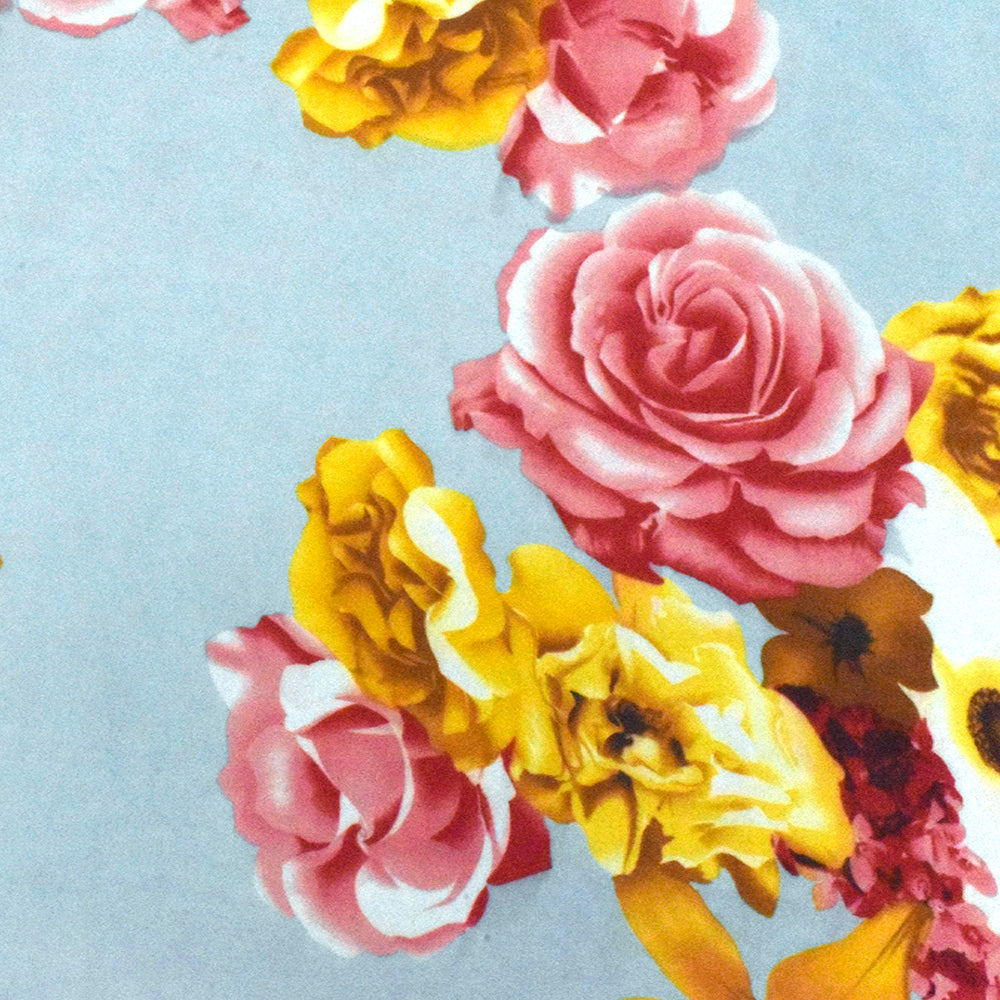
- Angel Blue-Yellow-Multi Floral Printed Polyester Chiffon Woven Fabric (100% polyester, 58″ wide) — the print camouflages a serged seam, making it the forgiving choice for a first sheer garment.
- Black Cotton Solid Chiffon Woven Fabric (100% cotton, 48″ wide) — a solid shows every finish honestly; the cotton's softer, less slippery hand makes it the easiest sheer to control.
- Black-Gold Viscose Metallic Stripe Chiffon Famous Designer Fabric (viscose/metallic, 56″ wide) — occasionwear weight; the metallic stripe gives hems a line to follow.
- Runway Silks White Silk Double Georgette Fabric (100% silk, 45″ wide) — the georgette of the comparison; its textured surface hides a French seam's ridge better than glassy chiffon does.
Prices on the Fabric Depot–sourced chiffons are per fractional-yard cut; check the product page for the cut increments.
Care and limitations
Finishes must survive the fabric's care method: a hand-rolled hem and French seam suit silk georgette's dry-clean or gentle hand-wash care; serged rolled hems hold up to the gentle machine washing polyester chiffon tolerates. Limitation: no physical seam samples were sewn for this article; the comparison is written from construction standards for sheer fabrics.
Keep reading
More from Apparel Fabric School. Prerequisite: chiffon and georgette: which garments suit each fabric's structure and drape. Compare finishes on a slightly heavier fluid fabric in seams and edge finishes for rayon challis.


