
Hey everyone. Today we're starting something fun around here — a whole series of little-known things about batting and interfacing. And we're starting with the one that surprises folks the most: most batting has a top side and a bottom side. Yep. There is a right way to load it, and nobody tells you.
Here we go.
Why Your Batting Has Two Different Sides
Most cotton and blended battings are needle-punched. That means thousands of barbed needles punch down through a loose web of fiber, over and over, tangling the fibers together until the web holds as a sheet. No glue marathon. Just needles.
All that punching leaves evidence. On the side where the needles went in, you get tiny dimples. On the side where they came out, you get tiny pimples — little bumps of fiber pushed through. One side is a valley. The other side is a speed bump.
Same batting. Two different faces. And which one looks up at your quilt top matters more than you'd think.
How to Tell in Ten Seconds
You do not need a magnifier. You need your fingertips.
Lay a corner of the batting flat and stroke both sides, one at a time. The dimpled side feels smoother, with little shallow dips. The pimple side feels faintly rough, like tiny knots under your fingers. Still not sure? Hold it near a window. Raking light across the surface makes the dimples show up plain as day.
Do this once and your hands will remember it forever. Just like that.
What to Do About It
Simple rule: dimples up, toward your quilt top. Pimples down, toward the backing.
Here's why. When your machine needle — or your hand-quilting needle — stitches through the sandwich, it travels in the same direction those punching needles did. Fibers get carried along with it. Dimples up, the loose fibers tend to settle down into the quilt where they belong. Load it upside down and the needle can drag fibers up through your top. That's one of the quiet causes of bearding, those little white whiskers that poke through a finished quilt, especially on dark fabrics.
On the longarm, I check the batting as I load it on the rollers, before the top ever goes on. At the basting table, same thing. Ten seconds. Done.
When It Matters Most
A few honest notes, because there are always a few honest notes.
This only applies to needle-punched batting. A bonded or thermal batting may not have a readable side at all, and that's fine — use it either way. If your batting has a scrim, that thin net layer, most makers suggest the scrim side goes down against the backing. Read the package if it says otherwise. The package wins.
And listen. If you have been quilting for twenty years with your batting every which way, and your quilts are loved and holding up just fine? Then they're fine. This is a polish detail, not a quilt crime. Nobody's coming to check. You're your own worst critic on this stuff — take your time, it's not a race.
But next quilt? Dimples up. See if your dark tops come out cleaner. I think you'll notice it.
Thanks for spending a few minutes with me, folks. We'll see you next time. Bye.
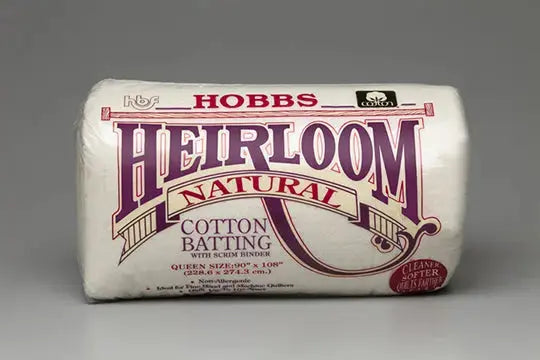
Shop Hobbs Heirloom 100% Cotton Batting Package at Linda's Electric Quilters.


