
Table of Contents
- Why Wideback Fabrics Beat Pieced Backs for Large Quilts
- Quick Comparison: Top Wideback Fabrics for Large Quilts
- 1. Kona Cotton Wideback: The 108-Inch Workhorse
- 2. Moda Grunge 108" Wideback: Texture Without the Print
- 3. Andover Americana Large Star: Patriotic Backing for Big Quilts
- 4. Windham Widebacks: Buffalo Plaid and Stacked Cats
- 5. Studio E Black and White Large Swirls: 118-Inch Coverage
- Calculating Quilt Backing Yardage for Queen and King Sizes
- Frequently Asked Questions
Last Updated: September 11, 2026
Why Wideback Fabrics Beat Pieced Backs for Large Quilts
Wideback fabrics are extra-wide quilting textiles, typically 104 to 120 inches across, designed to back a large quilt with a single continuous piece. For anyone hunting the best wideback fabrics for large quilts, the appeal is simple: no center seam, no panel math, no lumpy spine running down the middle of a king-size bed quilt. Wideback fabrics have shifted from a niche convenience to the default choice for quilters working queen-size and larger.
The math explains why. According to Missouri Star Quilt Co.'s wide backing guide, most common wideback widths fall between 106 and 108 inches, more than double the width of standard quilting cotton. That extra width eliminates the piecing step entirely on most bed quilts.
Quick Comparison: Top Wideback Fabrics for Large Quilts
The best wideback fabrics for large quilts balance width, fiber content, print scale, and, the variable most guides ignore, how the fabric actually feels and behaves on a finished bed. Two 108-inch cottons at the same price can produce wildly different quilts depending on weight and drape.
Here's how the picks in this guide compare at a glance.
| Fabric | Width | Fiber | Price/Yard | Weight & Drape | Best For |
|---|---|---|---|---|---|
| Kona Cotton Wideback | 108" | 100% cotton | $18.19 | Medium weight, crisp hand, holds a fold | Solid, modern quilts; year-round use |
| Moda Grunge 108" | 108" | 100% cotton | $24.99 | Medium weight, slightly softer hand than Kona | Texture without print; quilts where the back is seen |
| Andover Americana Large Star | 108" | Quilting cotton | $18.89 | Medium weight, standard quilting hand | Patriotic and themed quilts |
| Windham Buffalo Plaid & Stacked Cats | 108" | 100% cotton | $18.19 | Medium weight, similar to Kona | Rustic and novelty backs |
| Studio E Large Swirls | 118"/120" | 100% cotton | $18.19 | Medium weight, slightly more fluid than 108" solids | Oversized king quilts |
Reading the Weight and Drape Column
"Hand" is the term quilters use for how a fabric feels and moves. It matters more on a backing than on a quilt top, because the backing is the layer against the body and the layer that determines how the finished quilt folds, drapes, and breathes.

- Crisp hand (Kona, most Windham prints). The quilt holds its shape on a bed, folds with a defined crease, and feels substantial. Good for quilts that will be displayed or used as a bed cover rather than a couch throw.
- Softer hand (Moda Grunge, Studio E swirls). The quilt drapes more like a comforter and feels less stiff against the skin. Better for throws, baby quilts, and anything that will be cuddled.
- Heavier hand (flannel-backed or brushed widebacks, not in this guide). Warmer, but harder to quilt on a longarm because the extra loft fights the needle. Reserve for winter quilts where warmth outweighs quilting ease.
Matching the Backing to the Quilt's Purpose
Most quilters default to whatever solid is on sale, then wonder why a summer throw feels heavy or a winter bed quilt feels thin. A simple framework:
- Summer throw or baby quilt: Choose a softer-hand wideback like Grunge or a lighter-weight cotton print. The quilt should fold easily and breathe.
- Year-round bed quilt: Kona or a comparable medium-weight solid is the safe default. It wears well, washes well, and doesn't fight the longarm.
- Winter bed quilt: If warmth is the priority, a flannel wideback or a double-layer cotton backing adds loft. Expect to slow your longarm speed and possibly adjust tension.
- Show or wall quilt: Crisp hand keeps the quilt hanging flat and shows quilting texture clearly. Kona is the standard choice here.
A Note on Fiber Blends
Nearly every wideback on the market is 100% cotton, because blends behave unpredictably at 108 inches and up, they can stretch unevenly across the width, which shows up as a wavy backing edge on the frame. If you see a poly-cotton wideback, treat it as a specialty item: it will shrink less than cotton but may pill faster and won't take a dye as deeply as the quilt top. For most large quilts, 100% cotton remains the default for a reason.
1. Kona Cotton Wideback: The 108-Inch Workhorse
Solid-color backing is where most large quilts should start, and Kona is the benchmark. Robert Kaufman's Kona Cotton Wideback comes in a 108-inch width, which covers a queen or king quilt top without a single seam. The Black Kona Cotton Wideback Fabric per yard runs $18.19 and pairs with nearly any quilt top palette, while the Blue Kona Cotton Royal Wideback at the same price gives you a saturated royal for quilts that need a color statement.

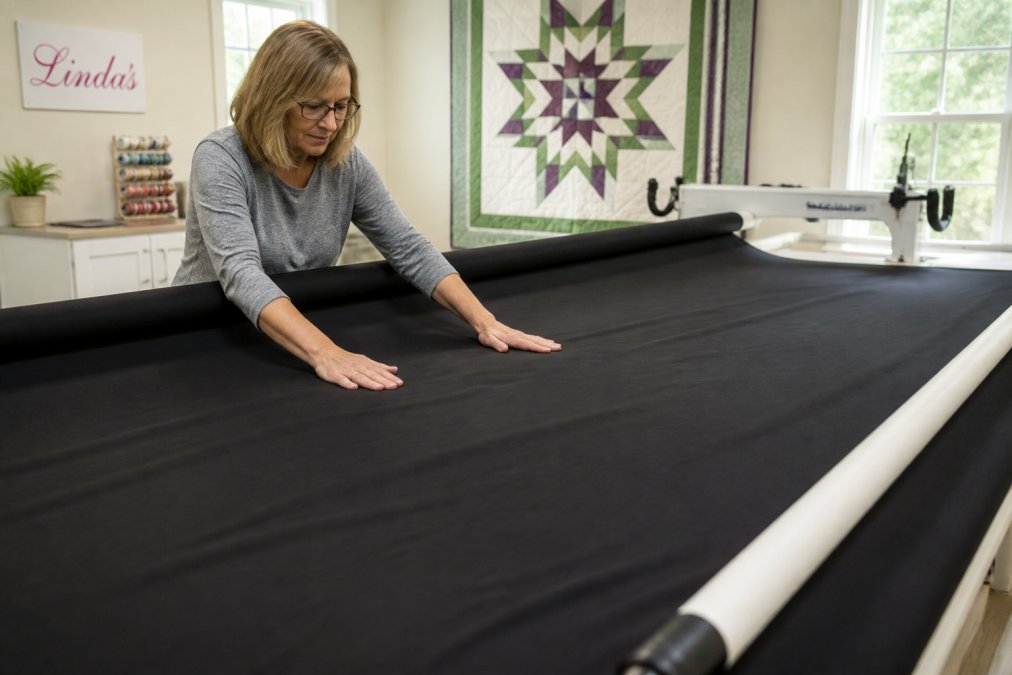
Kona's tight weave means less lint buildup in the bobbin case during longarm quilting, and fewer needle holes that stay visible after washing. The tradeoff: solid cotton shows every stray thread and pet hair, so keep a lint roller within reach.
2. Moda Grunge 108" Wideback: Texture Without the Print
Grunge solves a specific problem: quilters who want visual interest on the back but don't want a competing print. Moda's Grunge 108" Wideback uses a tonal, mottled dye treatment that reads as a solid from across the room but shows depth up close. The Grunge 108" Ash and Grunge 108" Cobalt both sell for $24.99 per yard.
Grunge's texture hides quilting stitches less aggressively than a busy print, so your longarm work stays visible.
3. Andover Americana Large Star: Patriotic Backing for Big Quilts
Themed backs can finish a quilt that already leans Americana, military, or patriotic. Andover's Americana Large Star in red and blue are 108 inches wide and priced at $18.89 per yard.
The large star motif scales up well. Small prints get lost on a king-size back; this one reads clearly from across a room. Where it falls short: the design locks you into a specific aesthetic, so it won't work as a neutral backing for a modern quilt.
4. Windham Widebacks: Buffalo Plaid and Stacked Cats
Windham covers both ends of the personality spectrum. The Red Buffalo Plaid Cotton Wideback delivers a classic red-and-black check that suits cabin quilts, flannel-adjacent projects, and anything with a rustic bent. The White Stacked Cats Wideback goes the other direction with a playful stacked-cat collage that works for baby quilts, pet-themed projects, and gifts. Both are 108 inches wide and $18.19 per yard.

A word on directional prints: check pattern alignment before you cut. Buffalo plaid has a clear grainline, and if you cut it off-square the check will run diagonally across the finished back. Measure twice.
5. Studio E Black and White Large Swirls: 118-Inch Coverage
Sometimes 108 inches isn't enough. For oversized king quilts, quilts with wide borders, or any project where you want generous overhang for a longarm frame, Studio E's Black and White Large Swirls delivers 118 to 120 inches of width at $18.19 per yard. That's the widest option in this guide, and it provides ample margin for longarm frames.
The abstract swirl design is forgiving. Busy enough to hide minor tension inconsistencies, restrained enough to work with most quilt tops. If you're new to widebacks, this is a low-risk first purchase.
Calculating Quilt Backing Yardage for Queen and King Sizes
Calculating quilt backing yardage means adding a buffer to both the width and length of your quilt top, then dividing by the fabric width. The buffer covers longarm clamping, frame attachment, and shrinkage during washing. Most guides stop at "add 8 inches." That number is a starting point, not a rule, and it fails on directional prints, oversized kings, and any project that will be washed hard.
Here's the formula in practice:
- Measure your quilt top width and length
- Add your buffer to each measurement (start with 8 inches; adjust per the notes below)
- Divide the adjusted width by your fabric width (108 or 118 inches)
- Round up to the nearest whole number of widths needed
- Multiply by the adjusted length, then divide by 36 for yardage
A queen quilt top at 90" x 108" becomes 98" x 116" after an 8-inch buffer. At 108 inches wide, that's one width. You need 116 inches of length, or about 3.25 yards. A king at 110" x 110" becomes 118" x 118", which fits within the 118-inch Studio E option but requires piecing on a 108-inch wideback.
When 8 Inches Isn't Enough
The 8-inch buffer assumes a standard longarm setup with 4 inches of clearance per side. Three situations push past it:
- Oversized king tops (over 110" square). Add 10 to 12 inches instead. The extra length gives your quilter room to advance the quilt without the backing slipping off the take-up bar.
- Directional or large-scale prints. Buffalo plaid, large stars, and one-way motifs need extra length so you can position the pattern intentionally. Add 12 inches to the length only, not the width.
- Quilts headed for frequent washing. See the shrinkage note below.
Shrinkage: The Number Most Guides Skip
Standard quilting cotton, including Kona, Moda Grunge, and the Windham and Andover widebacks above, is typically not pre-shrunk at the mill. Unwashed quilting cotton typically shrinks roughly 3 to 5 percent in length and width after the first hot wash and dry (hcquilts.com). On a 108-inch-wide backing, that's 3 to 5 inches of width lost, and proportionally more in length.
Two ways to handle it:
- Pre-wash the backing before quilting. Wash in warm water, dry on medium, press. This locks in the shrinkage so the finished quilt doesn't pucker or pull at the edges after the first wash. The trade-off: pre-washed wideback can be harder to load evenly on a frame because it's softer and less stiff.
- Do not pre-wash, but size up. Add 5 percent to both your width and length measurements before you cut. On a 118-inch king, that's roughly 6 extra inches in each direction.
If the quilt will be washed frequently, baby quilts, bed quilts in active households, anything for a pet, pre-washing is the safer choice. If it's a wall hanging or a show quilt that will be spot-cleaned, skip the pre-wash and keep the crisp hand.
A Worked King Example With Shrinkage
King top at 110" x 110". Add a 10-inch buffer for the oversized top: 120" x 120". Add 5 percent for shrinkage: 126" x 126". At 118 inches wide, you still need two widths, 126 divided by 118 rounds up to 2. That means 2 x 126 = 252 inches of length, or 7 yards. Compare that to the 3.25 yards a queen needs, and you can see why quilters who skip the shrinkage math end up short.
For a deeper look at how shrinkage affects finished dimensions, HC Quilts' guidance on cotton backing recommends pre-washing when the quilt will be washed frequently.
Frequently Asked Questions
What is the standard width for wideback quilting fabric?
Most wideback fabrics range from 104 to 120 inches wide, with 106 to 108 inches being the most common. A 108-inch wideback covers a queen or king-size quilt without seams or panels. Some brands offer 118-inch options for extra-large projects. Standard quilting cotton is only about 44 inches wide, so wideback fabric provides more than double the coverage.
Is 108-inch wideback fabric better than piecing a quilt back?
For large quilts, 108-inch wideback fabric eliminates the need for piecing, giving you a seamless finish that reduces bulk and puckering. Piecing standard-width fabric can work for smaller projects or when you want creative control over the back design. However, wideback fabric saves time and avoids seam allowance issues that can affect longarm quilting tension.
How do I calculate how much wideback fabric I need for a large quilt?
Measure your quilt top's length and width, then add 8 inches to each dimension for longarm quilting overage. For a 90 x 108-inch quilt, you need a backing at least 98 x 116 inches. Since wideback fabric is 108 inches wide, you would need 116 inches of length, which equals about 3.25 yards. Always round up to the nearest quarter yard.
Does wideback fabric shrink differently than standard quilting cotton?
Shrinkage depends on the fabric's thread count and finishing, not its width. Most 100% cotton widebacks shrink 3-5% after washing. Pre-washing your wideback fabric before quilting prevents uneven shrinkage that can pucker your finished quilt. Use cold water and a low dryer setting to minimize shrinkage and preserve colorfastness.
What are the best brands for high-quality quilt backing?
Robert Kaufman's Kona Cotton is a trusted choice for its tight weave and consistent color. Moda Fabrics' Grunge widebacks offer tonal texture that hides quilting stitches well. Windham Fabrics provides unique prints like buffalo plaid and stacked cats. Andover Fabrics and Studio E Fabrics also make durable 108-inch and 118-inch widebacks suitable for large quilts.
Large quilts expose every weak point in a backing choice: insufficient width, loose weave, mismatched fiber content. Linda's Electric Quilters carries the full range of wideback fabrics covered here, plus premium batting rolls that ship free, over 50,000 quilting and sewing products, and a library of 700+ educational videos to walk you through yardage math and longarm setup. Browse the wideback collection, confirm your measurements, and back your next large quilt without a single seam.