Table of Contents
- What Makes Quilting Needles Specialized
- Quilting Needle Size and Its Effect on Stitch Quality
- Quilting Needle vs Universal Needle: Key Differences
- Choosing the Best Machine Needle for Quilting
- Common Problems Specialized Needles Prevent
- When to Change Your Sewing Machine Needle
- Frequently Asked Questions
Last Updated: October 7, 2026
What Makes Quilting Needles Specialized
Specialized quilting needles differ from universal needles in three key areas: point shape, eye size, and scarf depth.
A quilting needle has a deeper scarf (the indentation above the eye), which prevents skipped stitches through multiple layers and batting.
The eye is also larger, which matters because quilting often uses heavier threads.
At Linda's Electric Quilters, we stock specialized quilting needles from top brands specifically because they're built for this work.
Quilting Needle Size and Its Effect on Stitch Quality
Needle size controls how well your stitches look and how cleanly the needle penetrates fabric. Sizes use two numbers, like 75/11 or 80/12: the first is European, the second American.
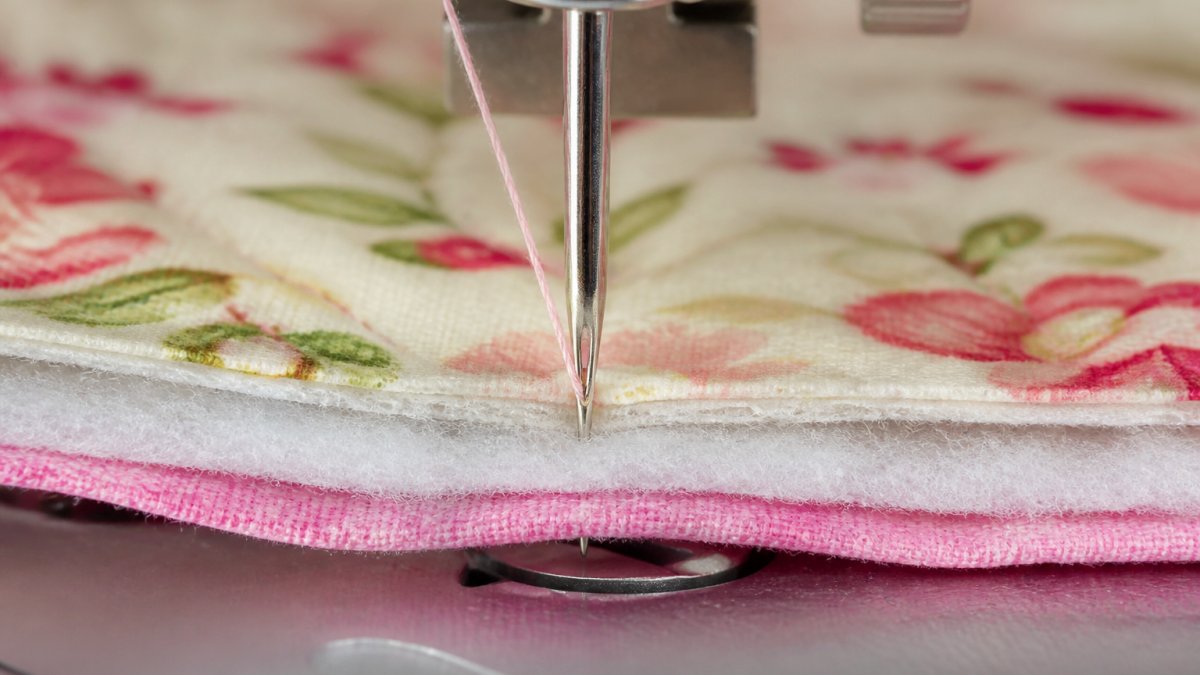
Smaller needles (60/8 or 70/10) suit lightweight fabrics and fine threads. Larger needles (90/14 or 100/16) handle thicker fabrics, multiple batting layers, and heavier threads.
What most quilters miss is that the wrong size creates problems that feel like tension issues.
Here's a quick reference for common quilting situations:
| Quilting Task | Recommended Needle Size | Thread Weight | Fabric Type |
|---|---|---|---|
| Piecing lightweight cotton | 70/10 or 75/11 | 40 wt | Quilting cotton |
| Machine quilting standard layers | 80/12 or 85/13 | 40-50 wt | Quilting cotton + batting |
| Quilting thick seams or dense layers | 90/14 | 40-50 wt | Multiple layers, heavier batting |
| Embroidery or decorative thread | 75/11 or 80/12 | 30 wt or thicker | Cotton or specialty fabric |
Quilting Needle vs Universal Needle: Key Differences
A universal needle works on wovens, knits, and some stretch materials, but quilting presents a challenge it wasn't designed to solve: penetrating multiple thick layers cleanly.
The scarf depth is where the biggest difference shows up.
Universal needles also have a smaller eye. That's fine with 40-weight thread on a single layer, but with 30-weight or heavier quilting thread, the smaller eye creates friction: the thread frays and breaks faster.
Point shape matters too. A universal needle's sharper point can split fibers in quilting cotton, especially on the visible top layer. A quilting needle's rounded point pushes fibers aside, leaving a cleaner hole.
Choosing the Best Machine Needle for Quilting
Picking the right needle starts with three questions: What fabric are you quilting? What thread are you using? What's your technique? Answer those in order and the choice usually makes itself.
Start with a decision path, not a guess
Work through these steps in sequence:
- Identify the task. Piecing, machine quilting, hand quilting, and decorative stitching each stress the needle differently.
- Match the needle system to your machine. Most household machines use a flat-shank system (often labeled 130/705 H or HAx1); longarm and midarm machines typically use a round-shank system such as 135x17 or 135x16. Installing the wrong system can throw off needle-to-hook timing, cause skipped stitches, or damage the hook. Check your machine manual or the needle package before buying.
- Pick a starting size from fabric weight. Lightweight cotton: 70/10 or 75/11. Standard quilting cotton and piecing: 80/12. Dense layers, batiks, or heavier batting: 90/14 and up.
- Adjust for thread weight. 50-weight and finer threads run cleanly through a standard eye. 40-weight pairs with 80/12 or 90/14. 30-weight and heavier decorative threads need a larger eye, where topstitch needles earn their place.
- Confirm the point. A slightly rounded point (often called a universal or quilting point) is the default for woven cotton. Sharper points are for specific fabrics, not general quilting.
Matching needle type to fabric and thread
Fabric weight sets the floor for needle size. Lightweight quilting cotton calls for 70/10 or 75/11; standard-weight cotton and most piecing uses 80/12. For thick batiks, multiple seams, or dense batting, jump to 90/14 or larger.
Thread weight matters equally: heavier thread needs a larger eye, while 50-weight or finer thread works in a smaller needle.
A common mistake is ignoring thread weight. Even with a perfect fabric-to-needle match, thread too thick for the eye will still break and fray.
| Task | Needle type | Size | Thread |
|---|---|---|---|
| Piecing | Quilting or sharp | 70/10-80/12 | 50 wt cotton |
| Machine quilting, standard layers | Quilting | 80/12-90/14 | 40 wt cotton or polyester |
| Machine quilting, dense or thick | Quilting | 90/14-100/16 | 40 wt |
| Decorative or heavier thread | Topstitch | 90/14-100/16 | 30 wt or heavier |
| Hand quilting | Betweens or quilting | 8-10 (betweens) | Hand quilting thread |
Needle point shape and fabric penetration
Most quilting needles have a slightly rounded point, the standard for quilting cotton and most piecing. It penetrates cleanly without splitting fibers.
Some specialty needles (topstitch, for example) have sharper points. These suit embroidery and decorative stitching but aren't ideal for piecing or machine quilting, since the sharper point can damage delicate fabrics.
For specialty fabrics like silk or velvet, use a needle designed for that fabric. For standard quilting projects, stick with a dedicated quilting needle with a rounded point.
Quilting thick seams and layered intersections
Bulky intersections are where needle choice matters most. Crossing a seam allowance with two or three folded layers means punching through fabric, seam bulk, batting, and backing at once. A needle that's too fine will deflect, skip, or bend.
Practical moves for thick intersections:
- Bump up one size for the quilting pass that crosses the bulk. Many quilters keep an 90/14 or 100/16 loaded for ditch work over seams.
- Slow the machine through the intersection. Needle deflection increases with speed, and a deflected needle is more likely to skip or strike the throat plate.
- Consider a quilting needle with a reinforced blade if your machine supports one; these resist bending through dense stacks.
- Avoid forcing the fabric. If you have to push, the needle is too small or too dull.
Keep two needles staged for a single quilt: an 80/12 for open field quilting and a 90/14 or 100/16 for seam-heavy sections. Swapping takes seconds and prevents the deflection problems that cause skipped stitches at intersections.
Needle compatibility and machine-specific guidance
Needle systems are not interchangeable across machine classes. A flat-shank 130/705 H needle won't seat correctly in a longarm expecting a round-shank 135x17, and forcing it can misalign the hook and cause timing damage. Before buying in bulk, confirm:
- The needle system your machine manual specifies.
- The shank shape (flat versus round) your needle clamp accepts.
- Any manufacturer guidance about maximum needle size for your model.
If unsure, the needle package you already own is the fastest reference: the system code is printed on the front, and matching it exactly beats guessing by size.
Common Problems Specialized Needles Prevent
Using the wrong needle, or keeping one in your machine too long, creates problems that cascade through your project.
Skipped stitches and thread breakage
Skipped stitches happen when the needle doesn't catch the thread properly, usually because the scarf is too shallow to hold it as the bobbin case rotates.
A specialized quilting needle with a deeper scarf solves this, holding the thread securely through each stitch cycle even through thick layers.
Thread breakage comes from friction: too small an eye makes thread rub and fray, especially heavier threads.
Fabric damage and enlarged holes
A needle that's too small or has the wrong point shape can split fibers.
A universal needle's sharper point can split quilting cotton fibers, especially on the top layer, while a specialized quilting needle's rounded point pushes fibers aside, keeping the hole clean.
Enlarged holes happen when the needle is too large for your fabric or bent. A bent needle wobbles, creating a larger hole than intended, which is why changing needles regularly matters.
When to Change Your Sewing Machine Needle
Most quilters change their needle too infrequently. One that's been in your machine for months is likely bent, dulled, or slightly damaged, damage you can't see without a magnifying glass.
A fresh needle should go in after every 8-12 hours of sewing. If you quilt regularly, that's every week or two. If you notice skipped stitches, thread breakage, or fabric damage, change the needle immediately; often that single step fixes the problem.
Signs your needle needs replacing
- Skipped stitches appearing randomly
- Thread breaking more often than usual
- Visible holes or fiber damage on your fabric
- Bent, dull, or discolored needle (hold it up to the light)
- Needle that feels rough when you run your finger along it
A practical test: isolate the needle before you touch the tension
Before adjusting tension, rethreading, or blaming the machine, run a needle test. It takes two minutes and saves hours.
- Build a test sandwich matching your real project: same fabric, batting, thread, and number of layers.
- Stitch a short line at normal speed, then a second at half speed.
- Inspect the stitches. Look for skipped stitches, loops on the underside, frayed thread, or enlarged holes.
- Swap in a fresh needle of the same size and type. Stitch the same two lines.
- Compare. If the fresh needle cleans up the problem, the needle was the cause. If not, move on to tension, threading, bobbin, or hook timing.
This test separates needle problems from machine problems, the most useful diagnostic habit in quilting. Most skipped-stitch complaints blamed on tension are actually needle-related.
If a fresh needle of the correct size and type doesn't fix the stitch, the needle isn't your problem. Stop swapping needles and start checking threading path, bobbin tension, and hook timing.
How project type affects needle life
Needle wear isn't just about hours. What you're sewing wears the needle faster:
- Lightweight cotton piecing is gentle. A needle can last 10-12 hours.
- Machine quilting through batting and backing is harder on the point. Expect closer to 8 hours.
- Dense layers, batiks, or heavy batting accelerate wear. Some quilters change every 4-6 hours on these projects.
- Metallic or specialty threads abrade the eye and can wear a needle faster than the point wears out.
Track needle changes by project, not calendar. Write the date on the package when you open it and note when you swap; after a few quilts you'll have a personal replacement rhythm that beats any generic rule.
What to check before you blame the needle
If a fresh needle doesn't fix the problem, the issue is almost always one of these:
- Thread path. A missed thread guide or unevenly feeding spool mimics needle problems.
- Bobbin tension. An incorrectly tensioned bobbin produces loops that look like skipped stitches.
- Needle installed backward. Flat-shank needles only seat one way; a backward needle will skip.
- Needle not fully seated. A needle not pushed all the way up can throw off timing.
- Wrong needle system. A mismatched system can cause skipped stitches even when the size is correct.
A needle costs a few dollars; your project costs far more in time and materials. Changing needles frequently is the cheapest insurance against problems, and a two-minute test before adjusting tension is the fastest way to know whether the needle was ever the issue.
Frequently Asked Questions
What is the difference between a quilting needle and a universal needle?
Quilting needles have a reinforced shaft, a special scarf, and a slightly rounded point designed to penetrate multiple fabric layers without deflecting or breaking. Universal needles are made for lighter fabrics and single layers, so they lack the structural support quilting needles provide. Using a universal needle on quilted batting often causes skipped stitches and thread breakage because the needle cannot handle the thickness and density of layered materials.
Why should I use a quilting needle instead of a regular sewing needle?
Specialized quilting needles reduce skipped stitches, prevent thread breakage, and protect your fabric from damage. They're engineered to pierce thick batting and multiple fabric layers without deflecting, which keeps your stitch formation even and your seams strong. Regular needles simply aren't designed for the demands of quilting, so you'll spend more time troubleshooting tension and needle issues than actually quilting.
When should I change my quilting needle?
Change your needle after every 8 to 10 hours of quilting, or sooner if you notice skipped stitches, bent points, or rough spots on the needle shaft. A fresh needle ensures consistent stitch quality and prevents fabric damage. If you're working on a large project or quilting through thick seams, inspect your needle more frequently, a worn needle can create enlarged holes and uneven seams that are hard to fix.
What needle size should I use for quilting?
The most common sizes are 75/11 and 80/12. The 75/11 works well for piecing and lighter quilting, while the 80/12 is better for dense machine quilting and thick batting. Your choice also depends on your thread weight and fabric type, heavier threads need larger needles, and densely woven fabrics may require a smaller needle to avoid splitting threads. If you're unsure, start with an 80/12 for general quilting and adjust based on your stitch quality.