
Good morning, quilters! Corey here.
You've squared your backing.
You've loaded it carefully.
You've checked your rollers.
So why do wrinkles still show up on the back of your quilt?
For many quilters, the culprit is actually too much tension.
Tighter isn't better
It's easy to assume a drum-tight backing is a well-loaded backing. But fabric is elastic—when it's stretched too tightly on the frame, it's being quilted in a distorted state. The stitching locks that distortion in, and the moment the quilt comes off the frame and the fabric relaxes, the excess gathers into puckers and wrinkles around your quilting lines.
Over-tension also drags on your side clamps unevenly, pulls the backing off-grain, and can even cause tension issues in the stitch itself as the needle fights the stretched fabric.
Think of your backing like a bed sheet
Pull it too loosely and you'll get folds.
Pull it too tightly and it will distort.
The sweet spot is right in the middle: smooth and flat, with just a little give. A good field test—press a hand lightly on the loaded backing. It should feel like a trampoline with a soft bounce, not a drum head.
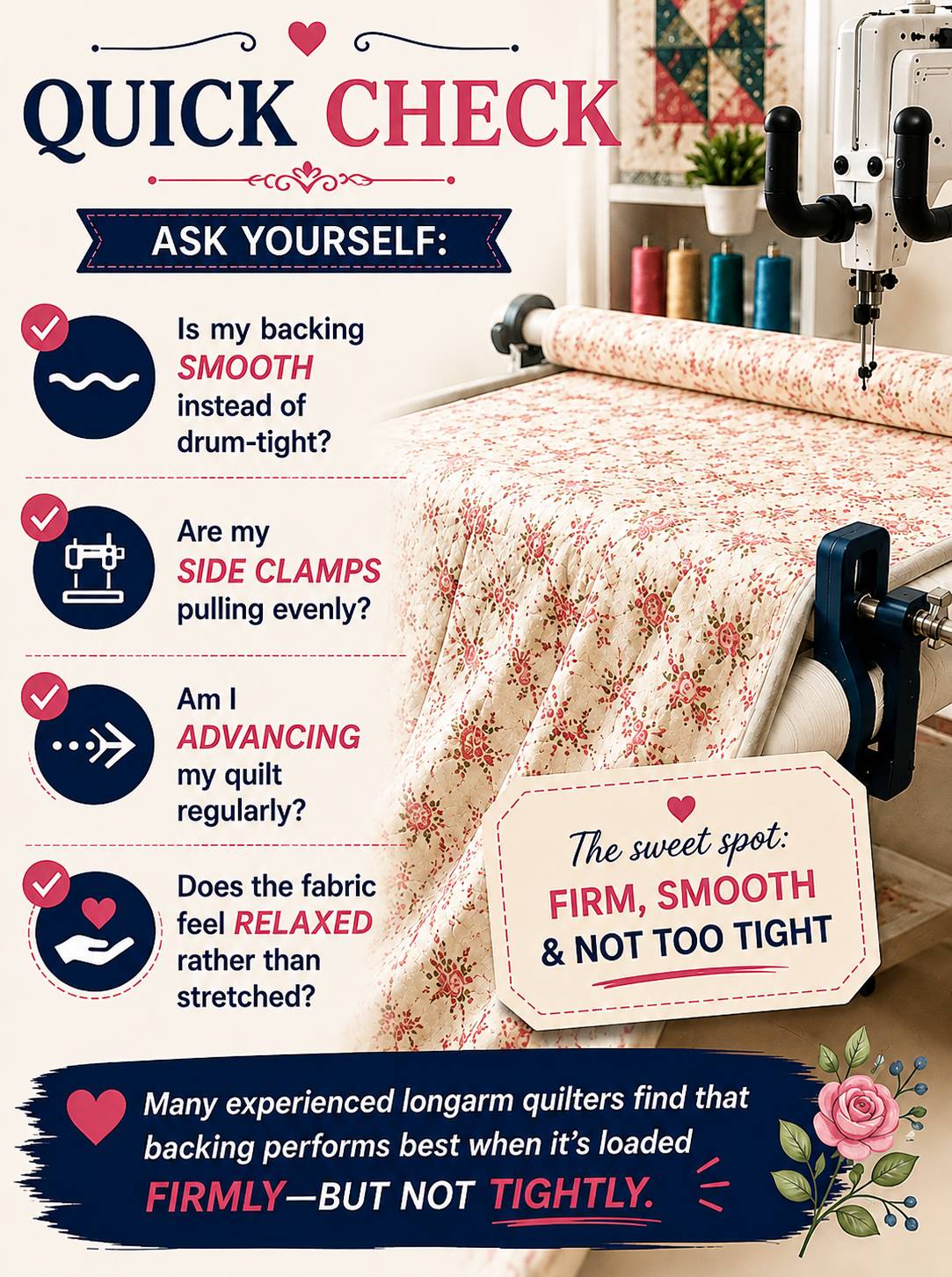
The quick check before you quilt
- Is my backing smooth instead of drum-tight? Smooth is the goal; tight is the trap.
- Are my side clamps pulling evenly? Uneven clamp pressure creates diagonal drag lines that show up later as wrinkles.
- Did I ease tension as the quilt rolled? Tension changes as the take-up roller fills—recheck it every few advances.
- Is the backing loaded on-grain? A backing pulled off-grain fights you the entire quilt.
The best quilters never stop learning
Every quilt teaches us something new.
If backing wrinkles have been frustrating you, try easing your backing tension on your next project. You may be surprised how much of a difference this small adjustment can make. And if your side clamps or leaders are part of the problem, our longarm tools collection has the helpers that make loading easier.
Here's to smoother backs, straighter stitches, and more enjoyable quilting.
Happy Quilting!
From Corey.