

40 wt is the reference size to check first when setting up machine embroidery. Wilcom's thread thickness guide lists about 120/2 denier or 27 Tex and a 75/11 needle as typical references. Use them to establish a starting point, then adjust for the thread and design.
The label describes weight, while fiber, ply, twist, fabric, and digitizing affect how a spool stitches. Verify the thread, then choose the needle, assess the design's density, and balance tension on a properly stabilized sample. That sequence helps troubleshoot stitching differences between spools with the same nominal weight.
What 40 Wt Embroidery Thread Means
40 wt is the reference size to check first for general machine embroidery. It provides useful coverage without the bulk of a heavier decorative thread, making it a practical starting point for satin columns, ordinary lettering, and fills. Use the thread's behavior on a sample to set the rest of the setup.
The table gives typical comparison values. Needle choice still depends on the thread and fabric.
40 wt thread reference values by weight
| Weight | Denier or Tex reference | Typical needle | Best use |
|---|---|---|---|
| 30 wt | Heavier than 40 wt; check the manufacturer's finished-thread specification | Follow the thread and fabric recommendation | Bold fills and strong decorative effects |
| 40 wt | About 120/2 denier, about 135 dtex/2, or about 27 Tex | 75/11 | Standard machine embroidery and normal-size logos |
| 60 wt | Finer than 40 wt; check the manufacturer's finished-thread specification | 65/9 or smaller, subject to thread clearance | Very small lettering under about 5 mm |
The 40 wt conversion and 75/11 needle reference are typical values; the table's 60 wt lettering threshold follows the Buckets of Ink thread chart. Do not calculate an exact diameter from the weight column. Smooth filament and spun cotton can have different surface profiles, which affects how they pass through the needle and cover the fabric.
Why does a higher weight number mean finer thread?
Weight uses an indirect count, describing length relative to mass. In the convention described by The Thread Exchange, 40 wt means approximately 40 kilometers of thread weigh one kilogram.
A finer thread supplies more length for the same mass, so the numbering runs opposite to what many shoppers expect. Digitizing software commonly assumes a standard thread size; when the design was created for the thread in use, its spacing and coverage are more likely to suit it. A stitch-out still matters, particularly on stretchy or loosely woven fabric.
Practical rule: Use the spool label to identify the starting size. Use the stitch-out to judge coverage and decide whether to adjust needle choice, tension, or density.
How do denier and Tex compare?
Denier and Tex run in the other direction. The textile thread reference) defines denier as grams per 9,000 meters and Tex as grams per 1,000 meters. Larger values mean heavier thread.
Historical numbering systems add another complication. AMANN's explanation of textile numbering systems describes how different fibers developed different sizing conventions. Cotton, linen, and filament thread labels do not all use the same measurement tradition.
Matching a replacement by its weight number alone can lead to different stitch coverage. Compare fiber, finish, and the finished-thread specification, then keep the original test sample beside the replacement sample.
Before buying, compare spools in Linda's Thread selection or bring the project details to the McKinney, Texas, store. The design and fabric help narrow the choice more than the color name alone.
40 Wt Compared with 30 Wt and 60 Wt Thread
Which weight fits this design? Start with the narrowest lettering and the heaviest stitched area, because those features often need different treatment.
The following comparison shows the practical roles of the common embroidery weights.
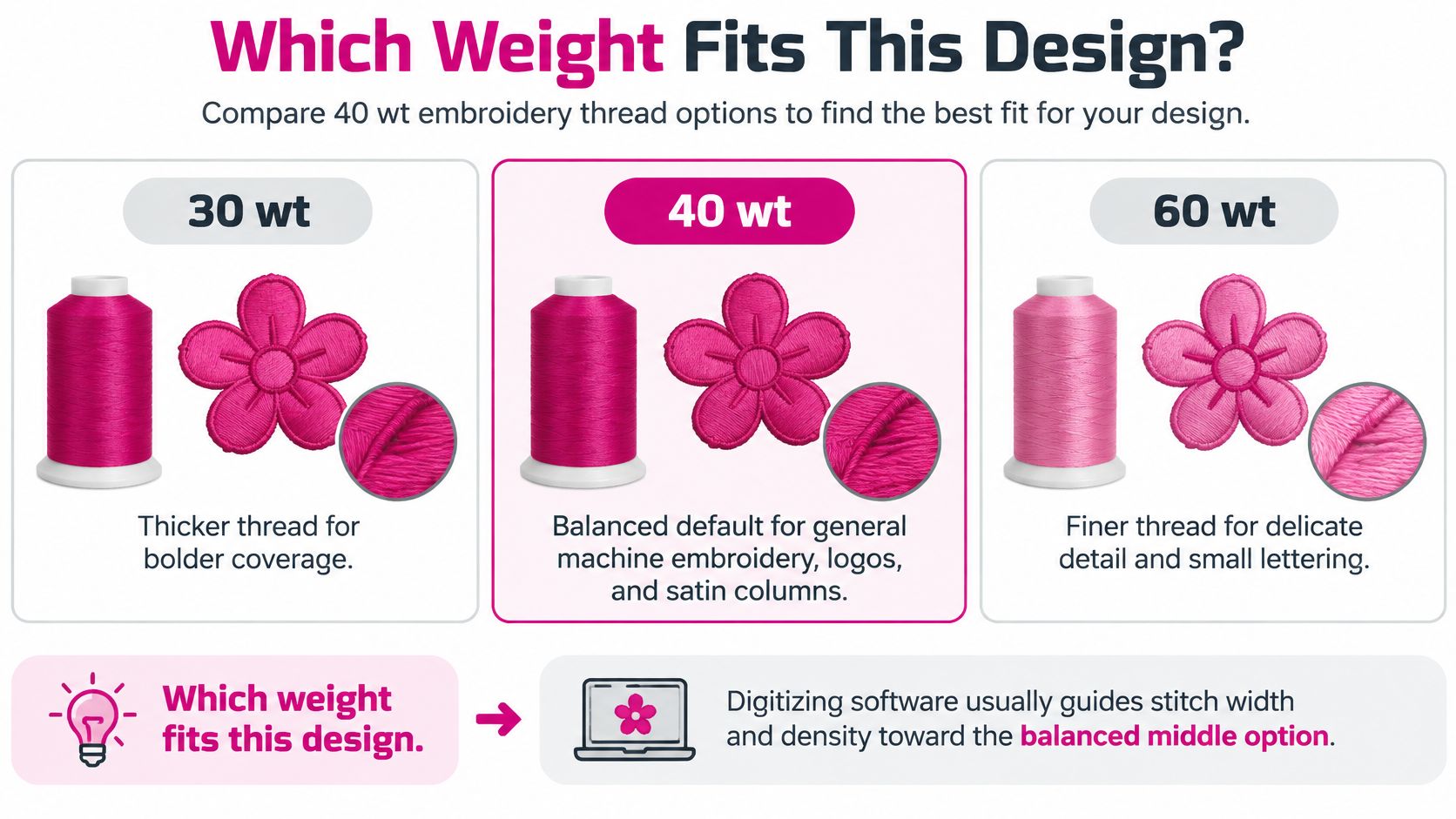
Which thread works for small lettering?
Say you're making a one-inch monogram. That overall size alone doesn't require fine thread. Broad initials may stitch well with the standard weight, while a monogram containing delicate serifs or a tiny surrounding name may need a finer option.
The Buckets of Ink thread chart recommends finer 60 wt or 75 wt thread for very small lettering, including lettering under approximately 5 mm. Judge the individual letter height and satin-column width, not the dimensions of the entire design.
Finer thread can preserve open counters and delicate strokes, but it isn't a cure for poor digitizing. Check stitch spacing, underlay, and tie-ins before assuming a spool change will restore every detail.
When should you stay with the standard weight?
For a normal chest logo, 40 wt embroidery thread usually offers the most straightforward route. It provides a visible stitched surface without requiring the extra coverage planning associated with very heavy thread.
A bold satin border presents a different choice. Heavier thread can create a stronger decorative line, but loading it into an unchanged embroidery file can produce a stiff ridge. Reduce density where appropriate or have the design redigitized for the heavier thread.
- Standard-weight advantage: Useful coverage across ordinary logos, lettering, and satin columns.
- Standard-weight limitation: Tiny text can close up, while dramatic decorative work may need more visual weight.
- Heavier-thread trade-off: Fuller coverage per stitch, with greater risk of excessive buildup.
- Finer-thread trade-off: Cleaner delicate detail, but less visual presence in a design intended to look bold.
Use this video as a companion to your project planning, then evaluate the actual lettering and fill areas in your embroidery software.
For a standard design, consider Linda's Floriani line when selecting your project colors. Choose the weight to fit the embroidery file before building the full palette.
Polyester and Rayon 40 Wt Options and Brands
Fiber choice changes the setup even when the weight stays the same. Polyester is a common choice when durability and color retention matter; rayon is often chosen for its softer-looking, lustrous surface.
Don't confuse sheen with thickness. A glossy thread can look more prominent under directional light without supplying the same physical coverage as a heavier thread.
Which brands offer polyester and rayon?
In its 2026 listings, Madeira Polyneon #40 offers 387 solid colors, 20 multicolor options, and 24 fluorescent colors. Madeira's Classic Rayon #40 listing identifies 387 solid colors, 19 ombre colors, 6 multicolor options, and 10 Astro colors for the same year.
40 wt fiber and product options
| Fiber | Example product | Color range | Watch for |
|---|---|---|---|
| Polyester | Madeira Polyneon #40 | Solid, multicolor, and fluorescent ranges listed above | Retest tension when switching from rayon |
| Rayon | Madeira Classic Rayon #40 | Solid, ombre, multicolor, and Astro ranges listed above | Generally needs lower tension than polyester |
| Polyester | Floriani 40 weight 1000M at Linda's | Check the current product selection | Confirm finish and any dye-lot guarantee on the product page |
Color names aren't reliable cross-brand matches. Compare physical thread samples against the actual fabric, particularly when the fabric has a strong texture or a reflective finish.
The sewing thread tips from More Sewing provide useful context when you're choosing between thread types for different sewing tasks. For embroidery, keep the machine's thread requirements and the design's intended construction central to that decision.
Where does cotton fit?
Cotton belongs in the comparison, but it shouldn't be presented as interchangeable with filament polyester or rayon. Its surface and finished appearance can suit quilting and embroidery projects where you want a less reflective result.
This catalog image shows a cotton alternative, not a standard-weight polyester embroidery spool.
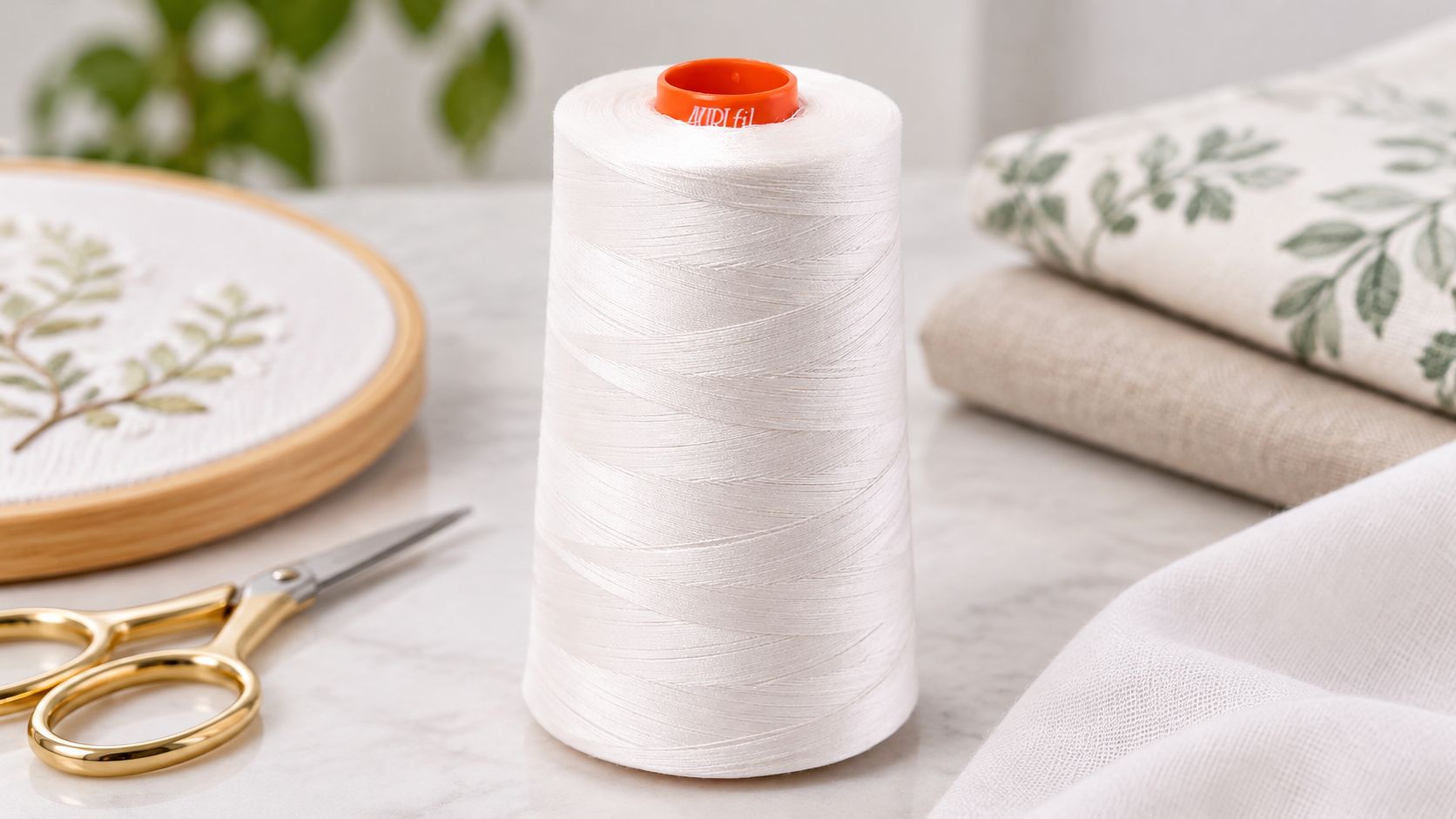
Linda's lists Mako Cotton Embroidery Thread Solid 50wt 6452yds Chalk as Aurifil cotton suitable for applications including machine embroidery, subtle quilting, and dense background work. It's an alternative for a different finish, not a direct substitute to load without testing.
When switching fibers, compare both the stitch surface and the fabric's hand. A sample that looks attractive but feels board-like may need density changes rather than another tension adjustment.
Compare Floriani colors in Linda's Thread selection before ordering, and verify current product details rather than assuming another brand's finish or guarantee applies.
Matching Needle, Tension and Density to 40 Wt Thread
A 40 wt label is a useful reference, not a complete setup specification. Fiber, ply, fabric resistance, and digitizing all affect how the thread runs, so confirm the needle, tension, and stitch spacing on a representative sample before starting the finished piece. Your machine's needle system and bobbin requirements take priority.
Starting setup for 40 wt machine embroidery
| Setting | Starting point | Adjust when |
|---|---|---|
| Needle | 75/11 | Move to 80/12 for heavier fabric or consider smaller for fine fabric |
| Thread fiber | Rayon or polyester | Lower tension for rayon; watch puckering on polyester |
| Bobbin thread | 60 wt where the machine permits | Change only after checking threading, seating, and stitch balance |
| Stitch density | About 0.40 mm spacing for standard 40 wt | Reduce stitch concentration for thicker thread or redigitize |
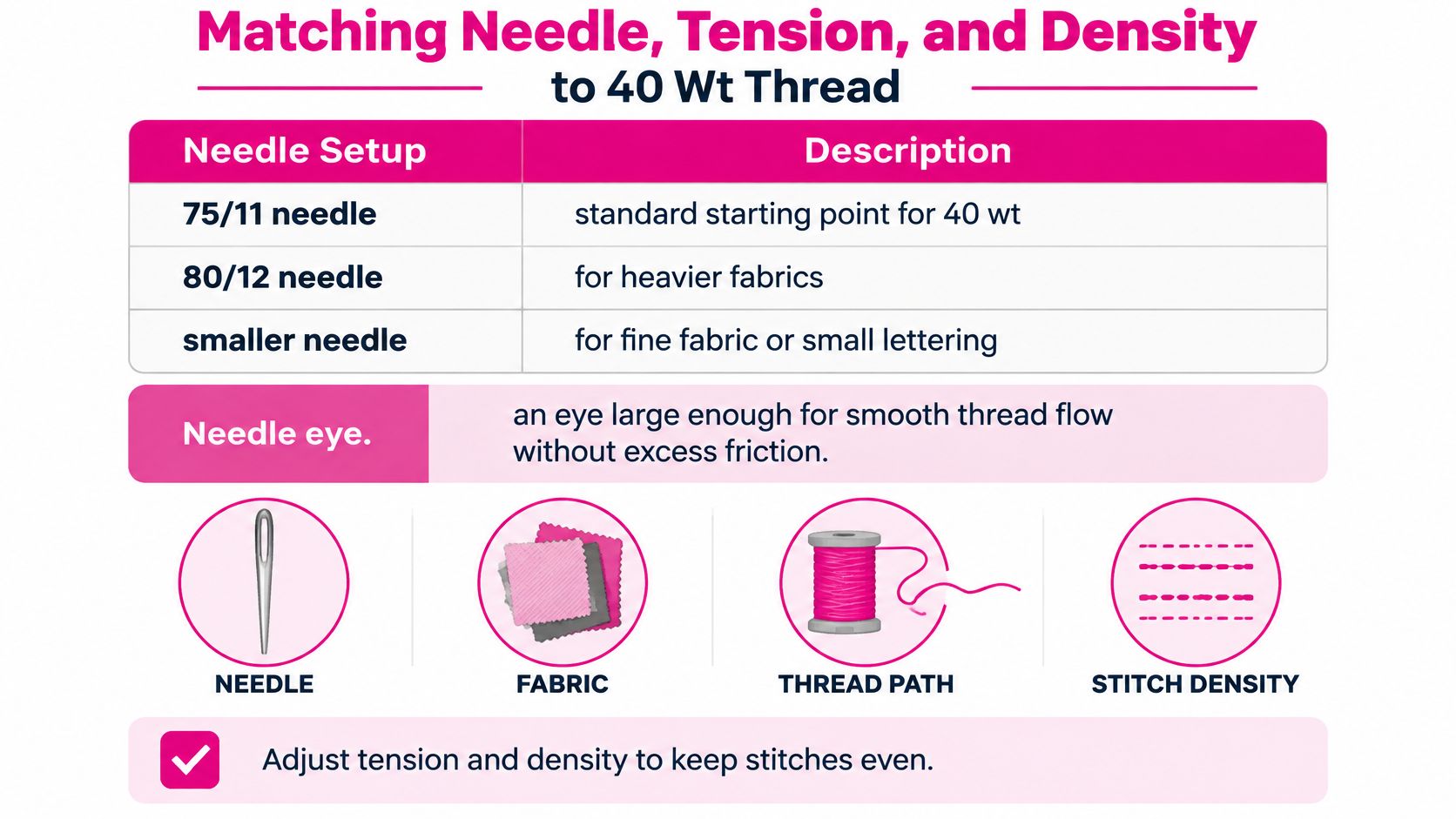
The SewingTrip needle compatibility guide identifies 75/11 or 80/12 embroidery needles as common starting points. Madeira's density examples pair spacing around 0.40 mm with standard-weight thread and list 65/9–75/11 needles. The right combination still depends on construction and thread clearance.
Why does the needle eye matter?
An eye that is too tight adds friction. Fraying, skipped stitches, or breakage can follow, even when the needle penetrates the fabric easily.
The infographic summarizes how fabric, needle clearance, and setup relate.
For longarm users, follow the machine's specified needle system rather than transferring a domestic embroidery needle size directly. Select the needle size for the thread and quilt sandwich. Batting loft, fabric density, and stabilizer all affect resistance, so a setup that works on a flat woven patch may behave differently through a quilted panel.
What should you adjust first?
Keep the test sequence controlled:
- Choose the needle: Match the machine system, thread clearance, and fabric.
- Prepare the sample: Use the project fabric, stabilizer, and hooping method.
- Stitch the intended density: Include the tightest lettering and heaviest overlap.
- Adjust tension: Make small changes and inspect both sides.
- Record the result: Note thread fiber, needle, bobbin, and design revision.
When density is expressed as spacing, larger spacing means fewer stitches. Increase spacing to reduce buildup; reducing the spacing value adds stitches.
Pro-Tip: Hoop the test scrap exactly like the project, using the same stabilizer and fabric orientation. A loose sample can hide puckering and distortion that appear after the finished piece comes out of the hoop.
Breakage, Looping and Puckering Fixes
Thread that breaks at speed isn't automatically defective. A tight needle eye, worn needle, snag in the thread path, or excessive tension can overload an otherwise suitable spool.
Start with the cheapest reversible fixes. Replace the needle, rethread correctly, and check spool delivery before changing the embroidery file.
40 wt symptom, cause and fix
| Symptom | Likely cause | First fix to test |
|---|---|---|
| Thread breaks at speed | Tight needle eye, high tension, or worn needle | Slow the machine and replace the needle |
| Loops on the back | Upper thread not seated, insufficient upper tension, or a threading fault | Rethread with the presser foot raised, then test |
| Puckering on polyester | Excessive tension, inadequate stabilization, or excessive density | Ease upper tension slightly and retest |
| Small text looks bulky | Thread too heavy for the available detail or excessive stitch concentration | Test finer thread and review density |
What do loops underneath really mean?
Loops underneath often point to a problem with the upper thread path, not a bobbin that needs immediate adjustment. Rethread before turning the bobbin-case screw.
Check that the thread passes through the take-up lever and every required guide. Seat the bobbin correctly and inspect the bobbin casing or bobbin-case area for lint and trapped thread.
Don't diagnose tension by color alone. Identify which thread forms the loose loops and which thread is being pulled through the fabric.
Why does changing fiber cause new problems?
Brother's embroidery thread guidance warns that thread type can affect breakage and tension. A replacement spool can pass through the same guides with different friction and stretch characteristics.
That's why copying the previous dial position isn't enough. Judge stitch formation, surface smoothness, and fabric recovery after unhooping.
Change a single variable, label the sample, and compare it with the previous result. Several simultaneous changes can produce a better sample without showing you which change actually helped.
A threading correction may be clear on the next test stitch. A design with stacked fills, heavy underlay, and cramped lettering may require redigitizing rather than more mechanical adjustment.
Use Linda's tutorial library for a visual check of the tensioning process, and choose a short upper-tension adjustment tutorial matched to your machine. Watch how the thread is seated before copying a tension change; the same dial movement won't correct a missed guide.
Choose Your 40 Wt Thread and Confirm Your Setup
Order one test spool in the fiber and construction you expect to use for the design. A single spool lets you check how that 40 wt thread performs before choosing colors or buying a larger quantity. Confirm the smallest lettering and narrowest satin columns can accommodate it.
For the purchase, check three things:
- Fiber: Choose based on the finish and care needs of the project.
- Construction: Compare the finished thread's denier or Tex, if listed, along with its ply. A 40 wt label alone may not describe how another brand's thread will stitch.
- Quantity and color: Once the test spool works, calculate the colors and amounts the design requires. If you need several spools of one color, ask the retailer whether they share the same dye-lot number.
A Floriani 40 wt, 1000 m spool is one option to consider. Linda's Electric Quilters carries thread among its quilting and sewing supplies. Check the current listing for the color and spool size you need before ordering.
After the test stitch-out, unhoop the fabric and let it relax. Check lettering, edge registration, puckering, and hand before deciding how much thread to buy. Keep the approved sample with the project details so you can compare a replacement under the same lighting.
Frequently asked questions
Is 40 wt the same as 40 weight?
Yes, wt is an abbreviation for weight. Check the manufacturer's construction and linear-density specification when comparing brands, since the label alone may not describe the finished thread.
Can I use 40 wt for small lettering?
Sometimes, but delicate strokes and closed letter counters may stitch more cleanly with finer thread. Assess the actual letterforms rather than the overall design size.
Does rayon need different tension?
Rayon generally needs lower tension than polyester. When changing fiber, make a new sample rather than assuming the previous tension setting will transfer.
What needle should I use with 40 wt?
Use an embroidery needle compatible with your machine, with enough eye clearance for smooth thread flow. Fabric resistance and the machine's needle system determine the final choice.
Linda's Electric Quilters offers thread, needles, stabilizers, and sewing supplies for embroidery projects. Choose the spool and colors that suit your design, then approve a stitch-out on your target fabric before committing to the full run.


