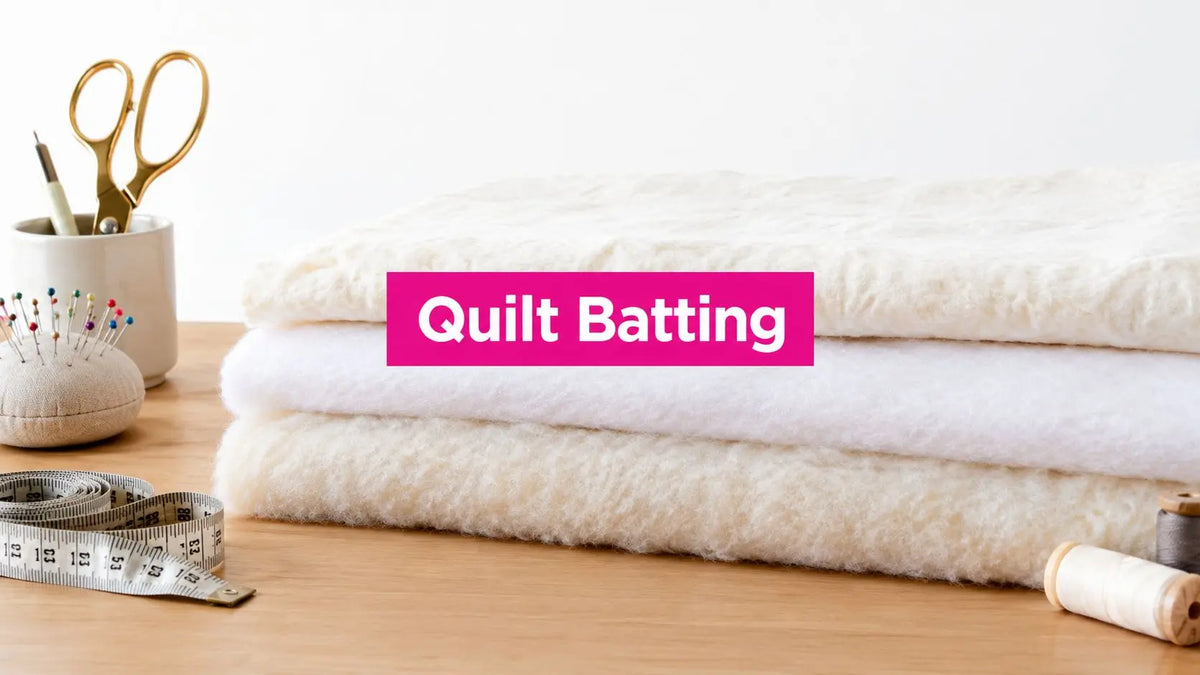
You've chosen your quilt top, thread, and backing, but the batting shelf still feels overwhelming. The best quilt batting for beginners is usually a low to medium loft 80/20 cotton-polyester blend, especially for an everyday quilt that may be machine quilted or sent to a longarm quilter. It's forgiving, stable, easier to stitch than lofty polyester, and has less shrinkage than many pure cotton battings. Just as important, order batting large enough to extend 4–6 inches beyond the quilt top on every side, or loading the quilt may become a problem. This practical batting guide places 80/20 batting among the most approachable all-purpose choices for new quilters.
| Batting type | Loft and feel | Best beginner use | Main caution |
|---|---|---|---|
| 100% cotton | Low loft, soft, breathable, flatter drape | Hand quilting, traditional quilts, washable everyday projects | Can shrink 3–5% after washing if not prepared properly, according to Pellon's quilting resources |
| Polyester | Often higher loft, resilient, puffy appearance | Tied quilts, comforter-style quilts, extra warmth | Can feel less natural and may be harder to handle when you want a flat drape |
| 80/20 cotton-polyester | Low to medium loft, stable, moderate warmth | First machine quilt, longarm quilting, everyday quilts | Check the package for quilting-density limits |
| Wool | Lightweight warmth with more loft than cotton | Warm quilts, three-season quilts, visible quilting texture | Needs more careful washing and handling |
| Silk or bamboo | Specialized feel and drape | Specific aesthetic or natural-fiber projects | Read the care and quilting instructions closely |
At Linda's, we simplify the choice this way: start with 80/20 unless your project has a strong reason to use something else. Then match the loft, washability, quilting density, and final size to the quilt you're making.
Common Mistakes When Choosing Your First Quilt Batting
A new quilter recently finishes piecing a beautiful quilt top and heads to the batting aisle with one thought: more loft must mean more comfort. She chooses a thick polyester batt because it looks wonderfully plush on the package. At home, the needle struggles through the layers, the quilt becomes bulky under the presser foot, and the batting shifts while she tries to baste it. By the time she considers loading it on a frame, the project feels like a wrestling match.
That mistake is understandable. Batting is hidden inside the quilt, so beginners often focus on softness or warmth without considering stitching behavior, drape, quilting density, and equipment. A high-loft batt can create a dramatic puffy finish, but that doesn't make it the easiest choice for learning accurate piecing, tensioning, free-motion quilting, or longarm loading.

The wrong loft creates the wrong lesson
Low loft keeps the sandwich flatter and generally makes it easier to see where the needle is traveling. Higher loft gives quilting lines more dimension, but it also increases thickness and can change how the quilt feeds through a domestic machine or moves beneath a longarm.
Early quilters worked with hand-carded cotton or wool that had to be stitched closely to prevent migration and clumping. Commercial cotton batting was manufactured by Stearns & Foster in Cincinnati in 1846, after cotton gin technology had already made seed removal much faster following Eli Whitney's 1793 invention, as documented in this quilt batting history. That history helps explain why cotton became such a familiar starting point. Its loft, hand, and stitch stability shaped expectations that still influence beginner recommendations.
Pro-Tip: Choose batting for the way you'll quilt, not just for how it feels in the package. A low-loft blend can teach you cleaner stitch control than a lofty batt that hides every movement.
Equipment changes the decision
A domestic machine, hand-quilting needle, and longarm frame each place different demands on batting. A batt that behaves nicely in a hand-quilted wall hanging may not give you enough stability for a frame, while a puffy polyester batt can be unnecessarily difficult for a first longarm project.
Common first-project errors include:
- Buying only the quilt-top size: The batting needs a working margin for basting, squaring, and frame handling.
- Ignoring the label: Manufacturer instructions determine allowable quilting spacing and care.
- Choosing warmth before drape: A thick quilt may be warm but too stiff for the intended use.
- Skipping the wash plan: Cotton and blends can change size and texture after washing.
For a straightforward first quilt, pick a low or medium loft 80/20 blend, confirm its quilting-spacing guidance, and order the full working size before you cut.
Cotton, Polyester, Wool, and Blends Compared
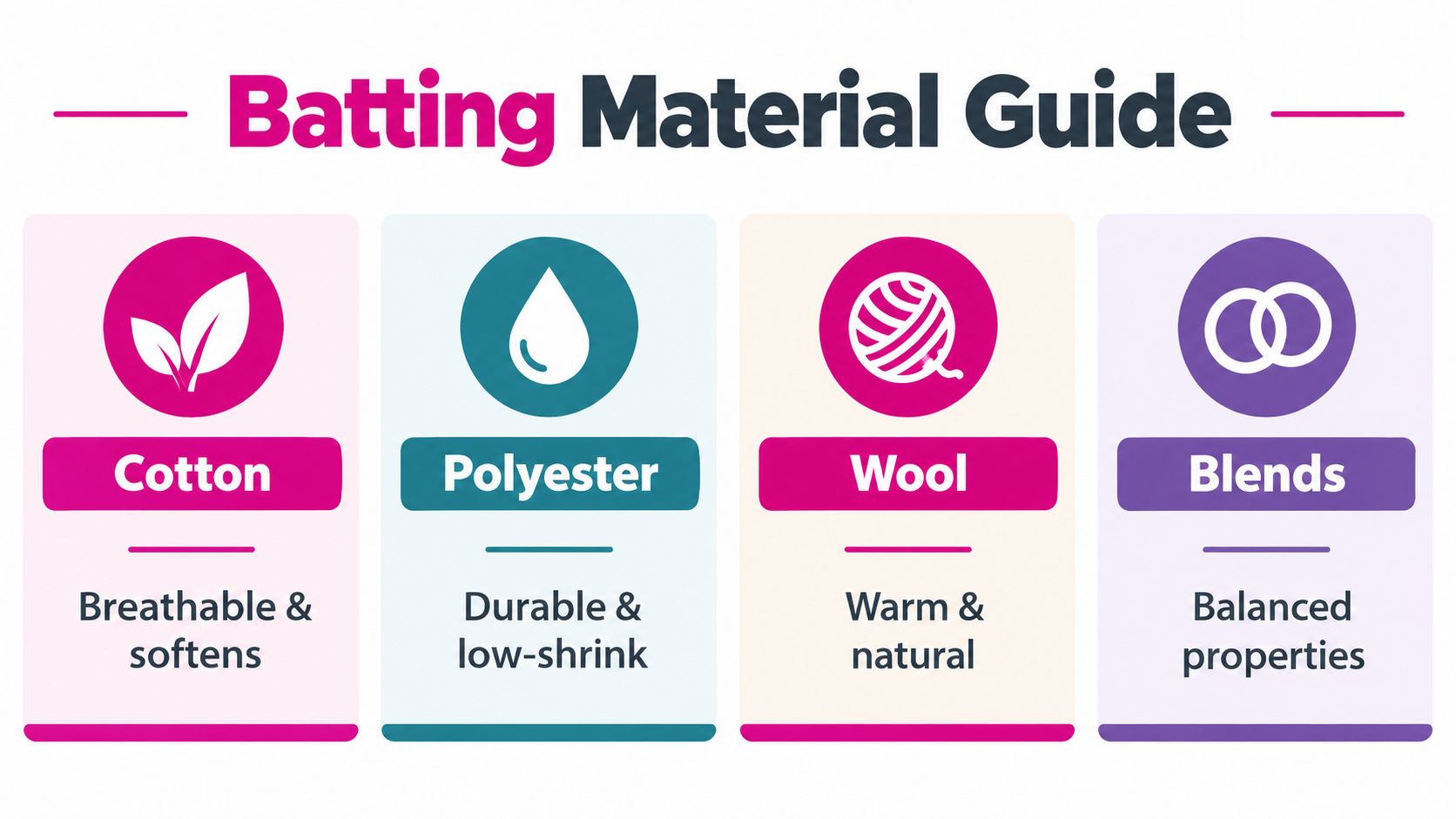
Batting fiber determines more than warmth. It changes drape, resilience, shrinkage, stitch definition, and wash behavior. Cotton gives a breathable, flatter quilt with a familiar soft hand. Polyester adds loft and resilience. Wool supplies substantial warmth without cotton's dense feel, while blends combine useful traits.
Cotton remains the easiest traditional reference point
Cotton batting is breathable, soft, and generally low loft. It creates a flatter quilt with natural drape, and washing can produce the familiar crinkled texture many quilters prefer. Shrinkage is the tradeoff. Cotton and cotton-blend battings may shrink up to 3–5%, so pre-shrink only if that change fits your plan. Soaking in hot water for 20 minutes without agitating the wet batting is one recommended method.
Pure cotton suits hand quilting because the needle moves through a relatively compact layer. Choose it when you want the quilt to soften through use instead of keeping a lofty, puffy profile. For a first quilt, cotton is easy to understand, but plan for its post-wash texture and size change.
Polyester prioritizes loft and resilience
Polyester batting creates a fuller, more dimensional finish. It generally resists shrinkage better than cotton, keeps its loft, and suits tied quilts or comforter-style projects with wider quilting. The result can feel less breathable and may lack the relaxed drape of a natural-fiber batt.
Choose polyester when puffiness, durability, or minimal post-wash change matters most. Skip it for a first project if you want a flat quilt or plan to hand quilt through a thicker, loftier layer.
Wool delivers warmth without a dense feel
Wool batting provides natural warmth and more loft than cotton while remaining relatively light. It fits quilts for cooler conditions and designs where quilting texture should stand out. Washing requires care. Excessive heat or unsuitable agitation can affect the fibers.
Silk and bamboo also serve specific projects. Research summarized in this discussion of batting behavior found that, at the same bedding insulation, silk quilts performed highest, followed by down and polyester quilts. That comparison supports a practical rule: select the fiber for the quilt's intended use, not only for its label or loft.
Blends are the practical compromise
An 80/20 cotton-polyester batt combines cotton's manageable loft and familiar feel with polyester's added stability. Guides commonly describe this blend as medium loft with roughly 2%–3% shrinkage, but products vary. Checker Distributors' product information lists an 80% cotton and 20% polyester batting with expected shrinkage of 3–5%. Read the package for the batt you buy.
For most first quilts, 80/20 is the sensible default. It is forgiving to handle, gives useful stitch definition, and avoids the strong shrinkage or loft preferences of the individual fibers. Order enough batting to extend 4–6 inches beyond the quilt top on every side. That working margin matters during basting and loading, especially on a longarm machine. Batting cut to the exact top dimensions can fail to reach the leaders or leave too little material for squaring.
Use the video alongside your fabric, batting, and backing selection, then shop the Linda's Electric Quilters batting collection when you're ready to build the quilt sandwich.
Loft and Quilting Density Guide
A batting choice can look right on the cutting table and still fail during quilting. Loft is the thickness of the batting before quilting. Low loft creates a flatter finish, while high loft produces more puff and visual relief. For a first quilt, choose low to medium loft. These battings are easier to baste, thread, tension, and move through a domestic machine or longarm.
Use this framework as a starting point, then follow the manufacturer's instructions for the specific batt.
| Loft type | Description | Best for | Quilting spacing |
|---|---|---|---|
| Low loft | Thin, flatter, easier to handle | Hand quilting, wall hangings, traditional drape | Often needs closer stitching. One guide lists up to 4 inches for 100% cotton without scrim |
| Medium or low-medium loft | Balanced thickness and stitch definition | Beginner machine quilting, everyday quilts | An 80/20 blend may allow up to 10 inches, depending on the product |
| High loft | Thick, puffy, more dimensional | Tied quilts, comforter-style quilts, bold texture | Follow the label closely because spacing limits vary |
Lo And Behold Stitchery's batting guide lists quilting limits of up to 4 inches for 100% cotton without scrim, up to 8 inches for 100% cotton with scrim, and up to 10 inches for 80/20 cotton-polyester blends or polyester battings. Treat those figures as product examples, not universal permissions. The package instructions control.
Match density to the design
Dense quilting holds the batt more securely and creates a firmer surface. Wider spacing leaves more loft visible and gives a softer, puffier finish, provided the batting supports that spacing. If fibers migrate, beard through the fabric, or clump, the surface can become uneven.
A fresh, sharp needle helps limit bearding, where fibers pull through the quilt top. Check the thread path, bobbin casing, and tension before blaming the batt. On a longarm, test a small area first. Watch how the batting responds to stitch length, hand speed, and quilting direction.
A pretty stitch pattern cannot compensate for batting that exceeds its spacing limit. Choose the batt first, then design the quilting around its instructions.
For detailed hand quilting and flat wall pieces, choose low loft. For a beginner using a domestic machine or longarm, medium loft, especially 80/20, is my clear recommendation. Choose high loft only when you specifically want a puffy finish.
Use the video while selecting fabric, batting, and backing, then visit the Linda's Electric Quilters batting collection when you are ready to assemble the quilt sandwich.
Preparing Batting for Washing and Use
Decide how the quilt will be washed before cutting the batting. Fiber choice, intended use, and the finish you want all affect that decision. A pre-shrunk batt gives more predictable dimensions, while skipping that step allows cotton to develop traditional crinkling after quilting.
Decide whether pre-shrinking fits the project
For cotton or cotton-blend batting, pre-shrinking can limit surprises after the first wash. Pellon's care guidance recommends soaking the batting in hot water for 20 minutes, then handling it gently without agitation while wet.
Use this process:
- Read the package first. Follow the manufacturer's care and quilting-density instructions.
- Measure before soaking. Record the batt dimensions so you can identify any change.
- Soak without agitation. Do not scrub, twist, or wring wet batting.
- Support it while wet. Lift it carefully to prevent uneven stretching.
- Dry according to the label. Avoid heat or movement the manufacturer does not approve.
- Press only if directed. Excessive pressing can flatten the loft you selected.
Some quilters skip pre-washing cotton batting and accept later shrinkage for a traditional texture. That finish works well when planned. A baby quilt, charity quilt, or frequently washed everyday quilt needs a clear care plan before quilting begins.
Washing affects more than size
Cotton can shrink and develop extra texture. Polyester usually holds its shape more readily, while wool needs gentler handling to protect its loft and fiber structure. Blends fall between those behaviors, which makes 80/20 batting practical for beginners who want simpler care with a natural-fiber feel.
Record the washing instructions with the project notes. If the quilt is a gift, include those instructions with the finished quilt so the recipient can protect its drape, warmth, and stitch definition.
Keep a trusted quilting tutorials resource available while preparing the sandwich. Linda's Electric Quilters also provides educational content and live shopping resources for quilters comparing materials before cutting.
Sizing and Loading Batting Correctly
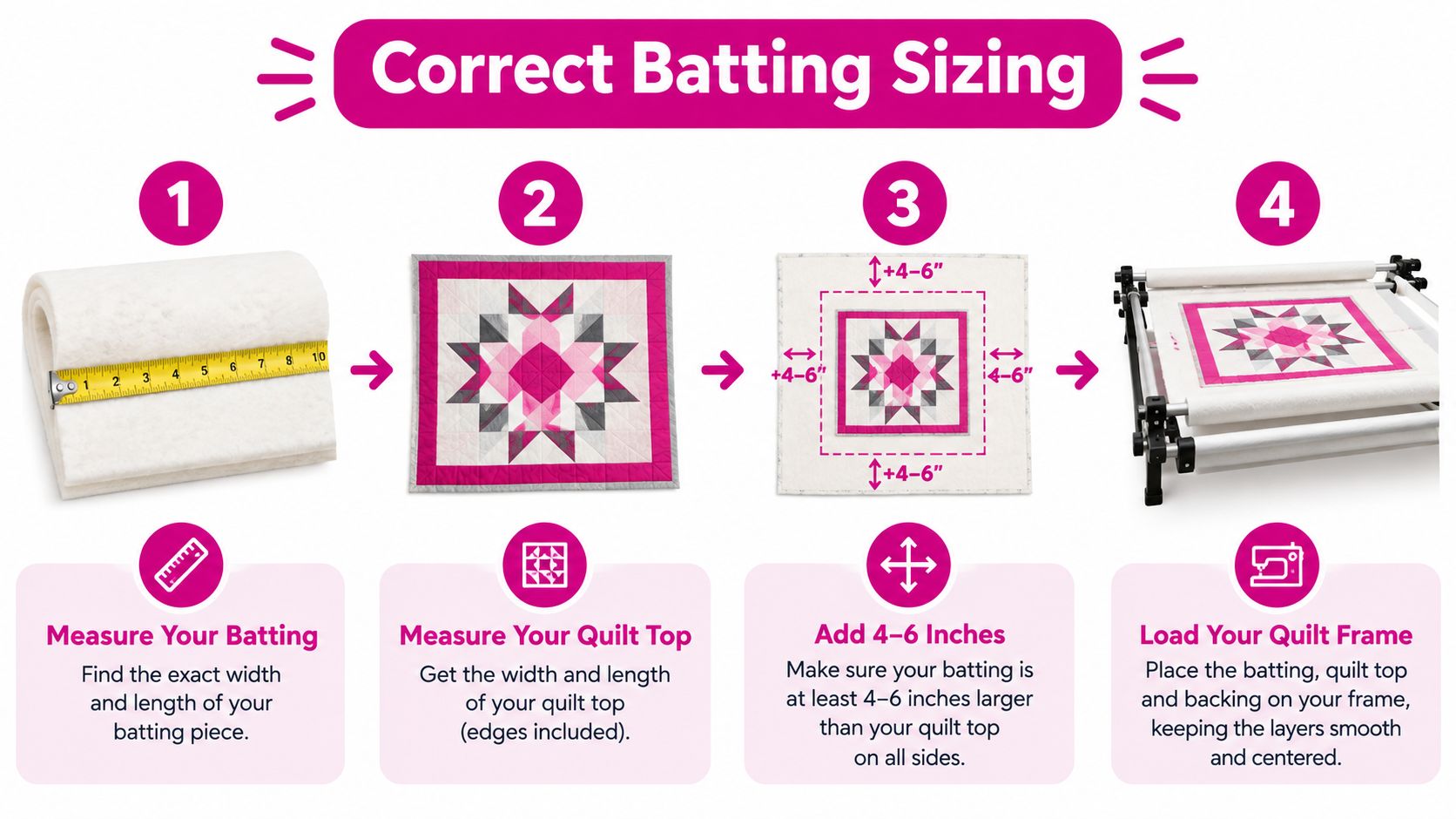
A longarm quilt can fail before quilting starts if the batting is cut to the quilt top's exact size. The frame needs extra material for leaders, clamps, basting, edge control, and squaring. Order batting that extends 4–6 inches beyond every edge of the quilt top. That adds 8–12 inches to both the width and length. For a 60-by-80-inch quilt top, buy batting measuring 68–72 inches wide and 88–92 inches long. The QuiltCraft Tools' batting guide also notes that some longarm setups need more room for handling.
Why 80/20 works especially well here
For a first longarm project, choose an 80/20 cotton-polyester blend in low-medium loft. Cotton provides a familiar hand and moderate loft, while polyester adds stability and limits post-wash change compared with many pure cotton battings. The blend also shows quilting lines clearly without the extra bulk of high-loft polyester.
Loading still requires care. Smooth the batting without stretching it, keep tension even, and check that the quilt top remains square as the rollers advance. A stable low-medium loft makes the quilt sandwich more predictable while you learn the frame.
Calculate before buying
Use these measurements:
- Quilt-top width plus 8–12 inches
- Quilt-top length plus 8–12 inches
- More material if your longarm quilter or frame manufacturer requires it
Ask the longarm professional about loading requirements before purchasing. Their frame may need extra batting at the top and bottom, especially when the quilt will advance repeatedly or attach to leaders.
Loading rule: Never trim batting flush with the quilt top before quilting. The extra margin lets you square the edges and protects the design from reaching the frame's working area.
Buy one continuous piece whenever possible. Seams can create thickness changes or shifting. If piecing is unavoidable, use a method approved for that batting and keep the join flat.
Choosing the Best Batting for Your Project
A first quilt often fails at the frame before the stitching begins. Batting cut flush with the quilt top cannot be squared, attached, or advanced safely, so plan the finished use, fiber, loft, wash method, and loading margin together. The choice is simpler once those practical requirements are clear.
A practical project matrix
| Project | Recommended starting point | Why it fits |
|---|---|---|
| Everyday bed quilt | 80/20 cotton-poly, low-medium loft | Balanced warmth, stability, and manageable quilting |
| Baby quilt | Washable cotton or 80/20 blend | Soft hand and practical care, with the label checked first |
| Hand-quilted traditional quilt | Low-loft cotton | Easier needle penetration and flatter drape |
| Puffy comforter-style quilt | High-loft polyester | Adds visible volume and loft |
| Warm seasonal quilt | Wool or cotton-wool blend | More warmth without relying only on heavy bulk |
| Wall hanging | Low-loft cotton or blend | Keeps the piece flatter and easier to display |
For a first project, choose an 80/20 blend in low-medium loft. It gives beginners a stable sandwich, moderate warmth, and quilting lines that remain visible without the bulk of high-loft polyester. Check the product label for maximum quilting distance, then choose a design that stays within that limit.
Use low-loft cotton for a flatter traditional finish or hand quilting. Choose wool when warmth matters without adding heavy bulk, and reserve high-loft polyester for projects where a distinctly puffy surface is part of the design. Baby and charity quilts benefit from simple care and dependable sizing more than dramatic loft.
Keep your workflow in view
Plan washing before basting. Cotton and cotton-blend batting can be pre-shrunk when limiting later size change matters, but follow the manufacturer's instructions. A hot-water soak may be suitable for some products, while polyester, wool, bamboo, silk, and specialty blends require their own care directions.
A longarm project also needs a loading plan. Batting should extend 4–6 inches beyond the quilt top on each side. Confirm the longarm professional's requirements before ordering, because the frame may need more material at the top and bottom for leaders, repeated advancing, and edge squaring.
Buy one continuous piece whenever possible. Seams can create thickness changes and shifting. If piecing is unavoidable, use a method approved for that batting and keep the join flat.
At home, test the needle, thread, bobbin casing, and tension on a scrap sandwich. This quick test shows whether the batting causes drag, skipped stitches, bearding, or unwanted puff before those problems reach the quilt.
Your first batt should make the project easier, not showcase every advanced option in the store. Choose 80/20 for a dependable middle ground, cotton for a flatter finish, wool for specialized warmth, and polyester when loft is the design goal.
Frequently Asked Questions
What is the best quilt batting for beginners?
The best starting choice is generally an 80/20 cotton-polyester blend with low to medium loft. It balances stability, manageable thickness, moderate warmth, and visible quilting texture. Check the label because shrinkage and allowable quilting spacing vary between products.
How much larger should batting be than the quilt top?
Batting should usually extend 4–6 inches beyond the quilt top on each side. A longarm quilter may request additional margin for frame handling, so confirm loading requirements before cutting or ordering.
Should I pre-wash quilt batting?
You can pre-shrink cotton or cotton-blend batting to limit later size change. Do not assume every fiber should be washed the same way. Follow the manufacturer's care instructions for polyester, wool, bamboo, silk, and specialty blends.
Is low loft or high loft better for beginners?
Low to medium loft is usually easier for a first project because it creates a flatter, more controllable quilt sandwich. High loft adds puff and warmth, but it can be harder to stitch through, baste, tension, and load. Choose it only when that fuller finish is intentional.
How far apart can quilting stitches be?
The spacing limit depends on the batting's fiber content, scrim, construction, and manufacturer instructions. Check the product label before planning the quilting design. Designs that exceed the stated limit can leave the batting loose or uneven after use and washing.
Linda's Electric Quilters carries batting and quilting supplies for first quilts and longarm projects, along with educational videos and live shopping resources for comparing materials. Visit Linda's Electric Quilters to choose an 80/20 blend, calculate the loading margin, and order the batting needed for your quilt.