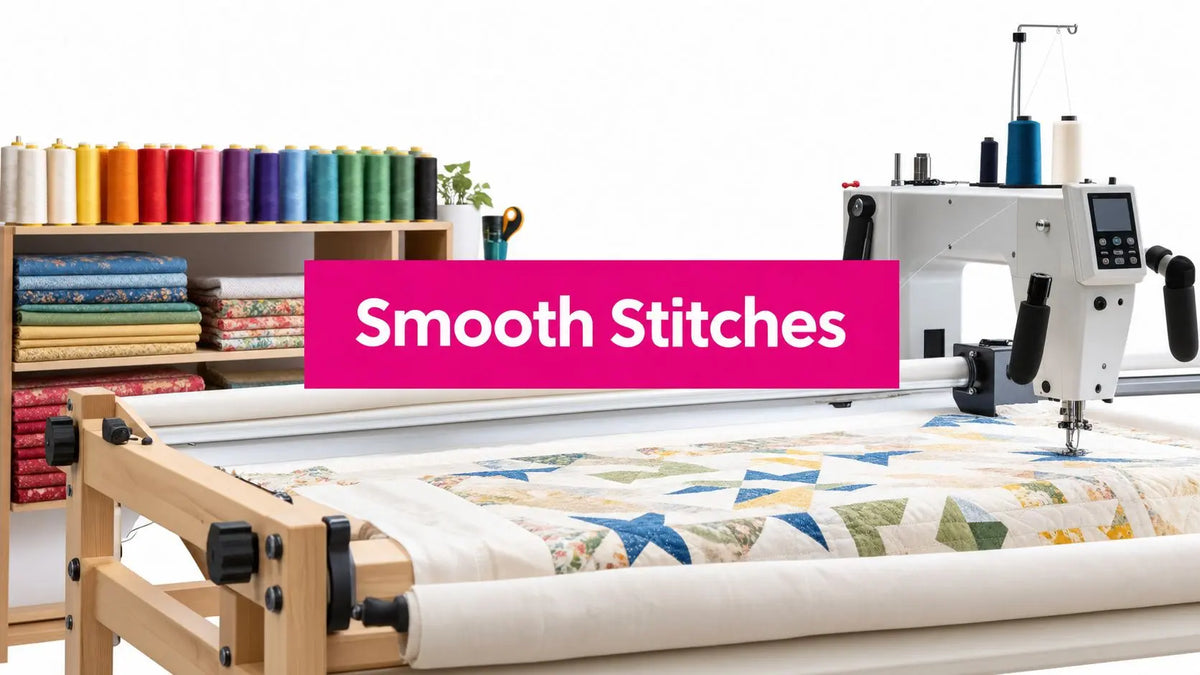
You're halfway through a longarm run when the thread starts snapping, lint gathers around the tension discs, and the stitches begin looking uneven. In most cases, the problem isn't the machine. The best all-around longarm quilting thread for most projects is a smooth 40 to 50 weight polyester, paired with the correct needle and adjusted tension. That combination reduces drag, limits lint, and gives an Innova longarm a dependable starting point for both edge-to-edge work and detailed motifs.
The right choice still depends on your quilt top, batting loft, desired hand, stitch visibility, and production pace. This guide gives you a decision-first method for choosing by fiber, weight, ply, finish, needle size, and tensioning, so you can test less, recover from breakage faster, and shop for thread with a clear purpose. If your next project needs more loft or drape, compare the thread with Linda's quilting batting collection, then review Innova longarm parts when a worn guide or bobbin component is affecting your stitch path.
Why Your Longarm Quilting Thread Choice Matters Right Now
You are midway through a longarm pass when the thread begins snapping, lint collects near the tension discs, and the stitches lose balance. That pattern usually points to a mismatch among fiber, weight, ply, needle size, and tensioning, not a simple color preference. Thread choice sets the conditions your Innova must manage through every guide, curve, and change in quilting speed.
The quilting market remains large and active. One industry survey estimated the market at $4.5 billion in 2025, compared with $1.8 billion in 2000, $3.6 billion in 2010, and $4.2 billion in 2020. It also estimated 9 to 11 million active quilting participants over the past decade, while a 2024 projection placed the market at $5 billion by 2027. (Craft Industry Alliance market survey) That activity keeps thread selection relevant for both home quilters and longarm professionals.
Start with the outcome, not the label
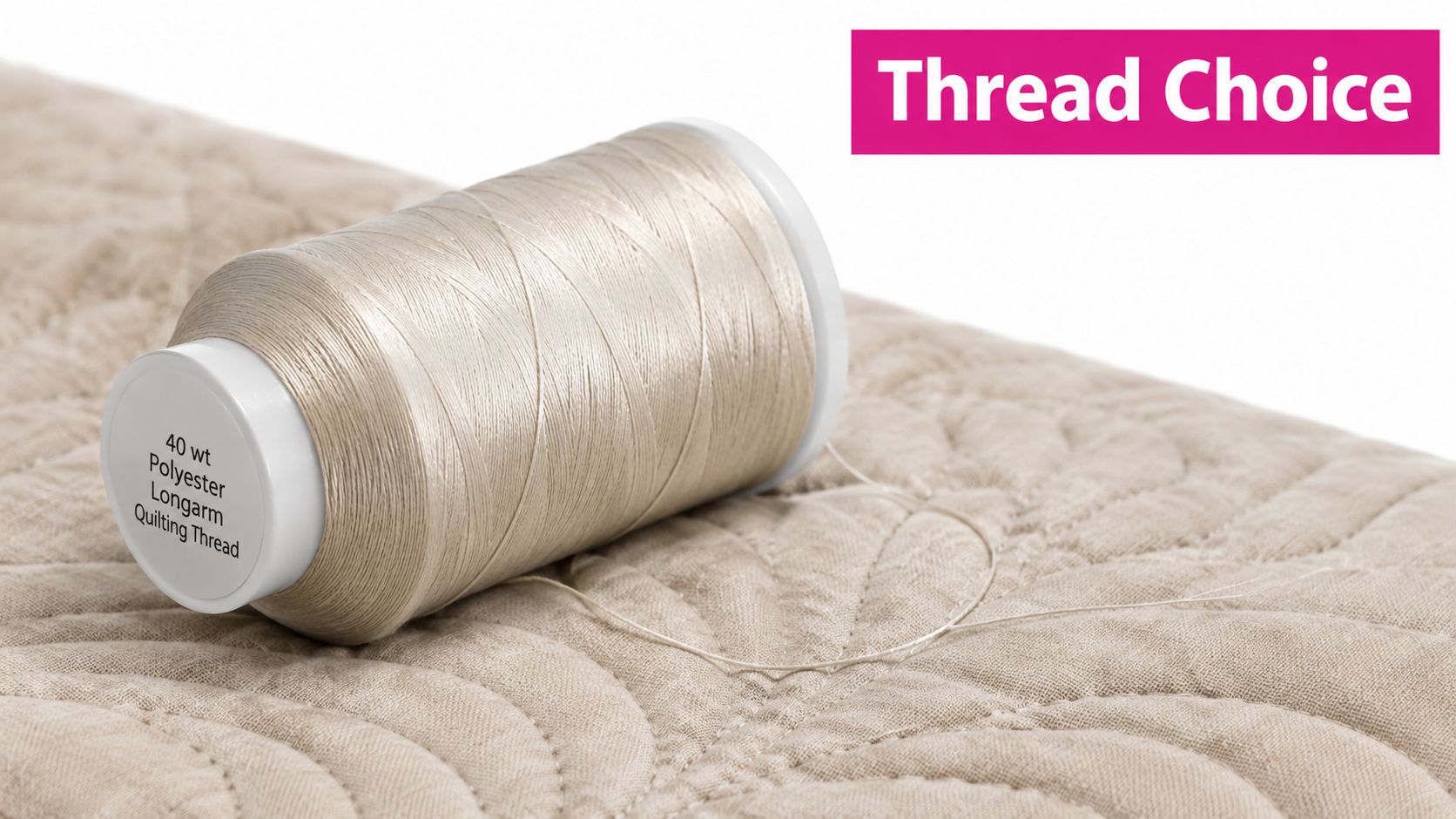
Choose polyester when low lint, smooth feeding, and reduced breakage are the priority. Its smooth surface can reduce drag through the needle eye and guides, giving you a practical starting point for long passes. Cotton suits a matte appearance, a traditional hand, and a closer visual relationship with a cotton quilt top. A blend or specialty thread fits projects where sheen, texture, or stitch visibility matters more than the simplest setup.
Weight changes the result as well as the appearance. A dense design over high-loft batting can swallow a fine thread, while a heavier thread can make every curve and point stand out. Ply affects how round the thread feels and how the stitch forms. Fiber influences lint and hand. Needle size and tensioning determine whether those properties work smoothly on the machine.
Linda's team in McKinney, Texas, tests thread on an Innova longarm instead of trusting spool labels alone. Run a short sample using the actual quilt sandwich, then inspect the top and bobbin sides for balanced tension, skipped stitches, fraying, and excess lint. Check the batting loft, stitch speed, and motif density together before quilting the full piece.
Practical rule: Decide the desired stitch visibility and hand first. Then match fiber and weight to lint and drag requirements, choose a compatible ply and needle, and tension-test the complete sandwich.
Understanding Longarm Quilting Thread Weight Ply and Sheen
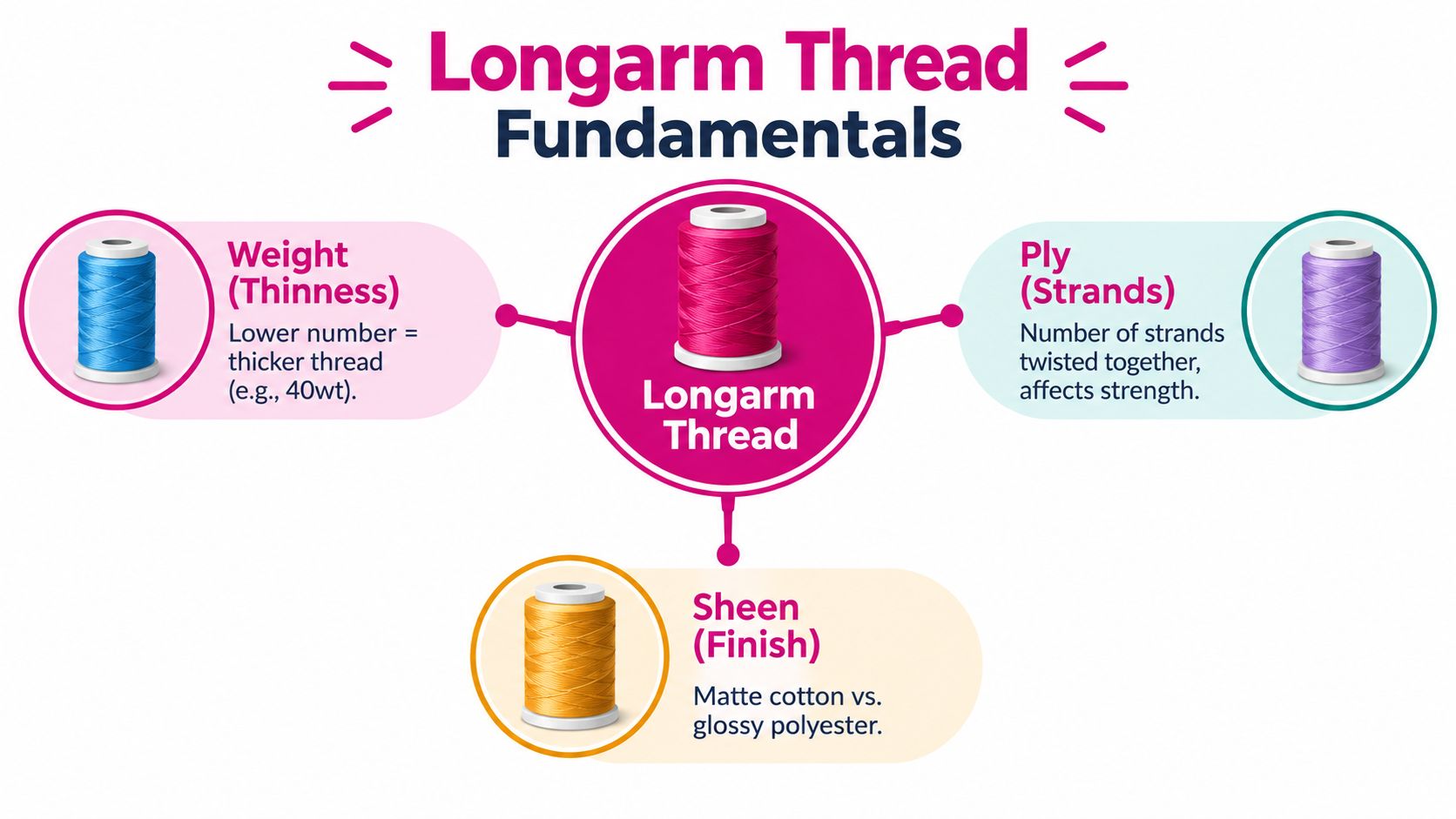
Thread labels become easier to read when you separate three ideas: weight, ply, and finish. Think of weight like yarn thickness. A lower weight number describes a thicker thread, so 40 wt is thicker and more visible than 50 wt, while 100 wt is much finer. That relationship often confuses new longarm users because the larger number sounds heavier. It isn't.
Weight predicts visibility and drag
A 50 wt thread is a practical thin-thread benchmark and is common on longarm machines. A 40 wt thread gives the quilting design more visual presence. Finer threads, including 100 wt specialty options, can sink into the surface and show the texture of the quilting without creating a strong line.
Weight also changes friction. A thicker thread has more surface area moving through the needle eye, tension discs, guides, and batting. If the needle eye is too small or the top tension remains too firm, the thread can fray or break. That's why a heavier decorative thread needs a coordinated change rather than a simple spool swap.
Ply changes hand and stitch character
Ply describes the number of strands twisted together. A higher-ply construction can feel rounder and create a more defined stitch, while a different ply arrangement may produce a softer or flatter hand. The label alone doesn't tell you exactly how the thread will behave, because fiber length, twist, lubrication, and finish also influence feeding.
Run the thread between your fingers before loading it. A smooth, round thread usually travels predictably. A fuzzy thread may create more lint and may need closer attention during long quilting runs. The quilt top and batting determine whether that texture looks pleasantly soft or obscures a fine motif.
Sheen affects the design
Cotton generally offers a matte, traditional appearance. Polyester often has more sheen, although the amount varies by construction and finish. A glossy thread catches light along curves, feathers, and ruler work, while a matte thread blends into the fabric and emphasizes texture instead of reflection.
Batting loft changes the result. Higher loft lifts the quilted surface and can make a visible thread stand out more. Low-loft batting gives the thread less physical separation from the top, which often favors a finer or more closely blended choice. Test both the hand and the appearance on a sandwich that matches the finished quilt.
Cotton Polyester Blends and Specialty Threads Compared
You have a quilt top loaded on an Innova, the motif is ready, and the first test row shows lint, drag, or a broken stitch. The spool may be the problem, even when its labeled weight appears correct. Fiber and construction affect how thread feeds, how much tensioning it needs, and how clearly each stitch sits in the quilt.
The history of these choices is long. Manufactured cotton thread was available to hand sewers in the United States and Europe by 1800, polyester thread became available in 1942, and cotton-wrapped polyester appeared in the late 1960s. Those milestones explain the range now available, from natural and synthetic fibers to hybrid and decorative constructions. (Thread history overview)
Cotton remains a familiar quilting choice, while polyester has become a practical performance option. Across market descriptions, cotton is still foundational, but polyester is selected for strength, smooth feeding, and reduced lint. Use that distinction as a decision point: choose the fiber that supports the quilt's hand and the machine behavior you need, rather than choosing by fiber name alone.
| Thread Type | Lint and Breakage | Sheen and Hand | Best Longarm Use |
|---|---|---|---|
| Cotton | More susceptible to breakage under demanding tension and can create more lint during extended work | Matte, soft, and traditional | Heirloom quilts, cotton tops, and designs where subtle stitch definition matters |
| Polyester | Usually lower lint and less likely to break when the machine is correctly tensioned | Smooth hand with a variable sheen | Production quilting, dense motifs, and long runs where machine consistency matters |
| Cotton-wrapped polyester | Polyester core supports strength while the cotton exterior changes grip and surface feel | A compromise between matte appearance and synthetic stability | Quilters who want a hybrid hand and predictable machine behavior |
| Specialty, including metallic and 100 wt | More sensitive to needle, speed, and tension choices | Decorative shine or extremely discreet definition | Accents, selected motifs, micro-detail, and intentionally visible design work |
When cotton earns the extra attention
Cotton suits a quilt whose character depends on a natural, matte finish. It can give crisp stitch definition without the reflection some polyester produces. Its rougher path through the needle and batting can increase drag, lint, and breakage during dense or fast quilting, so test tensioning before committing to a long run.
When polyester is the safer default
Polyester is often a sensible starting point for continuous longarm work. Technical guidance describes it as less likely to break and less prone to lint than cotton. Its smoother surface can also reduce drag through the needle and batting, which helps on dense motifs and extended runs. (BERNINA Q24 manual)
When specialty thread is worth the setup
Metallic thread functions as a design accent, not a universal replacement for 40 or 50 wt thread. Its shine can emphasize selected curves or motifs, but its behavior is more sensitive to needle, speed, and tensioning. Ultra-fine 100 wt thread can keep the texture visible while allowing the fabric or quilting pattern to lead.
Test every specialty choice on a matching quilt sandwich. Check the front for stitch visibility and the back for balanced tension, then run your fingers over the sample to compare loft and hand. If the thread drags, sheds lint, or breaks, change the setup before changing the design.
How to Match Thread Weight to Needle Size and Tension
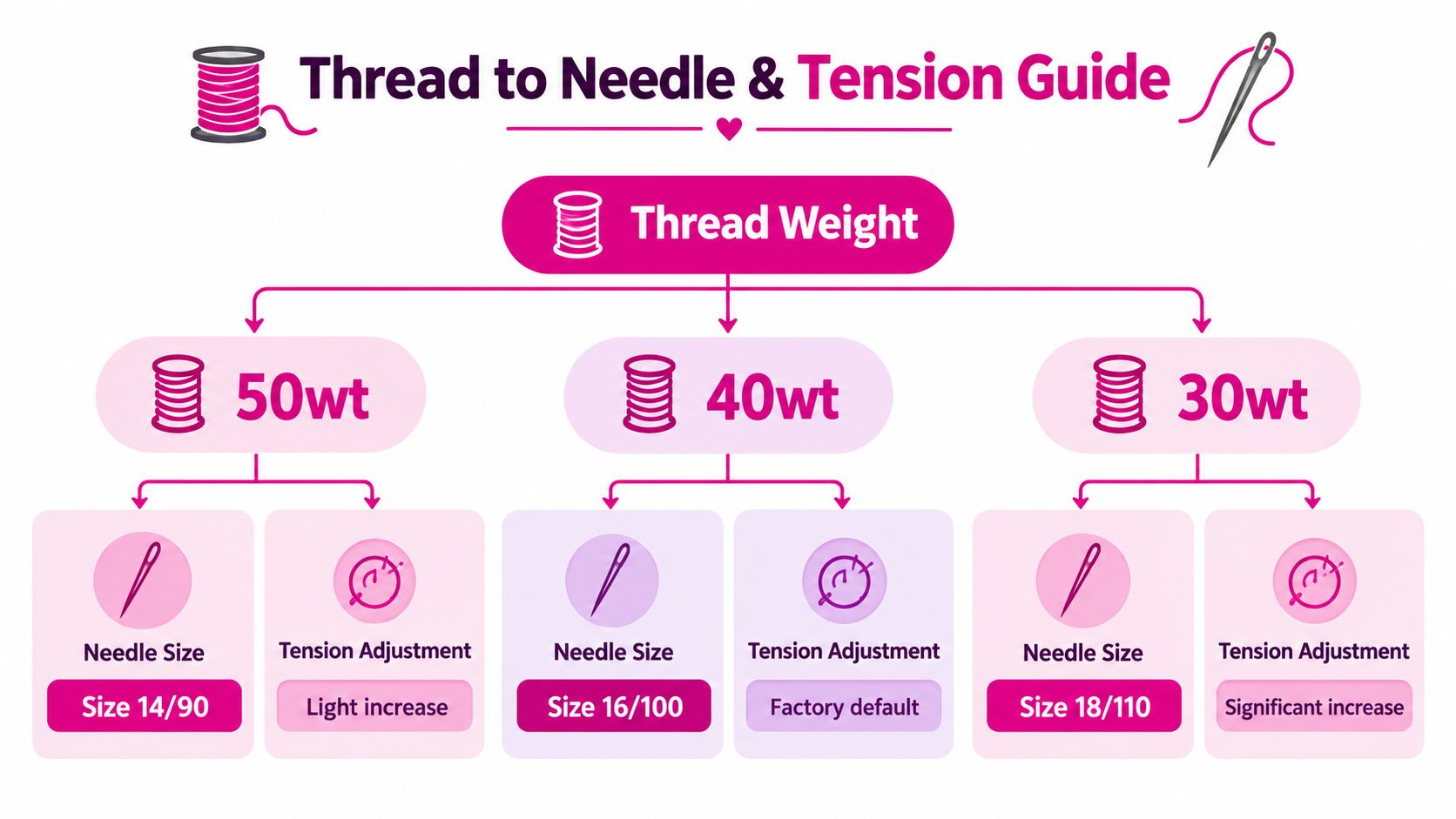
Needle choice controls the amount of space available for the thread. Handi Quilter lists sizes 80/12, 90/14, 100/16, 110/18, and 120/20, and states that the larger number indicates the larger needle. It identifies sizes 16 and 18 as the most commonly used, with sizes 12 and 14 suited to finer threads such as 100 wt silk or 100 wt MicroQuilter, and size 20 suited to thicker 12 wt thread. (Handi Quilter needle guide)
Use the pairing as a starting point
A practical longarm sizing guide maps 4.0 to size 18/110, a common all-purpose choice for 40 to 60 weight thread. It maps 3.5 to size 16/100 for finer 60 to 100 weight thread, and 4.5 to size 19/120 for thicker 30 to 40 weight thread. The guide's underlying rule is simple: smaller needle numbers suit finer threads, while larger numbers provide a larger eye for heavier thread. (Longarm needle sizing guide)
A separate educational reference maps the scale as #14 = 3.0, #16 = 3.5, #18 = 4.0, #19 = 4.5, and #20 or #21 = 5.0. It pairs extra-long-staple Egyptian cotton with needle size #18, or 4.0, for longarm work. (Longarm reference guide)
Understand the tension cause and effect
Many machines are factory set for a thin 50 wt profile. When you move to a heavier thread, the larger thread body increases friction through the eye and guides. A larger needle gives the thread room, and reduced top tension can prevent the thread from being pulled too tightly and breaking.
For a working setup, begin with the manufacturer's normal setting, stitch a test swatch, and change one variable at a time. Check the top thread, bobbin casing, needle eye, batting loft, and back before making a second adjustment. A bobbin casing that is already too tight can disguise a top-tension problem.
Pro tip: Don't compensate for a thick thread by changing every setting at once. Install the correct needle first, then make a small top-tension adjustment and inspect both sides of the sample.
Tensioning and Maintenance Tips for Flawless Longarm Stitching
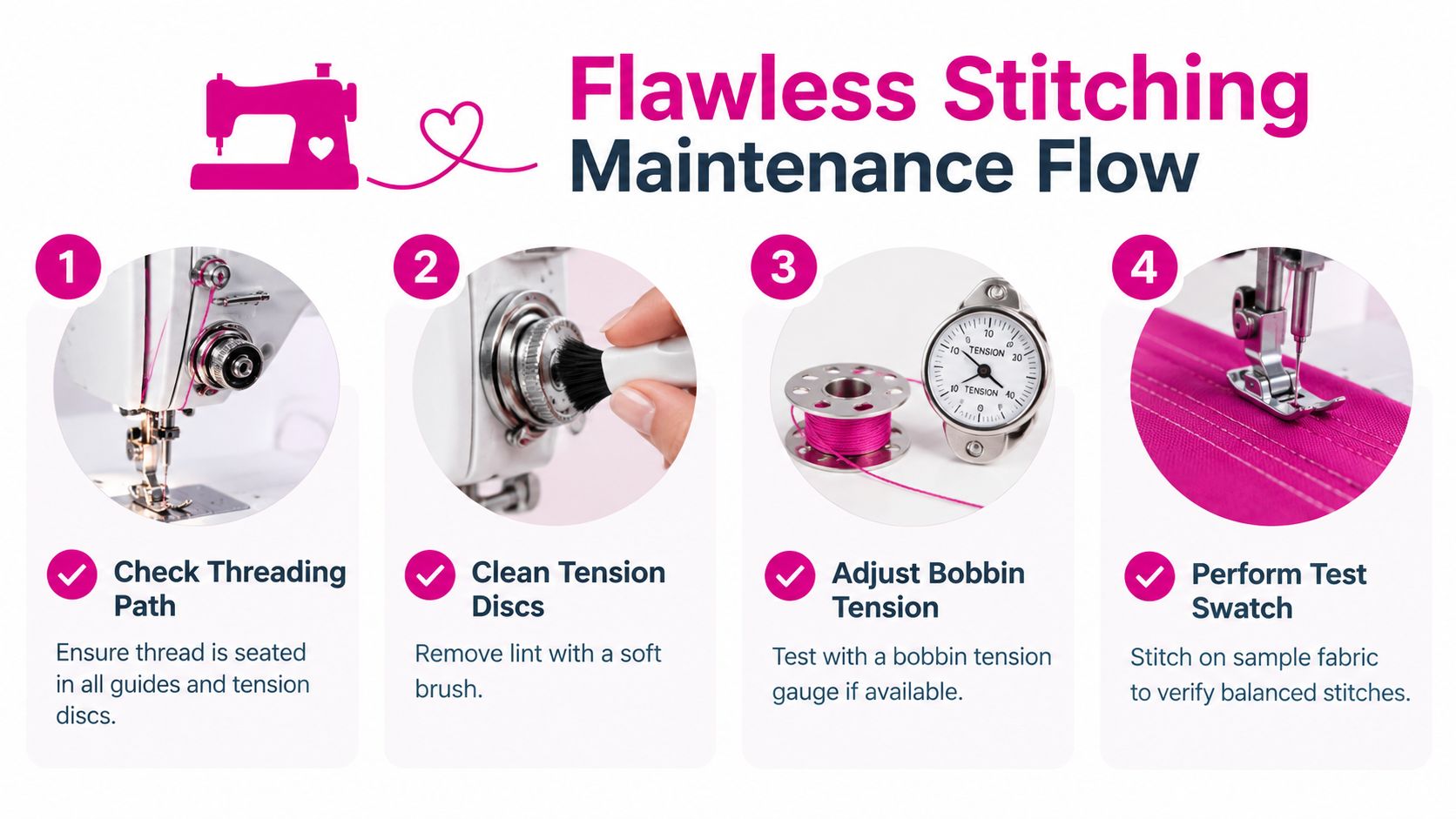
Balanced tensioning starts before the needle enters the fabric. Thread must sit completely inside every guide and between the tension discs. If it rides beside a disc or skips a guide, the machine can produce loops even when the dial setting looks correct.
Follow a repeatable setup sequence
- Thread the path carefully. Raise the presser foot or follow your Innova threading procedure so the tension discs open as intended. Seat the thread in each guide rather than pulling it across the outside.
- Inspect the needle. A damaged, bent, or worn needle can create skipped stitches and premature breakage. Match the needle size to the thread weight before you touch the tension dial.
- Check the bobbin casing. Confirm that the bobbin is inserted in the correct direction and that the thread follows the casing's path. If you use a bobbin tension gauge, record the result so you can return to a known baseline.
- Test on the actual sandwich. Use the same quilt top fabric, batting loft, backing, and thread combination. A plain fabric test can look balanced while a dense batting stack creates drag and changes the stitch.
Cotton's natural surface can pull harder through the needle and batting. Smooth polyester generally feeds with less drag, but it still needs a clean path and a suitable needle. If you see loops on the underside, inspect top threading and top tension first. If you see puckering, the thread may be too tight for the fabric movement or the batting may be resisting the stitch path. Repeated breaks point you toward friction, a small needle eye, excessive tension, a rough guide, or lint interference.
A beautiful first inch doesn't prove a setup is stable. Run a longer sample and inspect the thread path again before beginning the quilt.
Keep lint from becoming a tension problem
Clean the tension discs, needle area, bobbin area, and accessible guides with the tools recommended for your machine. Cotton fibers can collect along the tension path, and any buildup can make the thread tension inconsistent during a long run. Follow the Innova maintenance schedule for oiling, and don't add oil to areas that the manufacturer doesn't specify.
Use this short maintenance check before a production session:
- Clean the path: Remove lint from the tension discs and bobbin area.
- Confirm the needle: Install a fresh needle suited to your thread.
- Check the casing: Verify bobbin seating and tension.
- Run a swatch: Test both sides before quilting the customer quilt.
Choosing the Right Thread for Quilting Stippling and Bindings
A customer brings you a busy patchwork top with medium-loft batting and asks for quilting that feels refined rather than loud. I'd start with smooth 50 wt polyester in a neutral that sits between the dominant values in the top. The goal isn't to make the thread invisible at every angle. It's to let the stippling texture register without turning every overlap into a visual interruption.
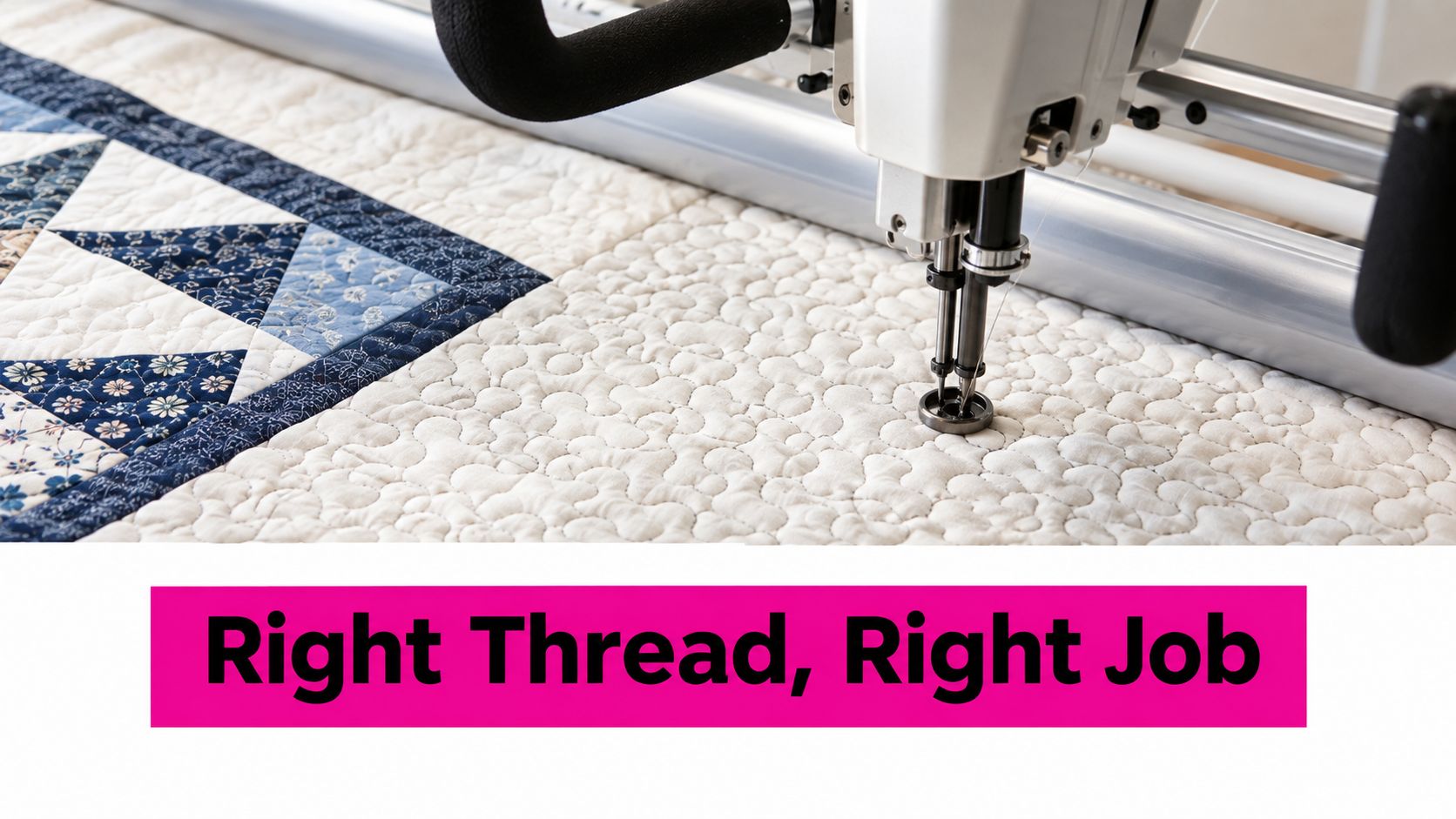
All-over quilting
For an edge-to-edge design, consistency matters more than drama. A 40 to 50 weight polyester gives a dependable machine starting point, while a neutral color can blend across a multicolor top. If the top is mostly solid, a contrasting 40 wt can make the quilting pattern part of the design.
Match the needle to the selected weight and test the tension across both light and dark fabric areas. A thread that blends on one block may appear much stronger on another, especially when batting loft lifts the stitches toward the light.
Dense stippling
Dense stippling increases the number of needle penetrations and the amount of thread movement through the quilt sandwich. That's where smooth feeding, low lint, and controlled drag become valuable. Polyester is often the practical choice, particularly when the quilting pace and motif density create more heat and friction around the needle.
Use a fine thread when you want the texture to lead. A 100 wt specialty thread may require a finer needle, while a 40 wt thread will give the stipple more presence and may need a larger needle and looser top tension. Sample both choices on the same batting loft before deciding.
Bindings and visible edge work
Binding work needs a thread that supports the finish without distracting from the edge. A neutral 50 wt can disappear into a traditionally finished binding, while a 40 wt or specialty accent can make the binding look intentionally outlined. Keep the hand in mind. A shiny thread can sharpen the edge visually, but a matte cotton may suit an heirloom finish more naturally.
Linda's team uses an Innova in McKinney, Texas, to evaluate how the thread behaves at the intended speed and through the selected quilt sandwich. You can also use the related longarm quilting tutorial before testing your first pass.
Watch the embedded tutorial for a visual look at machine quilting movement and setup:
For a solid top with a bold motif, I'd test the heavier visible option first. For a busy top or a customer who wants texture without contrast, start finer and more neutral. The batting's loft, not only the fabric color, determines how much the stitch rises from the surface.
Your Next Steps to Confident Longarm Thread Selection
A reliable thread decision follows a clear order: define the quilt's intended result, choose the fiber, select the weight and ply, then match the needle and tensioning. This sequence keeps color and sheen from driving the choice too early. A thread can look perfect on the spool yet create drag through lofty batting, shed excessive lint, break at the needle, or disappear from the motif.
Use this decision flow at the machine:
- For smooth production quilting: Begin with a smooth 40 to 50 weight polyester and a needle suited to that range. Run a longer sample to check lint, feeding, stitch balance, and breakage.
- For a matte heirloom appearance: Test quality cotton with a suitable needle and carefully balanced tension. Its traditional hand may suit the quilt, but its added lint and drag deserve attention during a longer run.
- For fine texture: Consider a finer thread, including a 100 wt option, with the smaller needle pairing described earlier. This choice keeps the stitch subtle while allowing the quilting texture to remain visible.
- For decorative impact: Choose a heavier or specialty thread only after confirming that the needle eye, top tension, speed, and bobbin casing support it. A bold thread needs room to pass cleanly, not a larger appearance on the quilt.
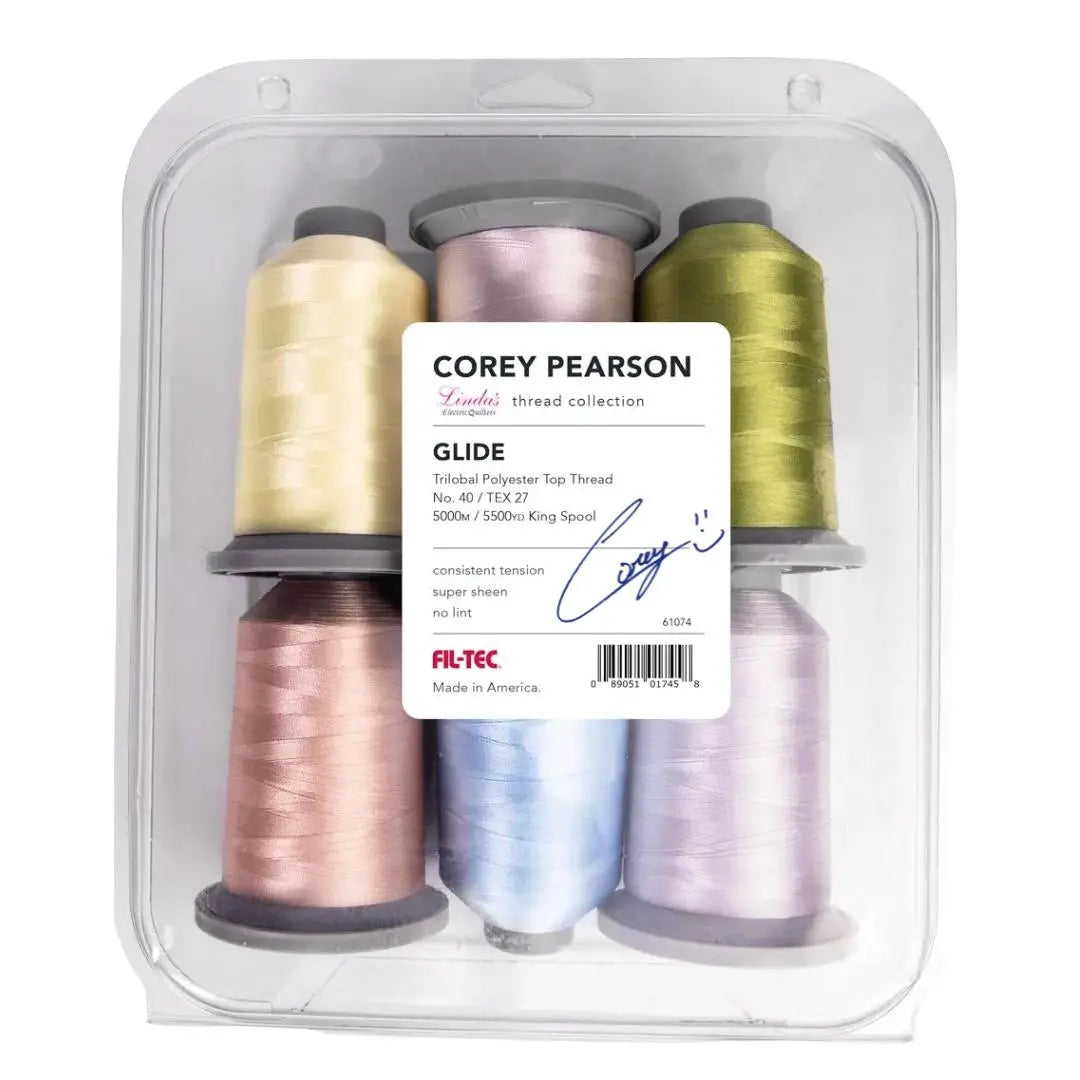
Build a small working lineup rather than relying on one thread that succeeded on a single quilt. Keep a dependable polyester workhorse, a matte cotton, a fine blending thread, and a specialty accent available for different surfaces and finishes. Record the thread, needle, batting loft, top tension, bobbin setting, stitch length, and stitch appearance on a sample strip. That record makes future tensioning repeatable instead of guesswork.
Save the actual test swatch with the quilt paperwork. A color card shows shade, but the swatch captures hand, stitch visibility, drag, lint, and tension on your machine.
Linda's Electric Quilters offers quilting thread, batting, notions, and Innova-related supplies for longarm projects, as well as educational videos and live shopping content. Visit the Linda's Electric Quilters store to compare options by fiber, weight, batting loft, and finish. Test the selected combination before committing to the full run.
Frequently asked questions
What is the best longarm quilting thread for most projects?
A smooth 40 to 50 weight polyester is a practical starting point for many longarm projects. Pair it with the correct needle, then adjust tension after testing the actual quilt sandwich.
Is cotton or polyester better for longarm quilting?
Neither suits every quilt. Cotton provides a matte, traditional hand, while polyester usually feeds more smoothly, creates less lint, and handles extended machine work well. Let the desired appearance, batting loft, and workload guide the choice.
Why does heavier thread keep breaking?
Heavier thread creates more friction through the needle eye and guides. Use a larger needle, reduce top tension as needed, inspect the bobbin casing, and test on the same fabric and batting layers as the quilt.
What needle size works with fine longarm thread?
Handi Quilter identifies sizes 12 and 14 as suitable for fine threads such as 100 wt silk or 100 wt MicroQuilter. Confirm the pairing with your machine and test before quilting the project.
How can I reduce lint during a long quilting run?
Smooth polyester generally produces less lint than cotton. Clean the tension path, guides, needle area, and bobbin area, then inspect the machine during extended quilting so lint does not become a stitch problem.
Linda's Electric Quilters has longarm quilting thread, batting, notions, and Innova supplies for quilt projects. Visit Linda's Electric Quilters to review the available fiber and weight options, then test the combination for controlled tension and clean stitches before starting the quilt.