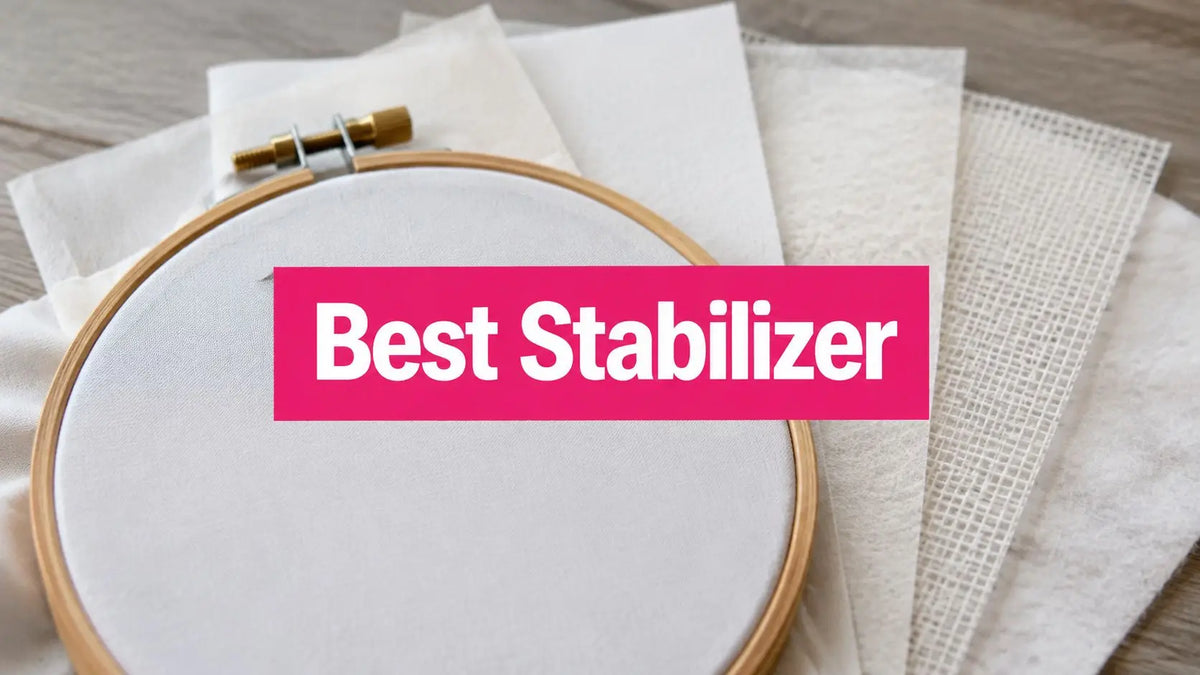
You've just stitched a design onto a T-shirt, towel, or jacket, and the result looks fine until you remove the hoop. Then the lettering puckers, the fabric tunnels, or the first wash exposes every weakness in your setup. The best stabilizer for embroidery isn't a universal roll. It's the backing matched to your project's fabric, stitch count, density, and finished-use demands.
My direct recommendation is simple. Use cutaway for stretchy garments and dense designs, tear-away for stable woven goods and lighter projects, and wash-away for lace, sheers, pile fabrics, and freestanding work. For a beginner's working kit, I'd stock a 2.5 oz cutaway, a medium tear-away, a lightweight wash-away, and a water-soluble topper. That combination handles most real embroidery projects without filling your cabinet with products you rarely use.
Why Stabilizer Choice Makes or Breaks Embroidery
The most expensive stabilizer mistake is grabbing whatever cutaway is closest to the hoop and calling the job ready. That shortcut can leave lettering puckered on knits, tunneling across towels, and designs that lose registration after laundering. Stabilizer is not packaging material. It's the foundation that absorbs needle penetration and controls fabric movement while your machine builds the design.
The traditional framework has three primary families: cutaway, tear-away, and wash-away. Cutaway remains beneath the design, tear-away is removed after stitching, and wash-away dissolves in water. Brother also identifies self-adhesive as an additional stabilizer type, which is useful when hooping would mark, distort, or damage the project surface. Brother's stabilizer guidance summarizes these removal-based categories clearly.
Stabilizer is part of quality control
Fabric structure comes first. Stretchy or loosely woven material needs permanent support, while stable woven goods can often release their backing after stitching. The Stabilizer and Backing Guide describes cutaway as permanent support for knits and loosely woven fabrics, tear-away as temporary support, and wash-away for surfaces where visible residue can't remain.
Stitch count matters just as much. A small, open monogram doesn't pull fabric like a dense filled logo or a broad satin border. If the backing is too light, the needle repeatedly pushes the fabric away from the design center. That creates puckering, distortion, stitch misalignment, and wasted setup time.
Shop-floor rule: Choose stabilizer by project first, then confirm the weight by stitch count. Brand loyalty comes after the fabric and design have passed a test stitch-out.
The cost of a mismatch isn't limited to one failed sample. You can lose thread, garment blanks, hooping time, and customer confidence. For production work, the correct stabilizer protects repeatability. For home embroidery, it protects the project you already spent time preparing.
The Six Main Stabilizer Types Explained
Each stabilizer has a job. Treating them as interchangeable consumables is how embroidery problems begin.

Tear-away for stable, lighter projects
Tear-away is the practical choice for woven cotton, canvas crafts, some towel applications, and designs under 5,000 stitches, following the stitch-count benchmark in the MaggieFrame stabilizer guide. You stitch through it, then remove the excess by tearing carefully along the design.
It's fast and comfortable for items where permanent backing isn't needed. Use too little support under a dense logo, though, and the fabric can draw inward. A light tear-away that works beautifully for a small monogram may fail on a broad fill design.
Cutaway for knits and permanent support
Cutaway remains in place after stitching, so it's my first choice for T-shirts, sweatshirts, baby garments, denim with a dense design, and frequently washed clothing. Expert guidance identifies it as the most stable major backing because it supports the design for the life of the garment. This cutaway stabilizer reference also ties it to stretchy and repeatedly laundered items.
For dense garments, I commonly reach for 2.5 oz cutaway. A lighter cutaway may be enough for a small chest monogram, but a full-front design needs more control. The wrong cutaway can still feel stiff, show through thin fabric, or leave an uncomfortable edge, so trim close without cutting into the embroidery.
Wash-away and water-soluble products
Wash-away stabilizer dissolves in water and is useful when no backing should remain visible. That makes it valuable for freestanding lace, sheer fabric, delicate work, and specialty designs. AllStitch's water-soluble stabilizer information specifically connects dissolving stabilizer with lace, delicate fabrics, and freestanding designs.
A water-soluble topper serves a different purpose. Place it over towels, velvet, fleece, or another pile surface to keep loops from swallowing the stitches. The backing supports the fabric from below, while the topper keeps the thread sitting visibly on top.
Fusible and adhesive options
Fusible stabilizer bonds to the project with heat and helps control items that are awkward to hoop, such as collars, cuffs, narrow pockets, and small appliqué areas. Sticky-back or self-adhesive stabilizer works well for hoopless applications or surfaces that shouldn't be clamped tightly.
These products aren't magic substitutes for proper tensioning. Smooth the fabric onto the adhesive without stretching it, and check the bobbin casing and needle path before stitching.
No-show mesh, Polymesh, and Heat-Away
No-show mesh, often sold as Polymesh, is my preferred backing for soft knits, performance wear, baby garments, and dark garments where a bulky white backing would be distracting. It offers permanent support with a softer hand and a cleaner garment interior.
Heat-Away products are specialty choices for projects where water isn't practical or where a temporary support needs heat removal. They can be useful for selected appliqué and performance applications, but test them first because the fabric's heat tolerance determines whether the method is appropriate.
One unrelated but useful hand-stitching option in a wool project is #Charms11 July, which contains 11 hand-dyed, felted wool charms packaged in a clear box with a laser engraved keepsake.
Stabilizer Comparison at a Glance
The table below gives you the quick decision I use at the shop counter. “Typical weight” is a working range, not a substitute for a test stitch-out.
| Stabilizer Type | Best Fabric Match | Removal Method | Wash Durability | Typical Weight | Best Project |
|---|---|---|---|---|---|
| Tear-away | Stable woven cotton, light canvas, selected towels, designs under 5,000 stitches | Tear away after stitching | Temporary, suitable when the fabric remains stable | 1.5 to 2.0 oz | Small monograms and stable craft goods |
| Cutaway | Stretch knits, T-shirts, polos, sweatshirts, loosely woven fabrics | Trim excess, leave support in place | Permanent, strongest choice for repeated wear and washing | 2.0 to 3.0 oz | Garments and dense designs |
| Wash-away | Sheers, lace bases, delicate surfaces | Dissolve in water | Disappears after washing | Light to medium | Freestanding lace and delicate embroidery |
| Water-soluble topper | Towels, fleece, velvet, terry, pile knits | Dissolve or remove after stitching | Topper is temporary, backing provides support | Film weight varies by product | Preventing stitches from sinking into loops |
| Fusible adhesive | Collars, cuffs, narrow pockets, hard-to-hoop items | Fuse during application, then trim or remove as product allows | Depends on the stabilizer construction | Light to medium | Small areas where hooping is impractical |
| No-show mesh | Performance wear, dark knits, baby garments, soft T-shirts | Trim close, leave support in place | Permanent, with a softer garment hand | Light to medium | Clean-backed knit garments |
Default to cutaway for knits, tear-away for stable wovens, wash-away for sheers and lace, and a water-soluble topper for towels and pile. Choose fusible or adhesive when the hoop itself is the problem, not because the fabric has stopped needing support.
The project-specific recommendations below turn that chart into actual hooping decisions.
Matching Stabilizer Weight to Stitch Count
Stitch count is the fastest way to catch an under-supported design. The University of Illinois stabilizer tutorial explains the broader principle: stabilizer strength should rise with fabric instability and embroidery density. A technical guide also describes stabilizer weights from about 20–30 g/m² for very light work through 60–80 g/m² for very heavy, dense embroidery, showing how support scales with design complexity.
Use your embroidery software to check the stitch count before you pull a roll from the shelf.
| Stitch Count | Recommended Weight | Stabilizer Type | Best Fabric |
|---|---|---|---|
| Under 5,000 | Lightweight, about 1.5 to 2.0 oz | Tear-away for stable fabric, light cutaway for knits | Woven cotton, light monograms, small knit lettering |
| 5,000 to 10,000 | Medium, about 2.0 to 2.5 oz | Medium cutaway or heavy tear-away | T-shirts, polos, towels, fleece, medium logos |
| 10,000 to 15,000 | Heavy, about 2.5 to 3.0 oz | Heavy cutaway or no-show mesh | Full-chest knits, dense lettering, denim |
| Over 15,000 | Heavy support, with an additional increment for every 5,000 stitches | Heavy cutaway, specialty mesh when appropriate | Dense fills, large-format designs, performance garments |
The stitch-count rule from SPSASG's stabilizer training guide recommends increasing stabilizer strength as density rises, with light, medium, and heavy support aligned to the 5,000, 10,000, and 15,000 stitch thresholds.
A dense satin border can behave like a much larger design even when the file's overall footprint looks small. Treat heavy satin columns and filled lettering as high-density work, not as a small monogram.
Pro Tip: Any design over 10,000 stitches on a knit needs cutaway, regardless of whether the finished design looks compact. A 1.8 oz tear-away that handles a 3,000-stitch monogram can pucker badly under an 8,000-stitch logo.
Leave 1 to 2 inches of excess stabilizer beyond the hoop to reduce edge pull and hoop-related distortion, as recommended in the MaggieFrame stitch-count guide. The extra margin gives the hoop and fabric a more stable working field.
Best Stabilizer by Project and Fabric
Fabric charts are useful, but project callouts are better. I'd choose backing differently for a small towel monogram than for a full-chest performance logo, even if both projects use similar thread.
Towels
Use medium cutaway around 2.5 oz beneath the towel, then add a water-soluble topper over the terry surface. The backing controls the towel body, while the topper stops loops from rising through the stitches and hiding detail.
For a small name, a medium tear-away may work on a stable towel, but don't make it your default for dense lettering. Test the loop height and the design's fill areas before committing.
Fleece
Choose medium cutaway or no-show mesh. I won't use tear-away as my first choice on fleece because the fabric can stretch and shift during hooping and stitching. If the fleece distorts in the hoop, a fusible option can hold the surface more evenly.
A topper is helpful when the fleece has a high nap or when small lettering needs crisp edges.
T-shirts and polos
For light knits, start with 2.0 oz cutaway. Upgrade to 2.5 oz for full-chest designs over 8,000 stitches, using the project benchmark described in the Embroidery Legacy stabilizer guide.
No-show mesh is the better comfort choice for soft garments and performance fabrics. It reduces bulk against the wearer while preserving permanent support.
Denim and canvas
Use medium-heavy cutaway from 2.5 to 3.0 oz for dense embroidery. Denim and canvas usually provide a stable surface, so a topper isn't normally needed unless the design crosses a raised or textured area.
For a graduation stole or similarly narrow, structured item, review this graduation stole embroidery near me guide before hooping. Narrow projects often benefit from adhesive or fusible handling because the available hooping area is limited.
Baby garments and onesies
Pick no-show mesh cutaway for a softer interior. Trim the excess closely and cover the remaining backing with a soft garment cover when the wearer will have direct skin contact.
Lace and sheers
Use wash-away or water-soluble stabilizer as the backing, topper, or both, depending on the design. Dissolve the material completely when the project calls for a clean, unsupported result.
Faux leather and vinyl
Use tear-away with temporary adhesive spray, then add a water-soluble topper when the surface needs protection from needle drag or the stitches need a cleaner outline. Cutaway is a poor choice here because permanent backing can show through or remain trapped against the coated surface.
How to Test Stabilizers Before You Commit
Never load a full garment run or buy a large roll before testing an unfamiliar combination. My preferred method takes only a few minutes per sample and exposes most backing problems before they become expensive.
- Hoop two layers of the project fabric. Add the candidate stabilizer exactly as you plan to use it. Don't stretch the fabric to make a difficult combination look better.
- Stitch a 2-inch test square. Include a satin column, a fill area, and a running-stitch line. These three structures stress the backing in different ways and reveal more than a simple outline.
-
Inspect four failure points.
- Satin edges: Look for puckering or a raised ridge.
- Fabric grain: Check whether the weave has shifted or pulled off square.
- Fill areas: Watch for push-pull distortion, tunneling, or gaps.
- Removal: Tear the tear-away, or dissolve the wash-away, and inspect the remaining surface.

Grade the sample pass, marginal, or fail. A pass has flat stitches and no visible grain shift. Marginal means the stabilizer held but left residue, minor ripple, or an uncomfortable hand. Step up one weight tier before the full project. Fail means the design tunnels, the fabric draws up, or registration moves. Change the stabilizer type, not just the thread tension.
Use scraps from the actual garment or fabric whenever possible. A generic cotton sample won't tell you how a moisture-wicking knit, towel loop, or faux leather surface will behave.
Keep notes in a project log. Record the fabric, needle, thread, stabilizer, design stitch count, hoop tension, and bobbin casing setting. That record turns a failed test into useful production knowledge instead of wasted material.
Stabilizer Cost, Weight, and Roll Size Compared
The cheapest roll isn't automatically the lowest-cost choice. A backing that fails under a dense design can waste the fabric, thread, and time already invested in the project. Compare the stabilizer's weight, width, yardage, and intended project before judging the price.
The following working quantities are practical buying references, not universal package standards. Roll formats vary by manufacturer, so check the product label before calculating your yield.
| Stabilizer Type | Typical Weight | Common Roll Size | Avg. Price Range | Best Value Use |
|---|---|---|---|---|
| Tear-away | 1.5 to 2.0 oz | 12-inch rolls and bolts | Varies by product | Small monograms and stable woven crafts |
| Cutaway | 2.0 to 3.0 oz | 20-inch rolls and bolts | Varies by product | Garments and dense embroidery |
| No-show mesh | Light to medium | Garment-width rolls | Varies by product | Performance wear and soft knits |
| Wash-away | Light to medium | Narrow and standard rolls | Varies by product | Lace, sheers, and freestanding work |
| Water-soluble topper | Film weight varies | Narrow topper rolls | Varies by product | Towels, velvet, fleece, and pile |
| Fusible adhesive | Light to medium | Craft and garment widths | Varies by product | Collars, cuffs, pockets, and hard-to-hoop areas |
A 20-inch by 10-yard cutaway roll yields roughly 45 standard 4-by-4 hooping backings, while a 12-inch tear-away bolt of the same length covers nearly double that amount, according to the purchase-planning benchmark in the provided guidance. Those yields depend on cutting layout and excess margin, so keep the extra stabilizer around the hoop in your calculation.
Economy rolls from brands such as OESD and Floriani are sensible for everyday projects when the weight and removal method match the fabric. Premium no-show mesh earns its place on high-stitch-count performance garments, dark knits, and luxury pieces where softness and a clean back matter more than the lowest per-yard cost.
Buy sample packs for unfamiliar fabrics or specialty films. Buy bulk only after your test swatches show a repeatable result.
Starter Stabilizer Kit and Where to Buy
My McKinney shop-counter kit is deliberately small. Beginners don't need every adhesive, mesh, film, and specialty backing on the market. They need the right materials for the projects they plan to stitch.
Start with these four products:
- 2.5 oz cutaway roll: Use it for T-shirts, polos, sweatshirts, baby garments, and dense knit designs.
- Medium tear-away roll: Keep it for stable woven cotton, light canvas, small monograms, and removable support.
- Lightweight wash-away roll: Reserve it for lace, freestanding lace, sheers, and projects where no backing should remain.
- Water-soluble topping film: Add it for towels, velvet, fleece, and other pile surfaces where stitches can sink.
For a beginner, I'd choose manageable rolls rather than the largest available bolt. A 10-yard roll gives you enough material to test several projects without overcommitting, while a larger roll makes sense after you know which backing your machine, hoop size, needle, bobbin casing, and preferred designs consistently require.
Keep each roll labeled. Write the stabilizer type, weight, and intended project on the package, then store scraps by category. A labeled scrap bin can save a surprising amount of waste when you need a quick placement or tensioning sample.
Browse the Linda's stabilizer category when you're ready to stock the hoop room, then match your purchase to a real project. Pick the three core backings, finish a test swatch, and start stitching today.
Linda's Electric Quilters offers embroidery, quilting, sewing, and craft supplies through its online store, along with educational resources and live shopping content. Visit Linda's Electric Quilters to choose the stabilizer and topper for your next garment, towel, lace, or dense-logo project.