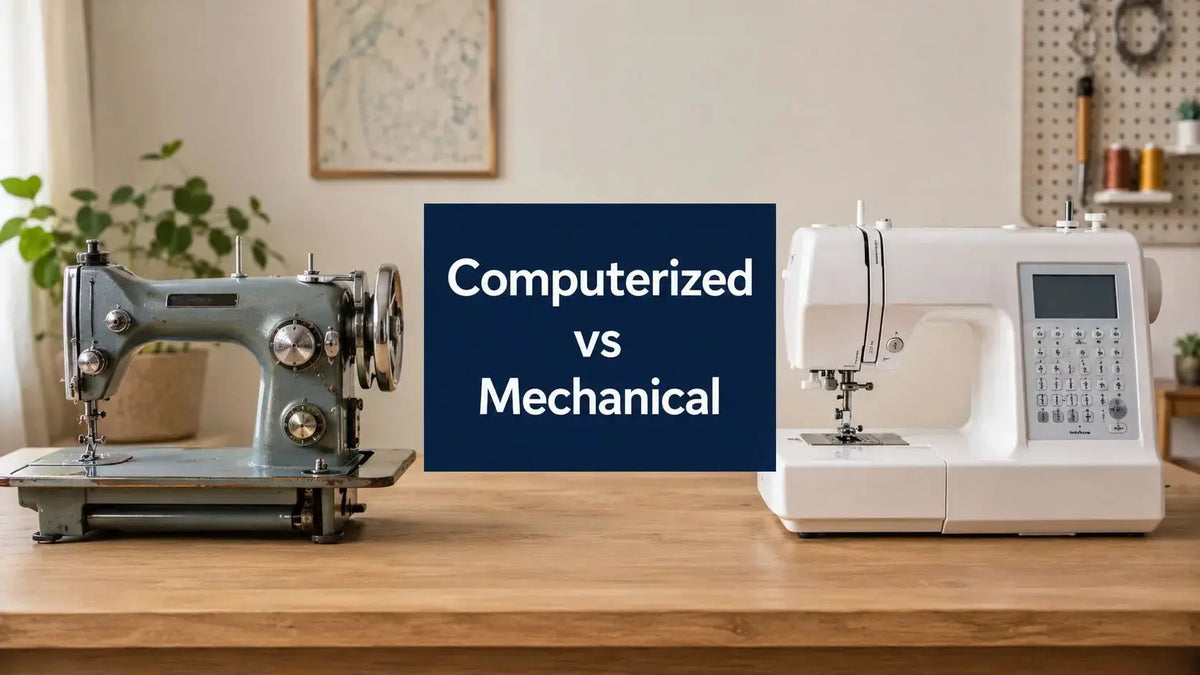
You're standing in front of a quilt top that needs to move fast, or maybe a decorative project that needs cleaner stitch control than your current setup can give. That's usually the moment the computerized vs mechanical sewing machines decision gets real. The short answer is simple, mechanical machines win for straightforward piecing and lower-maintenance ownership, while computerized machines win when workflow, stitch variety, and automation change how you sew.
| Feature | Mechanical Machines | Computerized Machines |
|---|---|---|
| Stitch range | About 10 to 30 built-in stitches | About 50 to 500+ stitches, with some advanced models exceeding 600 |
| Control style | Manual dials and levers | Microprocessors, LCD screens, memory functions |
| Automation | User handles threading, needle position, and more | Often adds automatic threading, needle up/down, speed limiting, and buttonhole automation |
| Maintenance | Simpler construction, easier to repair | More electronic complexity, which can mean harder servicing |
| Best value | Piecing, basic construction, long-term simplicity | Decorative work, mixed-technique quilting, convenience |

Choosing Between Computerized and Mechanical Sewing Machines
A quilter usually starts this decision with a project in hand, not a theory. Maybe it's a queen-sized patchwork top, maybe it's dense appliqué, maybe it's a stack of blocks that all need to match cleanly. The right answer isn't “computerized” or “mechanical” in the abstract, it's which machine gives you the best return for the fabric work you do.
Start with the job, not the spec sheet
For piecing, a good machine of either type can make a clean seam if it's maintained and threaded correctly. The difference shows up when the work gets repetitive, the seams get long, or the project demands repeatable settings without constant hand adjustment. That's where computerized control starts earning its keep, especially on quilts with lots of matching units or finish work that has to stay consistent from edge to edge.
A mechanical machine still makes sense when you want direct control, fewer parts to think about, and a machine that doesn't depend on a digital interface to do the basics. That matters if you're buying for longevity, want a machine that feels straightforward under your hands, or prefer a setup you can troubleshoot without navigating menus.
Practical rule: Buy for the seams you sew most often, not for the feature you think you'll use someday.
If you're comparing options at Linda's, it helps to line up the machine against the project itself, then compare that with consumables you already know you'll use, like batting or thread. A pattern like #1 Fan is a good example of a quilt that can be pieced in multiple sizes and finished with strip piecing or appliqué, which immediately raises the question of whether automation will help your actual workflow or just look impressive on paper.
For shoppers who like to see a machine in context, a short live demo video is worth more than a feature list. A quick clip of threading, stitching, and changing settings will tell you more about comfort and speed than a marketing paragraph ever will.
Core Differences Between Machine Types
The technology gap between these machines is bigger than the names suggest. Practical lockstitch machines were patented in 1846 by Elias Howe, Singer introduced the first practical electric sewing machine in 1889, and Brother brought programmable computerized sewing machines to market in 1978. That long progression, about 132 years, marks the move from purely mechanical control to microprocessor-based automation, with computerized machines adding stitch memory, automatic threading, and programmed patterns that old dial-and-lever machines can't do. Source
What changes under the hood
Mechanical machines rely on physical controls, so stitch length, width, and tension are adjusted by hand. That direct setup feels familiar to many sewists because it's immediate, visible, and easy to understand. There's less hidden complexity, which is part of why a mechanical machine often feels more approachable.
Computerized machines use microprocessors, LCD screens, and memory functions to manage stitch selection and stitch behavior. The result is more automation and finer repeatability, especially when you need the same setting over and over across a large project. The trade-off is that once electronics enter the picture, repair and service tend to get more specialized.
Mechanical machines are simpler to maintain because they have fewer electronic components, while computerized machines add convenience and precision but also electronic complexity. Some mechanical machines can also be treadle- or hand-crank-powered, while computerized machines are electric-only. Source
That electricity dependence matters more than people expect. If you sew in a space where power interruptions happen, or you want a machine that can keep working without a wall plug, the mechanical side has a real advantage. If you're sewing in a dedicated studio with stable power and you value automation more than backup flexibility, computerized control starts to look more practical.

Stitch Variety and Automation Features
Stitch count gets too much attention, but it still tells you something useful. A typical mechanical machine offers roughly 10 to 30 built-in stitches, while computerized machines commonly range from 50 to 500+ stitches and can exceed 600 stitches on advanced models. story isn't just decoration, it's how much work the machine can take off your plate. Source
More stitches only matter when they match the task
If your quilting life is mostly straight piecing, utility seams, and basic finishing, a long stitch menu can sit unused for years. In that case, a solid mechanical machine is often the better value because it gives you what you need without paying for a library you won't touch. If you do decorative work, custom borders, heirloom details, or machine embroidery, the bigger stitch library becomes part of the tool, not just a brochure line.
Computerized models also automate tasks that mechanical machines leave to you. That includes automatic thread cutting, needle up/down control, speed limiting, programmable buttonholes, memory for custom stitch combinations, and sometimes automated tension adjustment. Those are not just convenience features, they reduce handwork and help keep each seam consistent. Source
Here's the practical difference for quilters:
- Mechanical machine: You cut threads by hand, manage needle position yourself, and make more manual adjustments as you sew.
- Computerized machine: You get more guided control, which can reduce small mistakes on repetitive work.
- Decorative sewing: Computerized wins when stitch variety is part of the design.
- Structural quilting: Mechanical can be just as dependable when the goal is a clean seam and a straight line.
The useful question is not “How many stitches does it have?” It's “Which of these stitches and automation features will I use every week?” If the answer is only straight stitch, zigzag, and an occasional buttonhole, a mechanical machine keeps the workflow lean. If you want one-step buttonholes, programmable stitch sequences, and faster pattern changes, computerized features start paying for themselves in saved steps.
| Feature | Mechanical Machines | Computerized Machines |
|---|---|---|
| Stitch range | 10 to 30 built-in stitches | 50 to 500+, with advanced models above 600 |
| Thread cutting | Manual | Often automatic |
| Needle position | Manual or limited controls | Needle up/down automation is common |
| Buttonholes | User-guided or multi-step | Often one-step and programmable |
| Stitch memory | Not typical | Common on many models |
| Repair profile | Simpler, fewer electronics | More complex, may need specialized service |
Performance for Quilting Projects
A quilt can expose the weak spots in a machine fast. Piecing needs accuracy, free-motion quilting needs control, and decorative work needs the same stitch to land in the same place again and again. One machine may do one of those jobs very well and feel merely average on the others, so the better choice depends on which quilting task gets done most in your sewing room.
Piecing and seam construction
Straight-stitch quality can be close on both machine types if they are in the same build class. The difference shows up during long piecing sessions, where a mechanical machine can drift if you do not check settings as you go. Computerized control gives steadier repeatability in stitch length and width, which matters when you are chain-piecing blocks or building a large quilt and every small mismatch becomes visible.
Free-motion quilting and finish work
Mechanical machines often give better tactile feedback, and experienced free-motion quilters tend to value that because they can feel the quilt sandwich moving under the needle. Computerized machines can still handle free-motion work, especially when they offer speed limiting and needle stop position, but some sewists feel less connected to the fabric. That is not a flaw in either machine type, it is a difference in how the work feels in practice.
Decorative and specialty quilting
Computerized machines pull ahead here. Programmable stitch patterns, buttonhole automation, and memory features help with appliqué, decorative topstitching, and repeat motifs that need to look identical across a project. If you are making something like #1 Fan, where star and square elements can be customized with strip piecing or appliqué, the machine you choose can change how smoothly the decorative parts of the project move along.
Pro-Tip: For large quilts, test the machine with the actual quilt sandwich, not just cotton yardage. Batting drag, throat clearance, and stitch consistency matter more than a showroom sample.
Our team in McKinney, Texas, has serviced both types extensively, and the pattern is clear. Mechanical machines usually need less electronic servicing and keep doing standard quilting work with less fuss, while computerized machines do better when the project calls for more guidance and repeatable automation. If you want to see a machine in action, a short video tutorial beside a live shopping clip will show how the feed dogs, bobbin casing, and stitch controls behave under real pressure.

Who Should Choose Which Machine Type
The best machine depends on your role, your project mix, and how much automation you want in the middle of a sewing session. A person piecing bed quilts every week does not need the same machine as someone stitching decorative hems or embroidered gifts. The mistake is assuming that more technology automatically equals better sewing.
Match the machine to the sewer
Longarm quilting professionals usually get the most value from mechanical machines for piecing and construction work because they're easier to repair, simpler to maintain, and less likely to create downtime from electronics. If your day is built around dependable seam work, that reliability matters more than a long stitch menu.
Machine embroidery hobbyists are the clearest fit for computerized machines. They benefit directly from stitch libraries, memory functions, thread management, and programmable designs. For decorative work, the machine is part of the design process, not just a sewing tool.
Modern quilt makers who blend piecing, appliqué, and decorative finishing often land on computerized machines because speed control, needle stop position, and repeatable stitch functions smooth out mixed-technique projects. That's where the ROI shows up, not in the raw stitch count alone.
Beginners often do best with mechanical machines because the learning curve is clearer. Manual dials teach tension, stitch length, and speed control in a way that makes the fundamentals obvious. That matters when the goal is confidence, not feature overload.
A good way to decide is to ask one question. Which part of sewing causes the most friction right now, manual control or repetitive tasks? If the answer is control, a mechanical machine may feel better. If the answer is time, consistency, or decorative options, computerized features are likely worth the extra complexity.

Cost, Maintenance, and Buying Guidance
The purchase decision is about total ownership, not just the sticker price. Mechanical machines usually cost less up front and tend to be easier to maintain, because the design is simpler and repair technicians can often service them more easily. Computerized machines usually cost more at purchase and can bring higher repair complexity because the electronics and software-driven components need more specialized care. Source
Think in terms of downtime, not just dollars
If you sew often and need a machine that keeps moving with minimal interruption, a mechanical model can be the safer long-term bet. It's also the better choice for sewists who want a machine that can be kept running for decades with basic cleaning, oiling, and needle replacement. That kind of ownership style fits people who value repair access and straightforward service.
Computerized machines earn their keep when automation saves real time on real projects. If you regularly use one-step buttonholes, memory stitches, or automatic thread cutting, those features can reduce the number of small tasks that break your rhythm. If you only use them occasionally, the extra cost may not be worth it.
A practical buying filter looks like this:
- Choose mechanical if you want simplicity, lower maintenance, and strong value for piecing and basic construction.
- Choose computerized if you need decorative variety, guided automation, or more precise repeatability on mixed projects.
- Choose based on service access if you plan to keep the machine for a long time and want easy repair options.
- Choose based on power dependence if off-grid use or backup flexibility matters to you.
Linda's Electric Quilters carries sewing and quilting solutions that can support either path, including machine-friendly project supplies, batting, and tools that help you finish the work cleanly. If you're shopping for a setup that matches your quilting style, the right machine plus the right materials will always outperform a flashy feature list.

Frequently Asked Questions
Do mechanical sewing machines make worse stitches than computerized ones?
No. Stitch quality depends more on the machine's class, setup, and maintenance than on whether it is mechanical or computerized. For quilting, a well-tuned mechanical machine can produce clean straight seams and consistent stitches, especially on piecing work where steady control matters more than automated extras.
Are computerized machines harder to repair?
Usually, yes. They have more electronic parts, so repairs may require more specialized service and can take longer than a simpler mechanical machine. For a quilter who plans to keep the machine for years, that difference matters because service access affects long-term value as much as the feature set does.
Can a computerized machine work during a power outage?
No. Computerized machines depend on electricity. Some mechanical machines can be used with treadle or hand-crank setups, which gives them more flexibility if power is unavailable or if you want a backup option for basic sewing.
Should a beginner buy computerized features right away?
Only if those features match the projects you plan to sew. Many beginners learn faster on mechanical machines because the controls are simpler and the stitch behavior is easier to understand. If your first projects are mostly piecing and basic construction, a straightforward machine often gives better value than paying for automation you will not use much.
What matters most for quilting, stitch count or automation?
Automation often matters more. For many quilters, features like speed control, needle up/down, and automatic thread cutting save more time than a larger stitch library. Those functions matter most on real projects because they reduce small interruptions during piecing, help with free-motion quilting control, and make decorative finishing faster when you use those stitches often.
Which type gives better value for decorative quilting work?
Computerized machines usually return more value here because decorative stitches, memory settings, and repeatable patterns are part of the work itself. If you only want a few accent stitches, a mechanical machine can still handle them with a smaller investment. If you use decorative finishes on borders, bindings, or sampler quilts, computerized features tend to earn their keep more quickly.
Which type is better for free-motion quilting?
The answer depends on how you quilt. A mechanical machine can be a strong choice if it offers a smooth feed system, good needle penetration, and simple speed control. A computerized machine makes sense when you want features like needle up/down, adjustable speed, or saved settings that reduce the little adjustments that interrupt quilting flow. The best fit is the machine that keeps the quilt moving without forcing you to stop and reset often.