

You're halfway through a beautiful curtain panel when the lining aisle creates a new problem. Cotton, polyester, sateen, blackout, thermal, interlining, muslin. Which drapery lining material will let the face fabric hang well, protect it from the McKinney sun, control glare, and still behave properly at the sewing machine?
The right choice depends on the window, room, face fabric, and desired hand. Lining and interlining aren't interchangeable, and heavier doesn't automatically mean warmer. This guide breaks down fiber content, weave density, loft, opacity, thermal behavior, sewing compatibility, care, and room-specific performance so you can select with confidence.
Choosing the Right Lining Without Second-Guessing
At the cutting table, start with the job rather than the bolt label. A south-facing window with a delicate printed cotton needs a different solution from a shaded guest-room window dressed with a sturdy linen blend. A media room may need glare control and density, while a living room may prioritize a soft hand and graceful drape.
The face fabric is the visible decorative layer. The lining is the supporting layer attached behind it. Interlining sits between those two layers and adds loft, body, and another air space. A blackout lining is designed for strong light reduction, while a privacy lining filters visibility without necessarily creating darkness.
Workshop rule: Choose the lining after you identify the window's solar exposure, the room's purpose, and the face fabric's care requirements.
A lining changes more than opacity. It affects the panel's weight, header construction, hem behavior, fold memory, thermal resistance, and how the fabric ages. It can also change the amount of light reflected into the room and the way upholstery appears beside the window.
For additional window-maintenance ideas, you can read our recent articles from Pine Country Window Cleaning. The practical lesson is simple: a lining is part of the finished window-treatment system, not an afterthought hidden on the back.
By the end of your selection process, you should be able to compare fiber and construction, calculate the material you need, test compatibility, and match the finished panel to the room. If you already sew quilts, think of lining as a performance layer, much like choosing batting for warmth, loft, and drape rather than choosing it by color alone.
What Drapery Lining Actually Does
Drapery lining material is a functional textile layer, not merely a decorative backing. It can create thermal resistance, moderate daylight, improve privacy, protect the face fabric from direct solar exposure, and give a panel more controlled body.
A typical layered panel contains:
- Face fabric: The visible textile that supplies color, pattern, texture, and primary hand.
- Lining: The supporting layer behind the face, selected for opacity, stability, protection, or insulation.
- Interlining: An additional middle layer that adds loft and body between face and lining.
- Blackout layer: A dense or coated lining intended to reduce incoming light substantially.
- Privacy layer: A lining that limits visibility while allowing some daylight through.
The protective role matters. A South Dakota State University study found that color failure accounted for 47 percent of all justifiable complaints, while fabric damage represented 39 percent of cases involving curtains and draperies exposed to sunlight and atmospheric conditions. The study also identified low sunlight resistance as the largest single cause of textile-damage complaints. Review the South Dakota State University study on lined and unlined drapery fabrics.
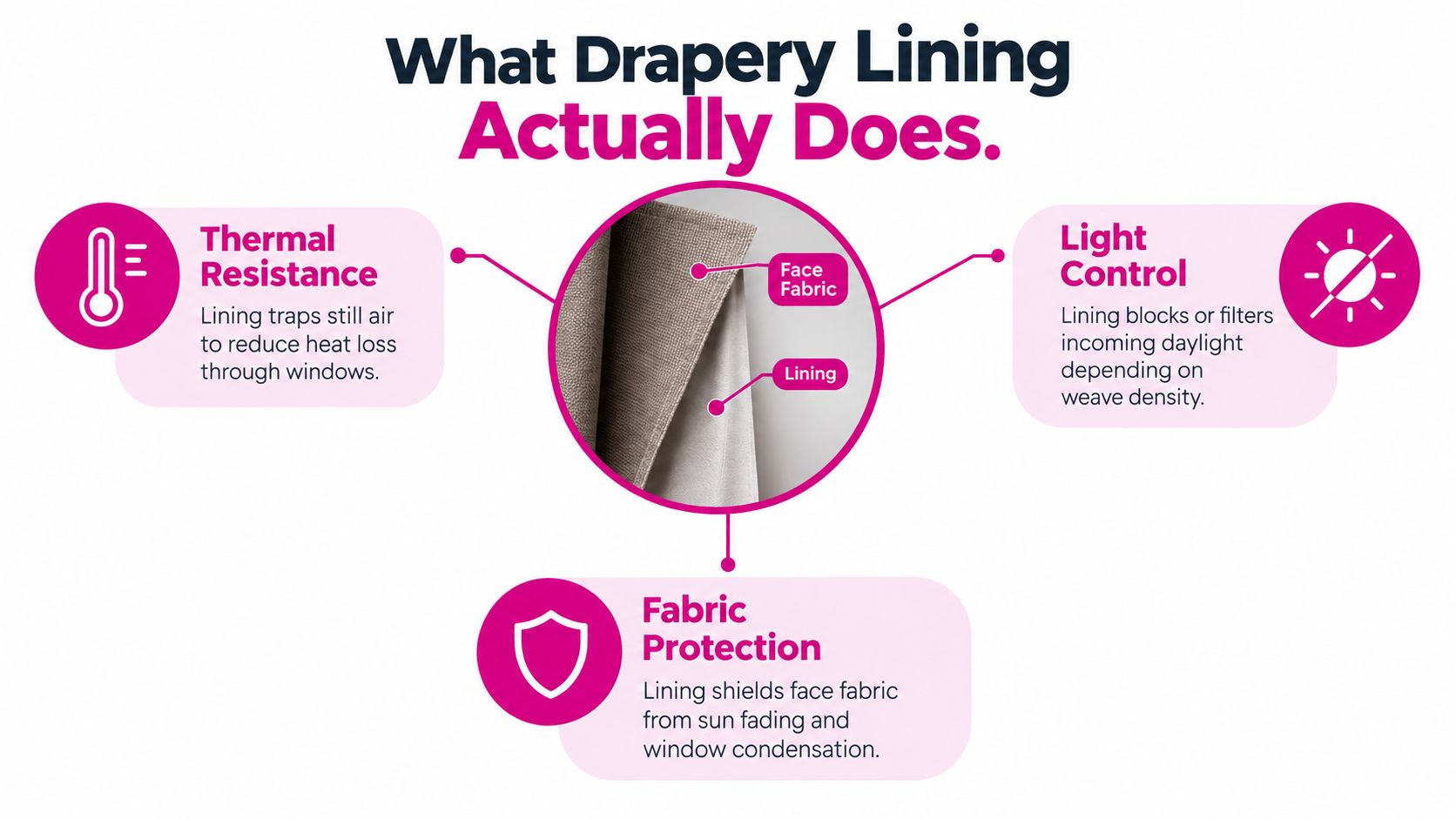
A lining doesn't make a vulnerable face fabric invincible. It does move the face layer farther from direct exposure and can reduce the amount of solar stress reaching it. That's why lining selection should account for window orientation, fiber sensitivity, and expected service life.
Light control also depends on construction. A light-colored, loosely woven face fabric behaves differently from a dense, dark textile. Layering changes the visual result, so a small swatch test near the actual window is more useful than judging the bolt under store lighting.
For ideas about matching function with room style, compare this guide to best living room window treatments. The central question remains: do you need filtering, privacy, darkness, protection, insulation, or a combination?
Fiber Choices and What They Mean for Your Project
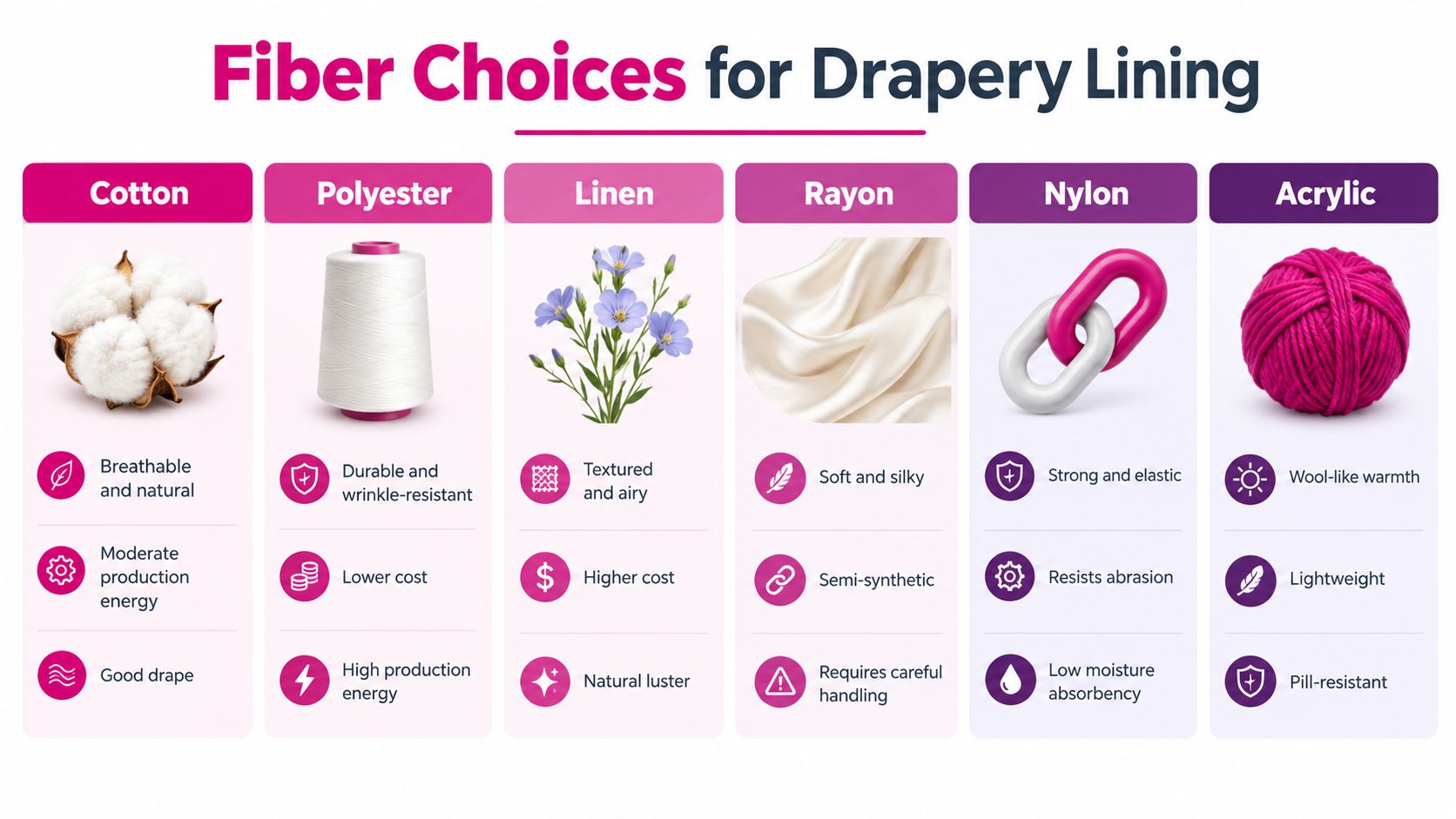
Fiber content affects hand, pressing behavior, dimensional response, and production inputs, but fiber name alone doesn't tell you how a finished lining will perform. Yarn size, weave density, surface finish, and coating can matter just as much.
A comparative textile assessment reports that producing 1 kilogram of polyester requires approximately 125 megajoules of energy, compared with 60 megajoules for cotton, 71 megajoules for rayon, 130 megajoules for nylon, 175 megajoules for acrylic, and 10 megajoules for linen. These are production-energy comparisons, not complete life-cycle scores. Review the textile energy comparison.
How each fiber behaves at the machine
Cotton has a familiar hand, presses readily, and can provide a comfortable, natural-feeling layer. It may respond to moisture differently from a synthetic face fabric, so preconditioning and care-label compatibility matter.
Polyester supports stable, tightly woven linings and generally resists wrinkling. It's often useful when you want predictable handling and durable construction, but its production-energy input is higher than cotton or linen in the cited comparison.
Linen offers a crisp, textured hand and a natural luster. Its low production-energy figure in the comparison is appealing, but its dimensional behavior and pressing needs still have to match the face fabric.
Rayon can feel soft and fluid, while nylon brings strength and abrasion resistance. Acrylic may offer a wool-like hand, but its cited production-energy input is the highest among the listed fibers.
ASTM D3691 covers woven, lace, and knitted household curtain and drapery fabrics. That performance perspective is useful because a good choice considers breaking strength, elongation, abrasion resistance, and air permeability, not only whether a fiber is natural or synthetic.
Before selecting a lining, use the same careful comparison you would apply when choosing upholstery fabrics. Look at the complete construction, then test the hand, fold, and seam response with the actual face fabric.
Seven Common Lining Types Compared
A comparison table is useful, but it can't replace a swatch test. Weight labels aren't always consistent between suppliers, and a napped surface or coating can make a lining behave differently from another textile with a similar fiber content.
| Lining Type | Weight | Opacity | Thermal Performance | Best Use |
|---|---|---|---|---|
| Cotton | Light to medium | Moderate | Moderate | Natural-feeling panels, breathable layers, traditional home décor |
| Polyester | Light to medium | Moderate to high | Moderate | Stable everyday lining, wrinkle resistance, durable construction |
| Thermal or insulating | Medium to heavy | High | High when installed with a sealed fit | Draft-prone windows, bedrooms, seasonal temperature swings |
| Interlining | Medium to heavy | Adds filtration beneath the lining | High because of added loft and air space | Fuller panels, delicate face fabrics, acoustic warmth |
| Sateen | Light to medium | Moderate | Moderate | Smooth support for silk, rayon, and other delicate fabrics |
| Flannel | Medium | Moderate to high | High because of loft | Soft body, sound absorption, cozy formal rooms |
| Muslin | Light to medium | Moderate when tightly woven | Low to moderate | Budget privacy layer, test panels, casual treatments |
How to read the trade-offs
Sateen has a smooth hand that can reduce friction against a delicate face fabric. That polished surface is useful when you want the face textile to slide and fold without a rough supporting layer catching at the back.
Flannel-backed interlining adds loft. The raised surface can make a panel feel warmer and fuller, while the extra thickness may also soften reflected sound. It isn't the right choice for every rod or heading because the added body can increase bulk.
Tightly woven muslin can provide practical privacy without the cost or stiffness of a specialized blackout product. Its light control depends on construction, face-fabric color, and the number of layers.
An insulating lining works best as part of a complete assembly. A dense lining behind a loosely fitted panel may perform less effectively than a moderate lining installed with a close fit and well-sealed edges. Choose the tool that solves your actual problem, then confirm that the hardware and sewing plan can support it.
Sewing and Installation Considerations
Layered drapery rewards careful preparation. A face fabric and lining that look compatible on the bolt can pull against each other after pressing, hanging, cleaning, or seasonal humidity changes.
Begin by checking the manufacturer's guidance for both fabrics. Precondition or preshrink compatible materials when permitted, then test a small layered sample. Watch for puckering at the seam, rippling along the selvedge, coating damage under the iron, and a difference in recovery after the sample hangs.
Build the panel from the bottom up
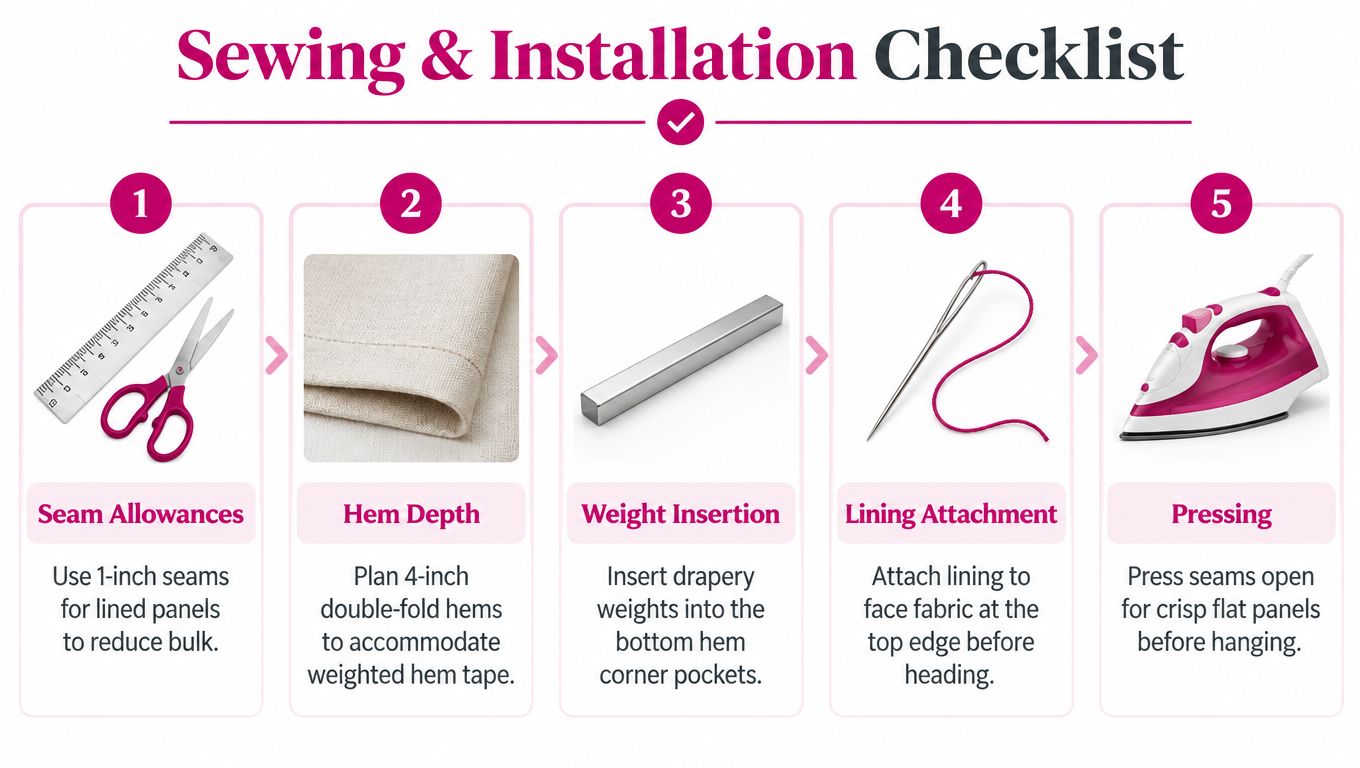
A generous hem gives a lined panel visual stability. Plan a deep double-fold hem when the design and fabric allow it, especially if you're inserting drapery weights or weighted tape. Keep weights contained in corner pockets or purpose-built channels so they don't create sharp stress points.
At the top, account for the combined thickness of the face, lining, and any interlining. A rod pocket that works for unlined cotton may become too tight for a multilayer panel. Ring spacing, track glides, and heading tape must also support the finished weight.
For machine sewing, use a needle appropriate to the face and lining combination. Coated or blackout backings may need a sharper needle and a longer test run to avoid skipped stitches or excess drag. Use a longer stitch where the textile stack calls for it, but let the sample determine the final setting.
Pro sewing tip: Press each layer according to its own heat tolerance, then press the completed assembly with a protective cloth. Synthetic blackout surfaces can distort under heat that cotton sateen handles comfortably.
A study of 18 drapery constructions found that fiber cross-sectional shape and weft density significantly affected thermal conductivity, showing why compactness and yarn engineering matter alongside fiber identity. Read the textile study on drapery construction and thermal conductivity.
Measuring, Yardage, and Room-Specific Performance
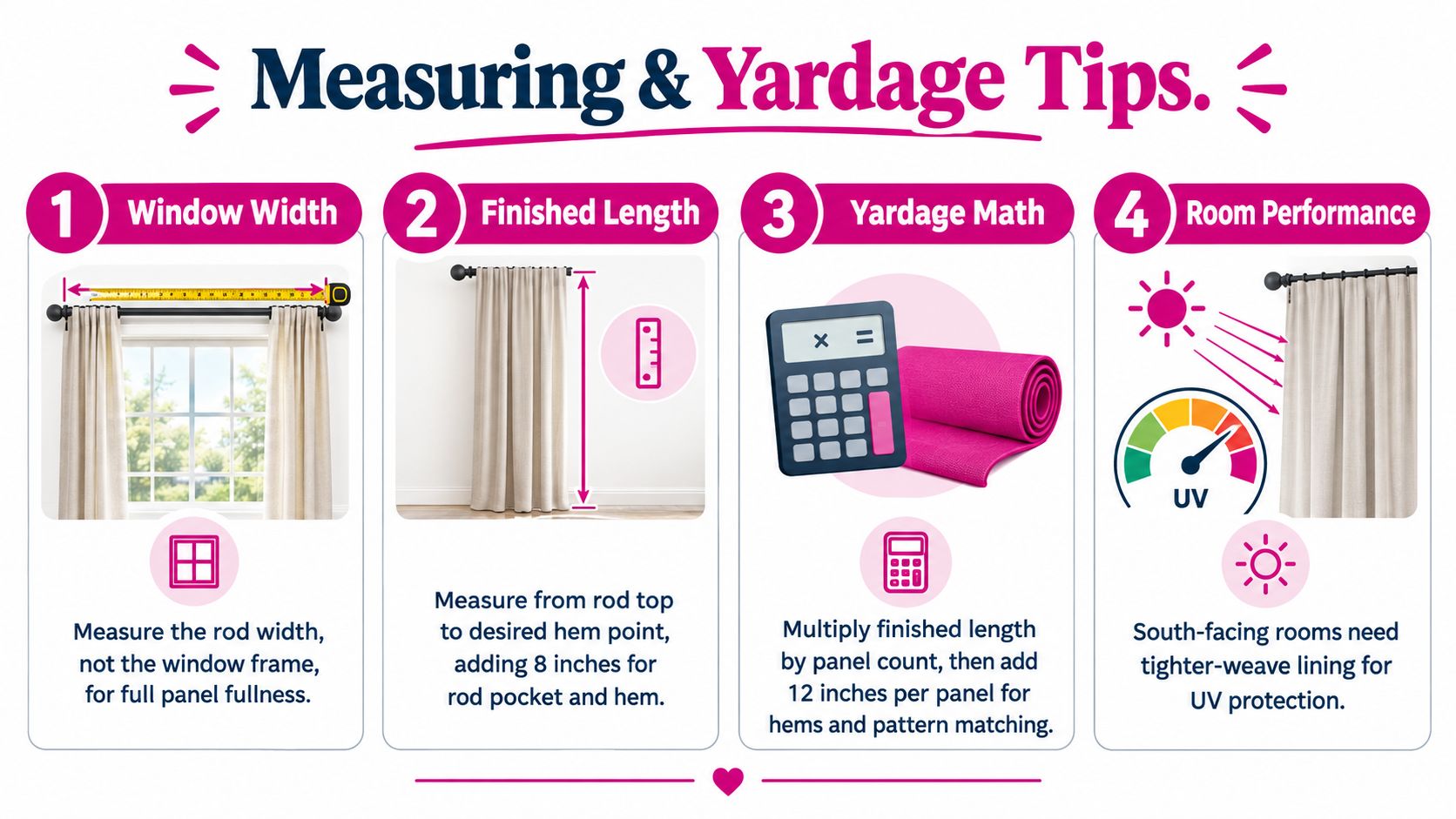
Measure the rod or track, not just the glass. Record the installed width, desired finished length, heading style, hem depth, seam allowances, pattern repeat, and whether the panels will meet at the center or return toward the wall.
Create a small worksheet before buying fabric:
- Record the finished width for each panel.
- Add fullness according to the face fabric and heading style.
- Add allowances for side hems, the top treatment, and the bottom hem.
- Account for pattern matching and usable fabric width.
- Calculate lining separately if its width differs from the face fabric.
A room's performance goal should guide the final construction. Bedrooms often benefit from strong light control and a dense supporting layer. Living rooms may need solar protection while preserving a fluid hand. Media rooms can benefit from added density and layered construction that reduces glare and helps soften reflected sound.
A properly installed lined drapery can reduce heat loss by up to 25 percent because the trapped air layer between face fabric and lining resists conductive and convective heat transfer. See Cornell Cooperative Extension's guidance on energy-saving window treatments. The installation matters as much as the material. Full closure and reduced air leakage at the top, sides, and bottom improve the assembly's usefulness.
Indoor exposure deserves a measured response. A review identifies curtains among furnishings that can release VOCs, semivolatile compounds, and particles, while the Dutch National Institute for Public Health and the Environment reports that textiles can contain substances such as flame retardants, phthalates, formaldehyde, and dimethylfumarate. Its conclusion is nuanced: the overall contribution of textile emissions to indoor-air concentrations is expected to be low, and no urgent action was identified. Ask suppliers about finishes and certifications rather than rejecting an entire fiber category.
Common Misconceptions and Troubleshooting
Heavier doesn't always mean warmer. Thickness can help, but fiber cross-sectional shape, weft density, weave, air permeability, and the number of layers all affect heat transfer. A compact, low-air-permeability lining can outperform a loosely constructed heavier textile in a poorly sealed treatment.
Blackout isn't only for bedrooms. Offices can need glare control, and media rooms may benefit from reduced daylight on screens. A blackout layer can also protect a sensitive face fabric, but its stiffness and coating may change the panel's hand.
Lining doesn't fix every construction problem. If the face and lining respond differently to moisture or cleaning, the finished panel can pucker, twist, or separate. Always compare care instructions before cutting a large project.
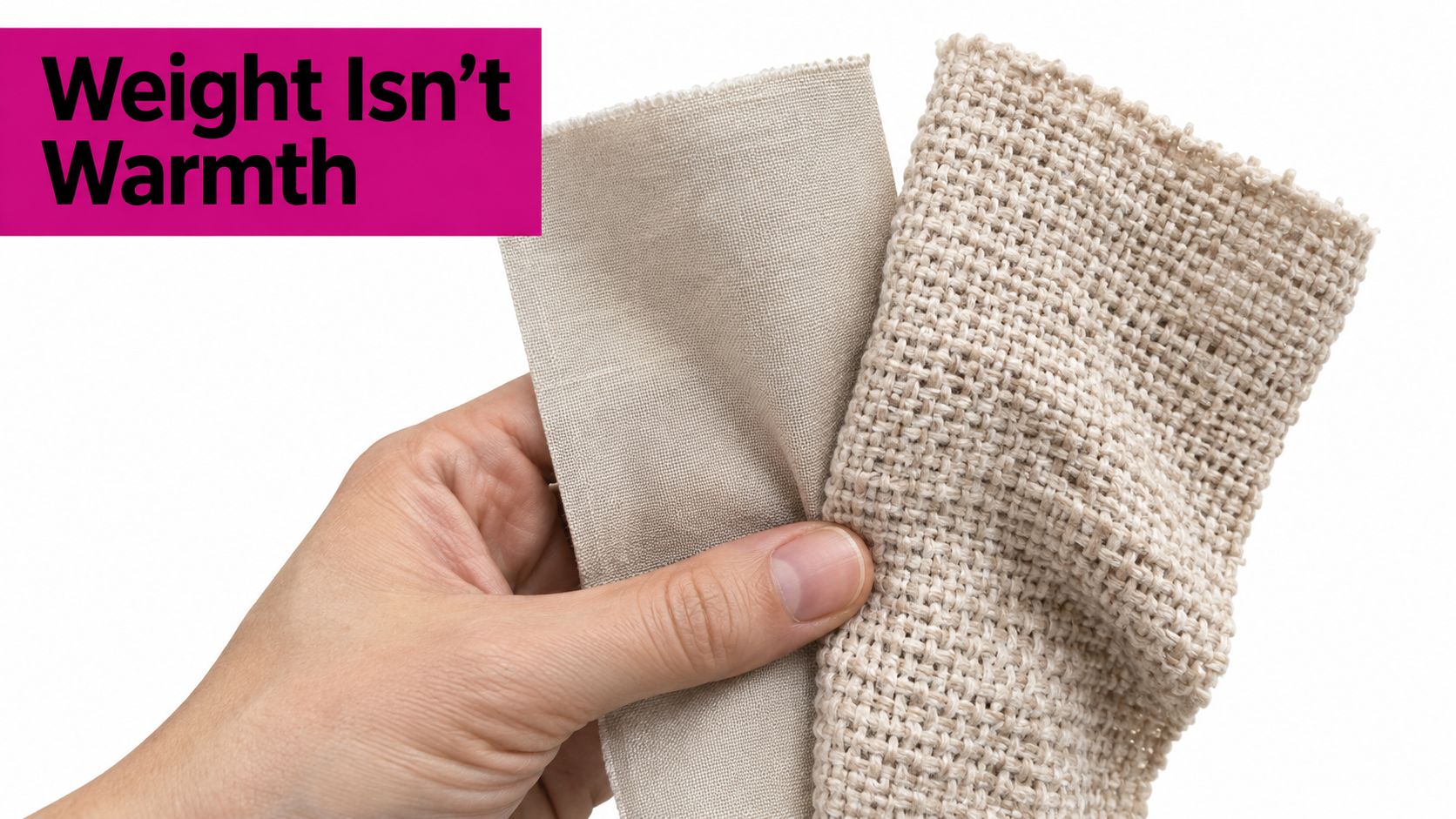
Research on curtain-fabric light transmission found that transmission is strongly affected by fabric color, followed by the number of fabric layers and prevailing sunlight conditions, with wavelength also influencing the result. Review the curtain-fabric light-transmission research%20421-425.pdf). That makes a swatch comparison more reliable than choosing by fiber name alone.
Troubleshooting common panel problems
- Puckering after cleaning: Check whether the face and lining have different dimensional responses. Professional cleaning may be required for the complete panel.
- Lining separation: Inspect attachment points, seam stress, and care history. Excess moisture or agitation can weaken the relationship between layers.
- Hem curl: Recheck pressing, fabric grain, and the tension created by the lining. A weighted hem may help, but only after the layers are behaving correctly.
- Uneven drape: Hang the panel fully, allow it to relax, and examine whether the header, lining, or side seams are pulling.
Care, Maintenance, and Shopping the Right Lining
Dust is easier to remove before it becomes embedded. Use a soft brush attachment or low-suction vacuuming on the face and lining, moving gently from the top toward the hem. Spot-clean only after checking the care label and testing an inconspicuous area.
Lined panels should not be treated like ordinary washable yardage. A published drapery-care guide states that lined draperies should be dry cleaned rather than laundered because layered materials can respond differently to moisture, heat, and agitation, causing puckering, distortion, or lining separation. Review the drapery-care instructions.
Before purchasing, ask about:
- Finish chemistry: Find out whether the lining has a flame-retardant, stain-resistant, or other applied finish.
- Care compatibility: Compare the face fabric's care label with the lining's recommended cleaning method.
- Hardware capacity: Confirm that rods, rings, tracks, and glides can carry the completed panel.
- End-of-life options: Fiber blends and coatings may make future recycling more difficult, so durability, repairability, and long service life deserve consideration.
- Sample behavior: Fold, press, stitch, and hang a layered sample before committing to the full cut.
A good shopping trip should leave you with more than a color match. Bring the face fabric or a representative swatch, note the window orientation, and compare hand, loft, opacity, and weight under realistic light. For a home-decor project, that small preparation step can prevent an expensive remake.
Linda's Electric Quilters offers project-ready fabrics, batting, lining-friendly notions, threads, and sewing supplies for home-decor makers in McKinney, Texas, with flat-rate shipping, BOGO promotions, clearance opportunities, and live shopping events. Visit Linda's Electric Quilters to choose the supporting materials that will help your drapery panels hang beautifully and perform well.


