The best embroidery designs for quilting aren't always the prettiest motifs in a catalog. They're the designs that match the quilt's visual language, construction method, and physical structure. A continuous edge-to-edge, or E2E, pattern behaves differently from a block motif, border, corner, or decorative fill. Before downloading, check hoop dimensions, file size, alignment requirements, stitch density, thread weight, batting loft, bobbin tension, and stabilizer needs.
This roundup compares seven design libraries by workflow. Kimberbell and Amelie Scott are strong choices for organized quilting systems and E2E repetition. OESD and Embroidery Library offer broad catalogs for coordinated borders, corners, fills, and blocks. Urban Threads suits modern texture, while Anita Goodesign supports block-based sampler construction. A current embroidery platform may include 338 built-in designs, 10 embroidery fonts, USB import, editing tools, a 230 x 300 mm hoop, and embroidery speeds up to 800 stitches per minute, according to Elna's Expressive 900 specifications. Your quilt sandwich still decides whether a design performs well.
Linda's Electric Quilters can help you source thread, batting, stabilizers, and quilting notions for the test sample and final project. If you're also researching commercial creative work, this guide to POD design research offers useful background on evaluating design ideas.
1. Kimberbell Background Quilting
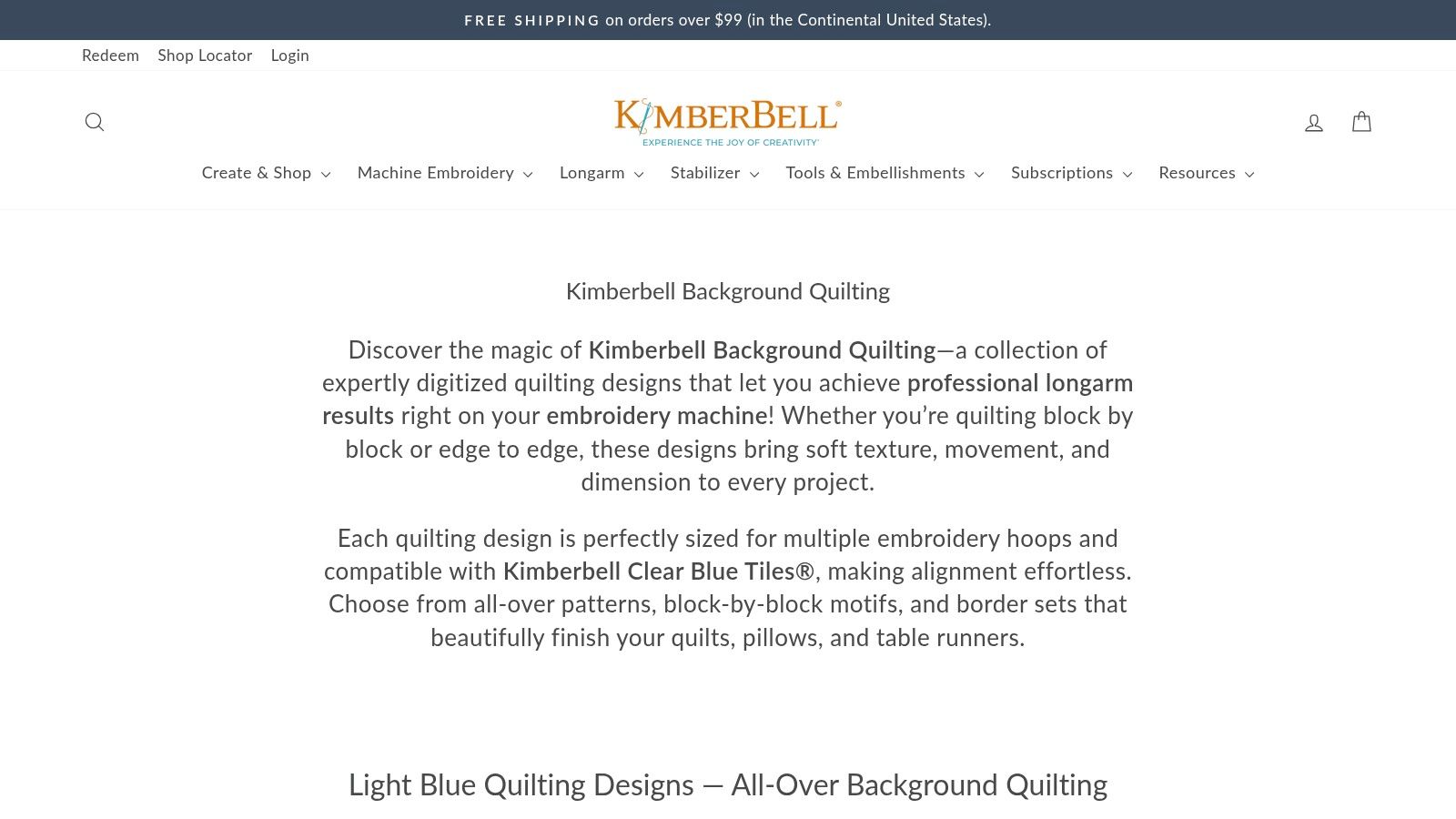
Kimberbell Background Quilting suits quilters who want a planned finishing system for a home embroidery machine. The library groups all-over, block-by-block, and border files into color-coded categories, so the search begins with the quilt's construction rather than an isolated motif.
Its designs support multiple hoop sizes and two distinct workflows. Block-by-block files treat each area like a tile placed inside a defined space. True E2E files repeat across the quilt, where accurate registration determines whether the pattern appears continuous. Compatibility with Kimberbell's Clear Blue Tiles provides a placement method for that repeated alignment.
Best use for organized background texture
Choose this library when piecing or appliqué already supplies the visual focus and the open background needs controlled texture. The categories condense the main choices into all-over, block, and border groupings, while the file's finished dimensions determine whether a motif supports the block or crowds its seam allowance.
For example, a 5-inch block with a design sized close to that area may leave too little clearance for the hooping and quilting margin. A smaller motif can preserve the piecing, though it may produce more visible gaps. Match the file to the space being quilted, not just to the machine's largest hoop.
The documentation also matters. Repeatable quilting requires consistent sizing, clear registration points, and a placement plan that survives repeated rehooping. Clear Blue Tiles can provide that structure. Without them, use measured templates, registration marks, and a written rehooping sequence.
Stitch density changes the sample result as much as motif shape. Dense quilting can flatten loft and draw the sandwich inward, while lighter linework may leave more batting texture visible. Test the actual top, batting, backing, thread, bobbin, and stabilizer before committing. Since files are sold individually, count the required blocks or repeats first, then compare the project cost with the finishing materials available through Linda's quilting batting collection.
2. OESD EmbroideryOnline
OESD's machine embroidery design library is a practical choice when one quilt needs several design roles. Its dedicated quilting technique category helps narrow a large catalog, while themed navigation makes it easier to search for floral, seasonal, geometric, and project-specific motifs.
The strength here is coordination. You can look for a border, corner, block motif, and fill that share a visual vocabulary instead of forcing one design to do every job. OESD also offers several purchasing formats, including individual designs, collections, dollar designs, and membership options, so you can test a style before building a broader library.
Where the catalog needs careful reading
Not every design listed under quilting is a true E2E file. Read the design description, inspect the stitch map, and confirm whether the file is intended for continuous repetition, a single block, a border, or an in-the-hoop project.
That distinction affects both planning and tensioning. A light linework fill may be ideal for a low-loft quilt with visible piecing, while a denser motif can provide stronger texture on a plain wholecloth surface. Dense stitching can also pull the quilt sandwich and create puckering if the hooping and stabilizer setup aren't controlled.
A useful OESD workflow looks like this:
- Start with the quilt structure: Decide whether the open spaces need a background fill, a block accent, or a continuous pattern.
- Build a coordinated set: Search for borders and corners that echo the central motif's line quality.
- Read the file notes: Confirm the intended hoop size, design dimensions, and alignment method.
- Test the thread path: Run the design on a layered sample before quilting the finished top.
OESD's broad catalog can save time when you need matching components, but the number of options can also slow selection. Keep a project folder with the file name, size, thread colors, orientation, and placement notes.
3. Amelie Scott Designs
Amelie Scott Designs focuses on downloadable E2E quilting designs for home embroidery machines. That narrow purpose is useful when your main goal is a continuous pattern across a quilt rather than appliqué blocks or decorative standalone embroidery.
Each E2E pack includes multiple sizes per design, and expansion packs are grouped by theme. The design index PDF gives you a way to review the catalog before downloading individual files, which helps you compare scale and motif character against the quilt top.
A strong fit for repeatable E2E quilting
E2E work succeeds when the repeat has clear entry and exit points. Amelie Scott's focused approach can make that concept easier to understand for hobbyists who are moving from free-motion quilting or block motifs into machine-embroidered repetition.
You'll still need accurate rehooping. Mark the design area, align the next placement with the previous stitch path, and check that the quilt sandwich remains square. A small shift can become visible across a long row, especially with geometric or tightly nested motifs.
E2E quilting rewards boring preparation. Measure, mark, and recheck before pressing the start button.
The catalog is less suited to decorative appliqué blocks, coordinated corners, or sampler construction. It's most efficient for a quilt top that calls for a consistent texture from one end to the other, such as a modern pieced quilt with open negative space.
Plan the sequence on paper first. Draw the quilt as a grid, note the hoop orientation, and mark where each repeat begins and ends. If you're building a content or promotion plan around creative products, keep your research organized with UGC creator platform resources, but keep the quilting file workflow separate from your marketing notes.
For the final setup, match the thread weight to the fabric contrast and desired texture. A tonal thread can let the piecing remain the focus, while a contrasting thread turns the E2E pattern into a visible design element.
4. Designs by JuJu End-to-End Quilting
Designs by JuJu combines a strong End-to-End Quilting™ line with in-the-hoop quilting and block designs. The E2E motifs are clearly labeled and available in multiple block sizes, which makes the library approachable for quilters who want a project-oriented path into machine embroidery quilting.
The site's tutorials and video walkthroughs are particularly useful for the first quilt. E2E quilting has a learning curve because the file may be simple to stitch but demanding to place. You'll need to understand how the first run establishes the reference point for the next hooping.
Good value for testing a quilting style
Single designs and promotional pricing make it easier to try a motif without purchasing a large collection. Seasonal releases also help when you're making a themed quilt, holiday wall hanging, or personalized gift.
The drawback is file management. Multiple hoop sizes and repeated downloads can create a crowded machine menu. Rename files consistently on your computer, preserve the original file name in a project log, and record the orientation before transferring anything by USB.
A useful setup record includes:
- Design name and size: Record the finished dimensions, not just the collection title.
- Hoop orientation: Note whether the design runs horizontally or vertically.
- Placement marks: Identify the seam, block center, or previous stitch line used for alignment.
- Thread and bobbin: Write down the top thread, bobbin thread, needle, and tension setting.
- Quilt sandwich: Record the fabric, batting loft, backing, and stabilizer used in the test.
The designs suit both modern and traditional projects, but they don't eliminate the need for sampling. A motif that looks balanced on a screen can become crowded when stitched over piecing or softened by a lofty batting.
If you're building a broader creator outreach workflow alongside your shop content, you can explore influencer outreach services. For the quilt itself, focus first on a stable hooping surface and clean alignment.
5. Embroidery Library Emblibrary
Embroidery Library is a useful source for quilters who want to assemble a coordinated design family from separate parts. Its quilting selection includes block motifs, borders, continuous-line and light-stitch fills, in-the-hoop blocks, and project tutorials.
That range supports a different workflow from a dedicated E2E system. You might choose a simple center motif for each block, a lighter fill for sashing, and a border that repeats the same botanical or geometric language without requiring every element to connect continuously.
Best for block, border, and corner coordination
The account organization tools, including The Study, can help separate purchased designs by project. That matters when a quilt uses several related files and you need to find the correct size months after the original download.
Look closely at stitch character. Some lighter-density linework designs may blend beautifully into a low-loft quilt, but they may not provide enough visual presence on a lofty sandwich or a dark, textured fabric. Conversely, a dense design can add stiffness, particularly in a small block where stitches occupy much of the available surface.
Thread finish changes the design's voice. A matte thread can make a traditional motif recede into the quilt, while a sheen can make the same outline read as decorative embellishment.
The main limitation is that the catalog isn't presented as one unified E2E system. You'll need to compare files for continuity, scale, and registration. Check whether the border's line weight complements the block motif and whether the corner file turns cleanly without a visible gap.
Use the project tutorials to understand construction, then test your chosen set on fabric that resembles the actual quilt top. Linda's educational resources, including instructional videos and live shopping events, can also help you review thread, batting, and stabilizer choices before you begin.
If you're researching promotional partnerships for a creative business, influencer gifting platform information may be relevant. It isn't a substitute for quilting documentation, so keep your technical notes focused on the actual embroidery files.
6. Urban Threads Quilting Collection
Urban Threads' quilting collection takes a more contemporary route. Its themed packs include modern and whimsical motifs such as optical illusions and mandalas, along with in-the-hoop blocks and E2E designs.
This is a strong match for a modern quilt where the quilting needs to contribute as much personality as the fabric. A simple pieced top can gain visual movement from a geometric repeat, while a solid or near-solid background can show off a mandala without competing with printed fabric.
Modern texture without overloading the quilt
Urban Threads also provides E2E alignment guides for embroidery machines. Follow the placement method carefully, especially when the design has strong symmetry. A slight shift can be more noticeable in a mandala or optical pattern than in an organic vine.
The collection includes affordable individual motifs and light-stitch options, which can be useful for testing. Start with a small sample and compare three variables:
- Density: Does the quilting create texture without making the block rigid?
- Contrast: Does the thread support the fabric palette or overpower it?
- Scale: Does the motif leave enough quiet space around seams and appliqué?
Modern quilting often benefits from restraint. Tonal stitching, abstract geometry, and open linework can preserve drape better than a heavily filled design, especially when the quilt will be washed or used regularly. The right choice depends on the quilt sandwich, not only on the trend.
Availability can vary because some designs rotate or move through discounts. Save the file documentation and preview image with your project records after purchase. For creators building a coordinated collaboration process, gifted collaboration application resources can support outreach, while the quilting decision still comes down to hoop compatibility and sample testing.
7. Anita Goodesign Quilting Collections
Anita Goodesign's quilting collections are designed for quilters who want to construct cohesive sampler quilts block by block in the embroidery hoop. The Foundations collection includes background blocks, borders, corners, and triangles in multiple sizes. Mix & Match lines help combine motifs while preserving a consistent block structure.
This approach works well when the quilt's identity comes from coordinated units rather than one repeated E2E pattern. You can build a sampler with different centers, then use matching edge pieces to make the overall layout feel intentional.
Designed for complete hoop-based construction
The benefit is consistency. When blocks share a finished size and the collection supplies related borders and corners, you may not need extra software to resize or combine every component. The hoop becomes part of the construction method, not just a place where a quilting motif is stitched.
The trade-off is the upfront commitment. A curated collection can cost more than selecting a few individual designs from another catalog, and the block-based format won't replace a dedicated E2E library when the quilt calls for continuous edge-to-edge texture.
Sampler planning starts with the finished block size. Confirm the hoop can accommodate the largest component before you choose fabric cuts or batting.
Make a paper layout before stitching. Mark the block orientation, triangle placement, border direction, and corner rotation. Then stitch one complete unit on the actual quilt sandwich, checking the bobbin casing, thread tension, needle choice, and stabilizer before producing the remaining blocks.
Anita Goodesign's education and events ecosystem can help you learn the technique, but your own sample remains the most reliable test. If you're also exploring a creator-focused gifting workflow, influencer gifting application resources can help with outreach planning. For the quilt, keep the focus on repeatable block measurements and clean assembly.
7-Brand Quilting Embroidery Comparison
| Product | Implementation Complexity 🔄 | Resource Requirements ⚡ | Expected Outcomes ⭐📊 | Ideal Use Cases 💡 | Key Advantages ⭐ |
|---|---|---|---|---|---|
| Kimberbell Background Quilting | Moderate, clear block-by-block and E2E workflows; uses Clear Blue Tiles for alignment | Medium, multiple hoop sizes; best with Kimberbell alignment tools; files sold individually (costs add up) | ⭐⭐⭐⭐, longarm-style finish; consistent sizing and repeatable workflows | Home quilters wanting longarm look, seasonal or motif-driven projects | Purpose-built quilting library, thorough documentation, tutorial videos |
| OESD (EmbroideryOnline) | Variable, large catalog with filters; learning curve to navigate techniques | Low–Medium, many price points (singles, collections, membership, dollar designs) | ⭐⭐⭐⭐, reliable stitch quality; easy to find coordinating borders/corners | Users needing a very broad selection and budget-friendly finds | Huge catalog, designer partnerships, frequent sales and support |
| Amelie Scott Designs | Low–Moderate, E2E-focused method reduces alignment guesswork | Low, instant downloads; multiple sizes per design; accurate rehooping still required | ⭐⭐⭐⭐, consistent E2E results when method and rehooping are followed | Hobbyists who want straightforward, repeatable edge-to-edge patterns | E2E-centric packs, good value, consistent sizing and design index |
| Designs by JuJu (End-to-End Quilting™) | Moderate, clear E2E line with tutorials but placement learning curve | Low–Medium, affordable singles and frequent promotions; many sizes to manage | ⭐⭐⭐⭐, effective E2E results; strong community examples | Budget-conscious quilters exploring E2E methods and seasonal projects | Affordable E2E library, video walkthroughs, active community presence |
| Embroidery Library (Emblibrary) | Moderate, deep searchable library; not a unified E2E system (selection needed for continuity) | Medium, account tools for organization; frequent sale-based packs | ⭐⭐⭐⭐, extensive matching options; verify density for lofty batting | Users who need matching borders, blocks, and bundle value | Long-running catalog, bundles/super saver packs, project tutorials |
| Urban Threads (Quilting Collection) | Low–Moderate, themed packs with E2E guides; modern styling | Low, affordable packs; availability may rotate with discounts | ⭐⭐⭐⭐, distinctive contemporary texture and in-the-hoop options | Modern/whimsical quilts seeking bold, graphic textures | Contemporary/design-forward motifs, themed packs, E2E how-to guides |
| Anita Goodesign (Quilting Collections) | Moderate, designed for block-by-block assembly in hoop; consistent formats | High, higher upfront cost for curated collections; education/events available | ⭐⭐⭐⭐, cohesive, professional sampler-style quilts from hoop work | Makers building sampler quilts block-by-block without extra software | Mix & Match and Foundations lines, consistent block sizing, strong education resources |
Turn Your Motif Shortlist Into a Finished Quilt
Choose the design library by construction method first. If the quilt needs one continuous texture across broad open areas, begin with an E2E collection such as Amelie Scott Designs, Designs by JuJu, or a suitable Urban Threads motif. If the quilt is made from distinct blocks, borders, corners, and sampler units, Kimberbell, OESD, Embroidery Library, and Anita Goodesign offer more useful formats.
Confirm the largest hoop and the actual file dimensions before you cut fabric. A machine may accept a file through USB, but that doesn't mean the design fits comfortably inside the intended block or leaves enough clearance from seams. Review the file format, orientation, registration points, color stops, and any required alignment system.
A practical finishing checklist
- Choose the construction style: Decide between block-based quilting, E2E repetition, borders, corners, or a combination.
- Check hoop compatibility: Compare the design's finished size with the embroidery field, not just the hoop's outside measurement.
- Test stitch density: Stitch on matching fabric, thread, batting, backing, and stabilizer before quilting the project.
- Match thread deliberately: Coordinate top thread and bobbin thread, then adjust tensioning while watching for loops, pulls, and bobbin show-through.
- Evaluate batting loft: A lofty batting can soften the definition of light linework, while dense stitching can compress the sandwich and reduce drape.
- Plan rehooping: Mark the previous stitch line, use a placement template, and keep the quilt square as you move across the surface.
- Record the setup: Note needle size, bobbin casing, stabilizer, thread, orientation, and machine settings for repeat runs.
Stabilizer selection deserves special attention. General embroidery advice often recommends cut-away for stretch fabrics, tear-away for stable woven fabrics, and water-soluble or no-show mesh when bulk and drape matter, as explained in Sulky's machine embroidery FAQs. A quilt sandwich adds batting, seams, and multiple fabric layers, so test whether the stabilizer supports the design without leaving unwanted stiffness or visible residue.
A current-generation embroidery and sewing platform can offer built-in designs, editing, USB import, a large hoop, and high stitching speed, but those features don't remove the need for correct hooping or tensioning. Decorative quilting is often tested around 4 to 5 stitches per centimeter, with needle sizes around NM 80 to 90 for tightly woven, multilayer work, based on the technical guidance provided with Elna's embroidery platform information. Treat those figures as a starting point, then follow the thread and needle manufacturer's instructions for your specific materials.
FAQ about embroidery designs for quilting
How do you choose between E2E and block quilting?
Choose E2E when you want a repeated texture that travels across the quilt surface. Choose block quilting when each pieced or appliquéd unit needs its own motif, especially if the quilt includes sashing, borders, corners, or sampler elements.
How does batting loft affect motif density?
Batting loft changes how the stitches appear and how much texture the quilt develops. Higher loft can soften fine linework, while a dense motif can compress the batting and create a firmer area, so test the design on the complete sandwich.
How should you test machine tensioning?
Use the same top thread, bobbin thread, needle, fabric, batting, backing, and stabilizer planned for the quilt. Stitch enough of the motif to evaluate loops, thread breaks, bobbin visibility, puckering, and whether the design lies flat.
What should you check before rehooping?
Confirm the quilt remains square, align the new placement with the previous stitch path, check hoop orientation, and verify that the next file is the correct size. Don't rely on the screen preview alone.
Do you always need stabilizer for quilt embroidery?
Not always, but the quilt sandwich may still benefit from support depending on fabric stability, batting, design density, and the amount of movement during stitching. Test the chosen stabilizer on a matching sample before deciding to omit it.
Pro-Tip: Keep a dedicated test sandwich for every major quilt project. Use the exact fabric, thread, batting, backing, stabilizer, needle, bobbin, and tensioning settings, then wash the sample if the finished quilt will be washed. A design that looks smooth before laundering may behave differently after the materials settle.
A video tutorial or live shopping clip is worth adding to your preparation routine because placement and rehooping are easier to understand when you can watch the hands, hoop, and registration marks in motion. Linda's Electric Quilters offers instructional videos and live shopping events that can help you compare finishing supplies while you work through the sample.
The quilting market gives this technique a durable audience. Craft Industry Alliance estimates 30 million active sewists in the United States and Canada, including 9 to 11 million active quilters, and reports a quilting market of about $4.5 billion in 2025, compared with $1.8 billion in 2000 and $3.6 billion in 2010. Those figures appear in its 2025 quilting market survey. For individual quilters, the practical point is simpler: embroidery quilting has enough design variety and equipment support that careful testing can turn a digital file into a repeatable finishing method.
Use a shallow internal-linking structure as you build your own project research. SEO guidance from Ahrefs' internal linking guide recommends keeping important pages close to the homepage and using contextual links, while Linkbot's internal linking recommendations describes linking new content from several related posts. The same logic works in a quilting notebook. Keep the design, tutorial, thread, batting, stabilizer, and test results connected so you can return to the correct setup later.
Linda's Electric Quilters carries quilting and embroidery supplies, including fabrics, batting, threads, stabilizers, and notions, with educational resources for project support. Visit Linda's Electric Quilters to choose the finishing materials for your selected design, then stitch a complete test sandwich before you commit to the quilt top.