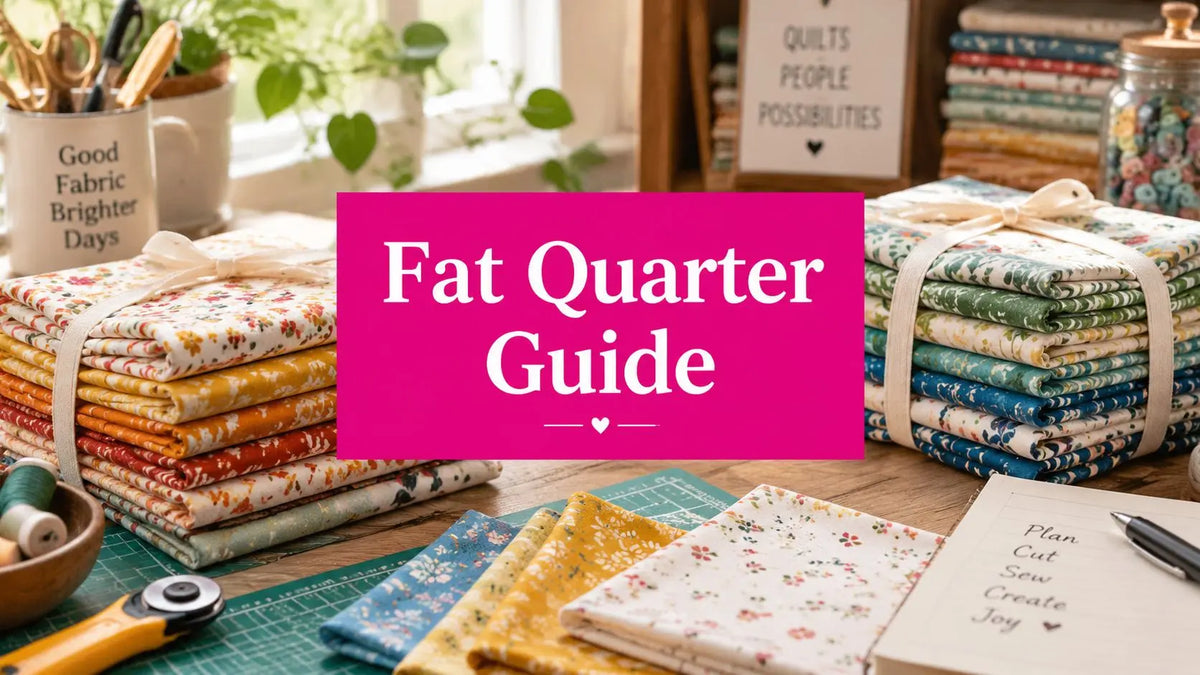
You're standing in a fabric shop with a pattern in one hand and a beautifully stacked bundle in the other. The label says fat quarter, but the pattern calls for squares, strips, borders, and background fabric. Before you buy, ask one practical question: will these pieces fit the cuts your quilt needs? A fat quarter bundle for quilting is a curated group of coordinating fabric pieces, usually cut to about 18 by 22 inches. It can make fabric selection easier, but it isn't the right choice for every quilt.
What Is a Fat Quarter Bundle for Quilting
A fat quarter bundle is a collection of pre-cut fabric pieces selected from a coordinated fabric line or color story. Each piece is typically a fat quarter, approximately 18 inches by 21 or 22 inches, although the finished size can vary with the width of the original fabric. Unlike a random assortment, the prints are usually designed to work together in color, motif, and scale. Quilt Keeper Studio explains the standard precut geometry and size variation.
That format solves a common quilting problem. Instead of buying several yard cuts and standing at the cutting table trying to match a floral with a blender, you can begin with a palette that has already been assembled. A bundle may include florals, geometrics, low-volume prints, blenders, and a few stronger accent fabrics. This gives a scrappy quilt or sampler quilt visual variety without requiring you to make every color decision independently.
At Linda's Electric Quilters in McKinney, Texas, quilters often ask about bundles when they want enough variety for meaningful blocks without committing to a full bolt or multiple yards of one print. Bundle counts vary widely. A commonly cited assortment contains 18 to 20 pieces, while retailers may offer bundles with fewer pieces or considerably more, depending on the collection. Yellow Umbrella Quilts discusses the range of fat quarter bundle sizes.

Why quilters reach for bundles
A bundle can be useful when you want:
- Coordinated color: The prints already share a collection palette.
- Built-in variety: Multiple fabrics create movement in patchwork and appliqué.
- Fewer purchasing decisions: You're selecting a fabric story rather than matching every piece.
- Flexible small-project fabric: The shape suits blocks, bags, runners, and other compact designs.
Read the label carefully before assuming every bundle is interchangeable. Check the collection name, manufacturer, fabric count, and whether the pieces are true fat quarters or another precut format. A fat quarter bundle for quilting is most successful when the pattern's largest pieces fit the cut and the bundle includes enough contrast for the design.
Fat Quarter Dimensions and Cutting Logic Explained
The name “fat quarter” refers to how the fabric is cut, not to a random rectangle chosen by a retailer. Traditional quilting cotton is commonly sold in widths of about 41 to 45 inches. A half-yard piece can be cut across its width to create a wider quarter-yard rectangle, generally around 18 by 21 or 22 inches. A standard long quarter is narrower and longer, about 9 by 44 inches. National Quilters Circle compares the two shapes and explains why the wider rectangle is useful.
The two cuts contain roughly the same fabric area, but quilters don't sew square inches in the abstract. They cut real templates. A wider rectangle may let you place a block unit in one piece, while a long quarter may force a different layout or leave awkward offcuts.
The shape matters more than the label
For an 18 by 22 inch fat quarter, the area is about 396 square inches, or roughly 2.75 square feet. Nifty Fifty Quilting provides this area benchmark for planning. A regular quarter-yard measuring about 9 by 44 inches has a similar total area, but its narrow width limits the size and arrangement of cuts.
| Attribute | Fat Quarter | Standard Quarter-Yard |
|---|---|---|
| Typical dimensions | About 18 × 21–22 inches | About 9 × 44 inches |
| Approximate usable area | About 396 square inches | Similar total area |
| Shape | Wide rectangle | Long, narrow rectangle |
| Useful cutting role | Squares, half-square triangles, appliqué, small blocks | Long strips and narrow continuous cuts |
| Layout advantage | Larger uninterrupted rectangles | Greater length, limited width |
A fat quarter can accommodate many common patchwork units, including 6-inch squares and smaller half-square triangle components, provided the pattern's cutting instructions account for seam allowances. The key is to measure the unfinished cut size, not just the finished block size. A block that finishes at 6 inches may require a larger starting square, and fussy-cutting can reduce the efficient portion of the fabric.
Pro-Tip: Before cutting, place the pattern's largest template on the fat quarter with the grain direction marked. Rotate the template only if the print allows it, and keep a margin for trimming. Directional motifs can make an apparently large piece less flexible than its measurements suggest.
Longarm quilters and makers who use specialty rulers also benefit from the wider format. It's easier to position rulers and batch-cut repeated units when the fabric offers a broader working surface. That convenience disappears, however, when a pattern calls for continuous pieces longer than the available dimension.
How Many Fat Quarters You Need by Quilt Size
A single 18 by 22 inch fat quarter contains about 2.75 square feet of usable fabric, but quilt planning can't rely on area alone. Blocks, seam allowances, sashing, borders, directional prints, and cutting waste all affect the final count. Fat Quarter Shop publishes common fat-quarter estimates by quilt size.
A useful starting point is to compare your pattern's required pieces with the fabric shape. If the design uses mostly squares, rectangles, half-square triangles, or compact appliqué pieces, a bundle may yield efficiently. If it uses long strips, large borders, or oversized motifs, the area calculation will overstate what you can use.
A practical size guide
| Quilt Size | Typical Dimensions | Fat Quarters Needed | Yardage Equivalent |
|---|---|---|---|
| Throw | Pattern-dependent | About 12 | Varies by cutting layout |
| Twin | Pattern-dependent | About 24 | Varies by cutting layout |
| Queen | Pattern-dependent | About 35 | Varies by cutting layout |
| King | Pattern-dependent | About 56 | Varies by cutting layout |
These are planning benchmarks, not guarantees. One independent quilting guide notes that a full-size quilt may require around 30 fat quarters, depending on the design, while the size guide above lists larger counts for queen and king projects. The Quilted Cowgirl explains why pattern shape and cut length matter when choosing precuts.
For a throw, the pattern may call for roughly a dozen fat quarters, especially when the blocks are compact and the background, borders, and binding come from yardage. A twin quilt commonly moves toward the mid-twenties. Queen and king quilts often need substantially more variety, especially if the pattern distributes every print throughout the top rather than assigning one fabric to a limited group of blocks.
What changes the count
- Sashing and borders: These often require yardage because they use long, continuous strips.
- Block size: Larger, efficient blocks may waste less fabric than tiny units.
- Fussy-cutting: Centering a motif can leave unusable corners and edges.
- Print direction: One-way designs may prevent you from rotating pieces.
- Background fabric: A bundle rarely supplies enough background for the full quilt.
Add an extra fat quarter when the pattern allows it and the collection is still available. That spare piece can cover a cutting error, a flaw, or a late design change. It's also useful for testing pressing, starching, or seam accuracy before you cut into the main stack.
Choosing the Right Bundle for Your Project
A coordinated bundle can make fabric selection faster, but coordination alone doesn't guarantee a successful quilt top. Examine the colorway, designer style, project theme, print scale, and value contrast before you purchase.
Color temperature is a practical first filter. Warm bundles with earthy terracottas and muted coastal blues may suit different rooms and recipients than a palette built around vivid jewel tones. Emerging 2026 quilting trend coverage highlights earthy tones, soft neutrals, bold accents, and textured low-volume fabrics, with palettes that include Mocha Mousse, Burnt Umber, Electric Fuchsia, and Lime Cream. Hen and Chicks Studio discusses these 2026 palette directions and bundle curation.
Compare the design choices
A curated bundle gives you harmony. A custom group assembled from yardage gives you control.
| Selection approach | Strength | Trade-off |
|---|---|---|
| Curated bundle | Fast palette selection and coordinated prints | Less control over individual colors and quantities |
| Hand-picked yardage | Precise color, scale, and yardage choices | Requires more planning and color evaluation |
| Mixed bundles | Broad variety and a scrappy effect | Values and print scales may clash |
Look for a useful spread of print sizes. Large motifs can anchor spacious blocks, medium prints support repeated units, small prints act as texture, and low-volume fabrics create breathing room. A stack made entirely of similarly scaled prints may look coordinated on the shelf but flatten into visual noise once cut.
The designer's signature style matters, too. A collection built around delicate florals will behave differently from one dominated by bold geometrics or novelty motifs. Directional stripes and one-way prints require extra attention because they can be difficult to orient in small pieces. Check whether the motif still reads clearly after cutting.
If you're comparing options online, precut fabric in navy can be a useful reference for seeing how a deep neutral changes the role of brighter prints. For projects that extend beyond quilting, the 1-inch Faux Velvet and Rhinestone Trim – 10 Yard Roll uses a faux-velvet ribbon base with centered rhinestones and can add a decorative finish to items such as pillows or table runners.

The video below offers another way to study bundle selection and fabric coordination before you commit to a stack.
When a Fat Quarter Bundle Is the Wrong Choice
A fat quarter bundle isn't automatically economical just because it's pre-cut. The wrong pattern can turn a coordinated stack into a pile of awkward scraps.
The main warning sign is a required piece longer than the fat quarter's usable dimension. A standard fat quarter is typically about 18 by 22 inches, so a pattern calling for a 22-inch border strip may leave no practical allowance for trimming, selvage removal, or squaring the fabric. If the cut must run in a particular direction, the piece may not fit at all.
Patterns with wide borders, elongated flying geese, large chevrons, or long strip sets are common trouble spots. You may piece multiple fat quarters to create the needed length, but that adds seams, extra bulk, and potential visual interruptions. A border that should read as one clean frame can become visibly segmented.
Decision rule: If the cutting instructions list more than three pieces longer than 18 inches, treat yardage as the safer starting point. Confirm the rule against the actual pattern, because grain direction and seam allowances can change the result.
Where yardage wins
Quarter-yard and half-yard cuts from the bolt provide the continuous width needed for borders and strip-based construction. That makes them a better fit for:
- Modern minimalist quilts with broad negative space.
- Medallion quilts with wide concentric borders.
- Bargello and other strip-pieced designs.
- Large-scale blocks that need uninterrupted motif placement.
A bundle can also be inefficient when the print is large and the design depends on showing the entire motif. Cutting that print into small units may remove the central image or create inconsistent fragments across the quilt. Buy the fabric format that matches the pattern, even if the bundle is more attractive at first glance.

Project Ideas and Smart Buying Tips
The best fat quarter projects use the rectangle rather than fighting it. Compact blocks, coordinated accessories, and small seasonal pieces let you distribute multiple prints without needing long continuous cuts.
| Project | Approximate fabric plan | Skill level |
|---|---|---|
| Charm-friendly nine-patch throw | Several coordinated fat quarters plus background fabric | Beginner |
| Log cabin table runner | A small group of fat quarters | Beginner to intermediate |
| Baby quilt | About 12 fat quarters | Beginner |
| Coordinated tote bag | Exterior, lining, and pockets from selected pieces | Beginner to intermediate |
| Seasonal wall hanging | A few feature prints with background and appliqué fabric | Intermediate |
Before purchasing, inspect the bundle information rather than judging only the photograph. Confirm the fabric count, collection name, manufacturer, and stated dimensions. Pinked edges can make a piece look larger or irregular, so compare the usable cut with the pattern requirements.
Store bundles flat when possible. Permanent creases can complicate rotary cutting, especially when a ruler must span the full piece. Keep the stack protected from direct sunlight, and avoid compressing it under heavy supplies.
At Linda's Electric Quilters, shoppers can compare fabric categories, notions, and finishing supplies in one place, then arrange longarm quilting services when the top is complete. If you're building a coordinated project, choose the bundle first, then select background fabric, batting, thread, and binding with the finished design in view.
Use this three-question check before checkout:
- Does the pattern's largest cut fit the fat quarter?
- Does the colorway suit the room, season, or recipient?
- Does the bundle include enough variation in value, motif, and print scale?
If the answer to any question is no, yardage may be the more efficient purchase. If all three answers are yes, a fat quarter bundle for quilting can give you a confident start without requiring a full custom palette.
Frequently Asked Questions About Fat Quarter Bundles
Are fat quarter bundles always 100% cotton
Most quilting bundles use quilting-weight cotton, but not every fat quarter has the same fiber content. Some manufacturers offer linen blends or flannel fat quarters for projects where a different hand, texture, or seasonal feel is appropriate. Check the product description and care instructions before combining fabrics with noticeably different shrinkage or drape.
How should I store a fat quarter bundle
Keep the pieces flat, protected from direct sunlight, and separated from materials that may transfer color or moisture. Acid-free tissue between folded layers can help reduce sharp creases, while plastic bins provide a practical barrier against dust. Don't pack the container so tightly that the fabric develops permanent compression lines.
Can I mix fat quarters from different bundles
Yes, but evaluate color value, temperature, and print scale before cutting. Two fabrics may share a color name while behaving differently in the quilt because one is much darker or visually busier. Add a low-volume print or solid between collections if the transition needs more breathing room.
Are bundles cheaper than equivalent yardage
A curated bundle can cost more than equivalent yardage because you're paying for selection, packaging, and convenience. The benefit is reduced matching time and a ready-made color story, while hand-picked yardage gives you more precise control over quantity and project fit. Compare usable cuts, not just the package label, before deciding.
Linda's Electric Quilters offers fabric, batting, thread, notions, and quilting support for projects built from a fat quarter bundle for quilting. Visit Linda's Electric Quilters to choose coordinated materials, prepare your quilt top, and arrange the finishing supplies or services that will carry it through to completion.