You're standing in front of a wall of solids, pulling one bolt after another, and every color seems right until it sits next to the previous choice. Then the budget question hits. Do you buy yardage in several shades just to test a palette, or do you go home and keep overthinking it?
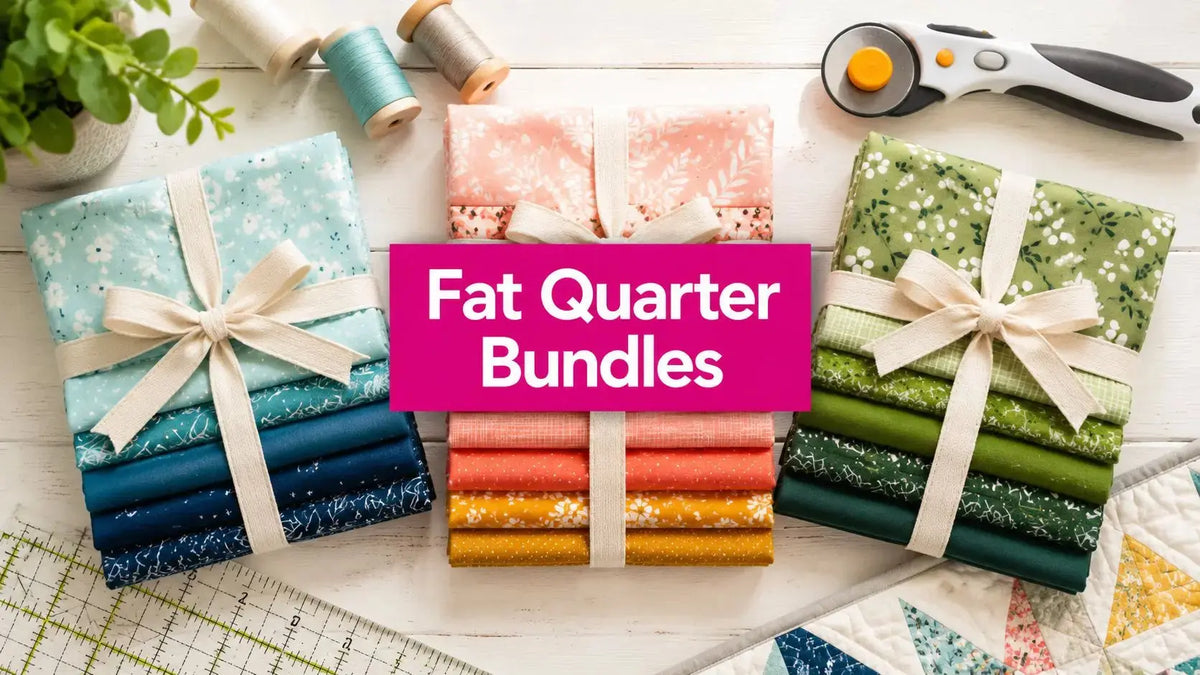
That's where Kona fat quarter bundles earn their keep. They give you coordinated solids, predictable cuts, and enough variety to move from idea to cutting mat without the usual color paralysis. For quilters who want practical planning, not just pretty product photos, they're one of the smartest ways to build a stash and start a project with confidence.
Kona Cotton has been around since 1984, which is part of why so many quilters trust it for both everyday piecing and polished modern quilts. Robert Kaufman Fabrics has produced Kona Cotton since then, and curated pre-cut bundles have stayed in demand over decades, including recurring club-style bundle offerings noted in this overview of Kona Cotton's long history.
Your Guide to Kona Fat Quarter Bundles
In a quilt shop, I see the same moment all the time. A quilter comes in with a pattern and a rough color idea, then stalls out when it's time to commit. They want more control than a mystery pull, but they don't want to buy full yard cuts of ten solids just to make one throw quilt.
Kona fat quarter bundles solve that exact problem. They let you try a full palette, keep your cuts versatile, and make modern quilt planning much easier, especially when you're building around solids instead of prints.
Why quilters keep reaching for Kona
Kona works because it sits in that sweet spot between design flexibility and dependable sewing performance. Solids show piecing cleanly. They also make quilting lines, thread choice, and negative space stand out in a way busy prints don't.
For many projects, bundles are the easier path because they help with:
- Palette control so your quilt doesn't drift color by color
- Stash building without committing to full bolts or repeated half-yard cuts
- Faster starts because the fabric is already grouped with a design point of view
- Better variety for scrappy blocks, gradients, one-color quilts, and modern layouts
Practical rule: If the fabric pull is delaying the quilt, a curated bundle is often the right answer.
I especially like Kona bundles for quilters who want to pair a crisp pieced top with quality batting and longarm quilting. Solids give you room to let the stitching show. If you're already planning the finish, it's worth browsing batting options for the completed quilt while you choose your palette.
Where these bundles shine
They're excellent for:
- Modern quilts with strong geometry and negative space
- One-color or low-volume-plus-accent layouts
- Gradient work where value changes matter
- Gift sewing when you want a polished look without spending hours pulling fabrics
The advantage is that they make quilting feel lighter. Less second-guessing. More cutting, sewing, and finishing.
What Exactly Is a Kona Fat Quarter Bundle
A fat quarter is a pre-cut piece of fabric that gives you more usable width than a standard quarter-yard cut. In Kona bundle listings, that cut is commonly about 18 x 22 inches, though some product listings use 18 x 21 inches. That difference sounds small, but when you're counting block pieces or planning background cuts, it matters.

Fat quarter versus standard quarter yard
A standard quarter yard is usually a long strip cut from the bolt. A fat quarter is cut to give you a squarer shape, which is far more useful for patchwork, appliqué pieces, and block components.
Here's the practical difference:
| Cut type | Common dimensions | Best use |
|---|---|---|
| Fat quarter | about 18 x 22 inches or 18 x 21 inches | blocks, mixed cuts, stash variety |
| Standard quarter yard | about 9 x 44 inches | strips, bindings, borders |
That wider shape is why quilters love pre-cuts. You can cut squares, rectangles, and smaller motif pieces without fighting the narrowness of a strip.
How bundle counts translate into real fabric
Kona bundles are often sold in fixed counts such as 9 pieces, 10 pieces, or 12 pieces, depending on the palette. One helpful benchmark is that a 12-piece bundle equals roughly 5.5 square yards of fabric by area, which makes bundles a practical way to buy coordinated solids without moving into full-yard cuts, as shown in this Kona pre-cut bundle listing with yardage context.
That matters because many storefronts stop at “fat quarter bundle” and never tell you what the count means for an actual quilt top. If you know the count and the cut size, you can plan instead of guessing.
Why Kona performs so well under the needle
Kona Cotton isn't just popular because of color range. It's also technically dependable fabric. In the educational material from Linda's, Kona Cotton is described as 100% cotton with a weight of 4.3 to 4.35 oz per square yard, and those specifications are tied to reduced puckering and better thread tension stability in high-speed longarm quilting and embroidery applications, as noted in this Linda's education article on Kona Cotton performance.
For longarm quilters, that means the fabric behaves in a way that supports clean stitch formation. For piecers, it means the hand is substantial enough to cut accurately and sew clean seams without feeling stiff or cardboard-like.
A good solid should press crisply, feed evenly, and still drape like a quilt when the job is done. Kona usually does all three.
Navigating the Rainbow of Kona Bundle Types
Not every bundle serves the same job. Some are stash builders. Some are design tools. Some are really a shortcut for quilters who know the look they want but don't want to spend an hour balancing undertones.

Solid palette bundles
These are the workhorses. Think rainbow assortments, warm groups, cool groups, neutrals, or monochromatic collections.
They work well for quilters who need:
- A core stash of versatile solids
- Scrappy blocks with controlled color families
- Background and accent options in one purchase
- Small project flexibility for bags, pillows, and table runners
If you make modern quilts often, this is usually the smartest first buy. Solids let the piecing and quilting do the talking.
Gradient and ombré bundles
Kona presents exciting opportunities for design-driven quilting. Recent quilting content shows active interest in Kona color-led projects, including the Kona Color of the Year and modern one-color quilt ideas, which points to a real need for bundle guidance beyond simple product listings, as seen in this video focused on Kona color-based quilting inspiration.
A gradient bundle helps when you want:
| Bundle type | Best for | Watch out for |
|---|---|---|
| Monochrome gradient | one-color quilts, value studies | not enough contrast if values are too close |
| Full-spectrum rainbow | bold modern layouts, improv, kids' quilts | can feel chaotic without a grounding background |
| Low-volume to accent mix | negative space designs | may need added darks for visual structure |
These bundles are especially useful when your quilt relies on value shift more than print variety.
Curated theme bundles
Some bundles are built around a season, a mood, or a particular color story. Those are ideal for quilters who want direction. The bundle naming often gives away the design intent. Stormy neutrals, desert warmth, jewel tones, holiday brights.
This category also addresses a gap in the market. Many shops list bundles transactionally, but they don't tell you which one suits a scrappy modern quilt, a controlled gradient, or a background-plus-accent layout. That's why it helps to browse a collection with your project in mind, not just your favorite colors. If you want to compare palette styles side by side, take a look at fat quarter bundles and other pre-cuts.
If your pattern has strong geometry, choose the bundle for value range first and color family second. That decision usually produces a stronger quilt.
Quilt Math How Many Bundles Do You Really Need
This is the question most product pages skip. You can see a lovely stack of solids, but you still don't know whether one bundle is enough or whether you're about to run short halfway through the border.
Here's the cleanest way to think about it. Start with the bundle count, then think in terms of usable patchwork area, not just the number of fabrics. A 12-piece Kona fat quarter bundle gives you roughly 5.5 square yards of fabric equivalent by area, which is a very workable amount for piecing, especially when the project uses repeated units rather than large border cuts.
The table quilters actually need
The estimates below are intentionally practical. They assume pieced quilt tops using Kona fat quarter bundles for the main patchwork, with additional fabric often needed for backing and sometimes for borders depending on the pattern.
| Quilt Size | Approx. Dimensions | Bundles for Top | Notes |
|---|---|---|---|
| Crib | Varies by pattern | 1 bundle | Works well for patchwork tops, baby quilts, and many nursery throws |
| Throw | Varies by pattern | 1 to 2 bundles | Common sweet spot for fat quarter friendly modern quilts |
| Twin | Varies by pattern | 2 bundles | Often enough for scrappy or block-based tops with added background |
| Queen | Varies by pattern | 3 or more bundles | Usually needs extra background or coordinating yardage |
| King | Varies by pattern | 4 or more bundles | Better for highly scrappy designs or as part of a mixed-yardage plan |
These aren't rigid formulas. They're buying guides. The pattern always has the final say.
What changes the bundle count
A quilt can use the same number of fat quarters very differently depending on the design. Three project choices drive the math:
-
Block style
Small repeated units stretch a bundle further than oversized blocks with broad solid sections. -
Background strategy
If Kona fat quarter bundles are only the accents and you use yardage for the background, your bundle goes much further. -
Borders and binding
Wide borders usually call for yardage, not fat quarters. Scrappy binding can come from bundle leftovers if you plan for it early.
Pro tip: Don't cut every fat quarter to the same unit size on day one. Hold back at least a few pieces until you know where seam allowances, trimming, and color balance are eating more fabric than expected.
Yardage math that keeps you out of trouble
One of the biggest gaps in online bundle content is value comparison. Many storefronts don't explain whether the bundle uses 18 x 21 or 18 x 22 cuts, how many pieces are included, or how that compares with buying solids as yardage. That's exactly why true yardage math matters, and why explanatory guidance is still missing from many ecommerce pages, as noted in this discussion of the content gap around fat quarter bundles.
Here's what works in the shop:
- Use bundles for variety-heavy patchwork
- Use yardage for backgrounds, borders, and backing
- Mix the two when you want the palette convenience of a bundle without overusing pre-cuts where full widths are more efficient
If your quilt is headed to the frame, this is also the point where batting planning should happen. For quilters finishing multiple projects, a practical next purchase is a larger batting format such as the Hobbs Heirloom Premium 80 20 Cotton Blend Batting Roll.
From Stash to Stitches Prepping and Using Your Bundles
Buying the bundle is the easy part. The quality of the finished quilt depends on what happens next at the ironing board and cutting mat.

Prewash or keep it crisp
This question always gets a lively response in a quilt shop. Some quilters prewash everything. Others never do. With Kona, the decision is easier because the fabric is described as pre-treated to minimize shrinkage, helping the 18 x 21 inch dimensions remain stable after washing for precision piecing and flatter quilt tops, as noted in the earlier Linda's education reference.
In practice, here's how I look at it:
- Prewash if you're mixing Kona with unknown fabrics, very dark shades, or a project where shrinkage differences could bother you
- Skip prewashing if you want the cleanest possible cutting and piecing experience with pre-cuts
- Compromise by testing if you're unsure about a specific palette or project use
For many modern quilts, I don't prewash fat quarters before cutting because I want the fabric to stay crisp and square at the ruler.
Press first, then decide whether the project needs starch. Don't assume every solid wants the same prep.
A quick visual walkthrough can help before the first cut:
Cutting for accuracy instead of speed
Fat quarters are convenient, but they're not magic. You still need disciplined cutting if you want block points and seam intersections to behave.
My usual prep order is:
-
Press flat
Open every fold and remove packaging creases before measuring anything. -
Square one edge carefully
A clean starting line prevents compounding errors through the whole stack. -
Cut by project sequence
Take the largest pieces first. Save smaller leftovers for corners, binding segments, or scrappy units. -
Separate lights, mediums, and darks
This matters more than people think when you're sewing from a gradient or rainbow pull.
If you need a refresher on rotary-cutting habits and measuring discipline, it's worth spending time with a quilting tutorials collection.
Storage that keeps bundles usable
A fat quarter bundle can get messy fast once the ribbon comes off. The easiest fix is to store with intention.
Try one of these methods:
- By palette for future color-driven quilts
- By project bag if the bundle already has a destination
- By value range if you design visually and audition often
Keep them out of direct sunlight. Refold occasionally if they've been stacked tightly for a long time. Solids show crease lines more readily than many prints, especially on broad unpieced sections.
What doesn't work is tossing opened fat quarters into a deep bin and hoping they stay orderly. They won't. The bundle loses its biggest advantage, which is fast, coordinated access.
How to Buy Kona Bundles and Maximize Your Fabric Budget
A good bundle purchase starts with honesty about the project. If you need broad background cuts, don't force fat quarters to do a yardage job. If you need color variety, don't overbuy individual cuts just because you're worried a bundle feels less flexible.

When bundles are the smarter buy
Bundles usually make the most sense when your quilt needs:
- Many colors in smaller amounts
- A controlled palette chosen for you
- Stash growth with less decision fatigue
- Project speed, because the matching work is already done
They're less efficient when you need large continuous cuts. That's where yardage still wins.
Budget choices that work better in real life
The strongest buying strategy is simple. Buy bundles for palette and variety. Buy yardage for scale.
A few practical habits help:
| Buying approach | Good fit | Poor fit |
|---|---|---|
| Bundle only | scrappy patchwork, sampler quilts, color studies | wide borders, large background panels |
| Yardage only | two-color quilts, large negative space designs | broad multi-color layouts |
| Bundle plus yardage | most modern quilts | very few downsides if planned early |
This is also the stage where I tell quilters not to chase bargain fabric that won't sew the way they want. Saving money up front doesn't feel smart if the hand is off, the press is stubborn, or the top won't lie flat.
If your goal is to build a useful stash instead of a random one, shop by palette purpose. Neutrals for backgrounds. Deep values for contrast. Midtones for blending. Accent shades for movement. That approach gives each purchase a job.
Your Kona Fat Quarter Questions Answered
Are Kona fat quarter bundles good for beginners
Yes. They remove a lot of the stress around color selection, and the solid fabrics make it easier to see seam accuracy, block orientation, and quilting lines.
Is a fat quarter enough for a whole project
Sometimes. A small project like a pouch, pillow front, or a set of patchwork blocks can come from one or several fat quarters. For quilts, most makers combine multiple fat quarters and often add yardage for background, borders, or backing.
Should I choose solids or prints for a modern quilt
If your goal is strong geometry, clean contrast, and visible quilting texture, solids often give you more control. Prints can add personality, but they can also compete with the piecing.
Do Kona fat quarter bundles work well for longarm quilting
They do. As covered earlier, Kona's cotton composition and stated weight are tied to stable performance for quilting and embroidery, which is one reason many quilters trust it for both piecing and finishing.
How do I avoid wasting fabric from a bundle
Start with your largest cuts, group colors by value before sewing, and don't cut every piece into the same unit until you know the quilt layout is settled.
If you're ready to turn a color idea into a finished quilt, browse the fabric, batting, and quilting supplies at Linda's Electric Quilters. A well-chosen Kona bundle can take you from stalled at the planning stage to sewing with confidence, and the right finishing materials will help that quilt look as good on the bed or wall as it did in your sketchbook.