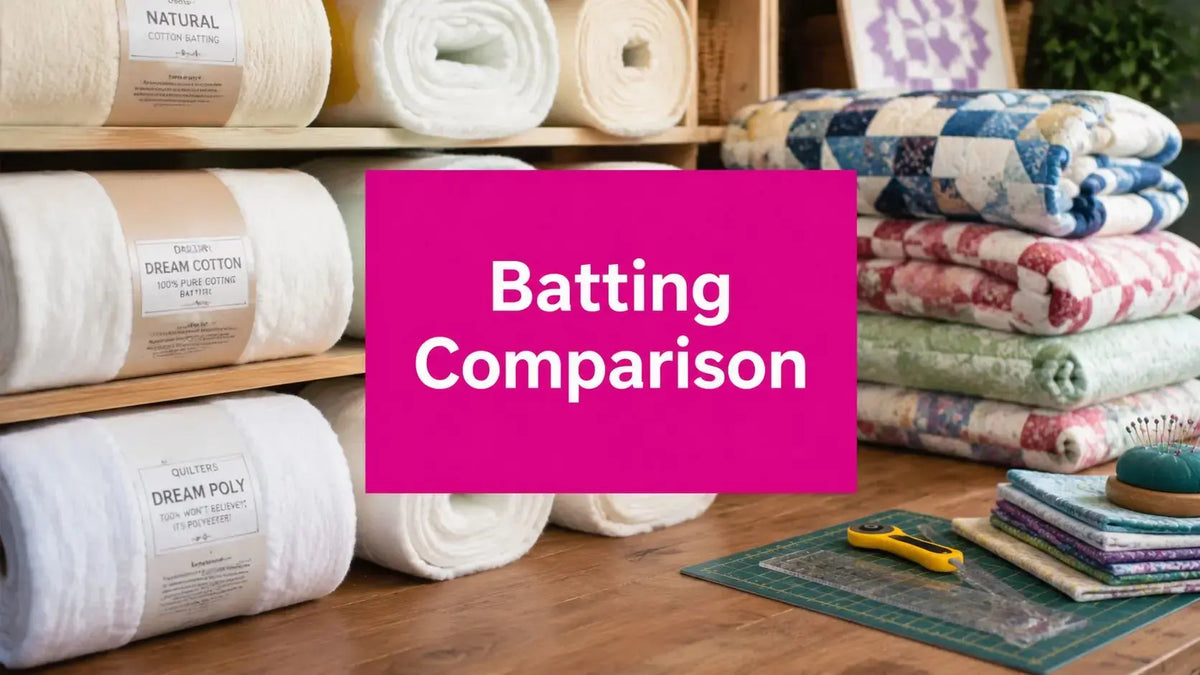
You're standing in front of a wall of batting rolls, reading labels that all sound useful, and none of them answer the core question. What will quilt cleanly on the frame, hold up in the finished project, and give you the look you want without fighting your machine? That's where a good quilt batting comparison chart earns its keep.
For most quilters, the decision comes down to a few practical variables. Fiber, loft, drape, shrinkage, and quilting distance tell you far more than a marketing label ever will. If you can read those five things clearly, you can choose batting with confidence for a baby quilt, a bed quilt, a wall hanging, or a dense longarm job that needs to track cleanly at speed.
Choosing the Right Batting Without the Overwhelm
A quilter can piece a beautiful top, load it straight on the frame, and still end up fighting the quilt by the second pass. The usual culprit is batting. It controls how the sandwich moves under the needle, how the stitches sit, and how much forgiveness you get at speed.
I see the hesitation even with skilled quilters. Fabric and thread are familiar territory. Batting asks a different set of questions, and the answers affect both the quilting process and the finished result. The top is visual, the thread is tactile, but many of the technical decisions sit inside the batting layer.
A quilt batting comparison chart helps because it shifts the decision from shelf appeal to performance. The better questions sound like this:
- How far apart can the quilting lines be
- Will it stay flat on the frame or build more loft than I want
- How much drape will the finished quilt have
- What changes should I expect after washing
- Will it suit the project, the quilting design, and the machine setup
That change in perspective is important. A batting that gives a crisp, showy stitch line in a wall quilt can feel stiff in a bed quilt. A loftier batting can make motifs stand out, but it can also increase drag, highlight wobble in fast curves, and ask more of your thread tension. On a longarm, those trade-offs show up quickly.
Practical rule: Batting is part of the quilting plan. Choose it with the design, thread, and intended use in mind.
For day-to-day quilting, the main categories are still polyester, cotton, and cotton/poly blends. Wool, bamboo, and silk have their place too, especially for specific finish goals, but most quilters can narrow the field faster by starting with how the batting behaves under the needle rather than by chasing fiber labels alone.
When batting feels overwhelming, the answer usually is not more choices. It is a clearer way to sort them. A good chart turns batting from a guess into a working decision.
The 2026 Quilt Batting Comparison Chart
You are halfway through loading a king-size top on the frame, the client wants open edge-to-edge quilting, and the batting choice will decide whether the quilt runs cleanly at speed or fights you row after row. That is the point of a chart like this. It should help you rule materials in or out fast, based on how they behave in the machine and how they finish in the quilt.
Use this chart as a bench-side reference, not a substitute for the package label. Brand construction, scrim, needle punch, and bonding method can change how two battings with the same fiber label perform.
| Batting Type | Loft/Thickness | Warmth | Drape | Shrinkage | Quilting Distance | Stitch Definition | Recommended Uses | Care Instructions | Price/Yard (Est.) | Linda's SKU |
|---|---|---|---|---|---|---|---|---|---|---|
| 100% Cotton with Scrim | Low | Moderate | Soft with structure | Some shrinkage expected | Wider spacing than cotton without scrim is often allowed. Check the package label. | Moderate, flatter finish | Wall hangings, traditional quilts, quilts needing stability | Follow package directions | Varies by brand | N/A |
| 100% Cotton without Scrim | Low to medium | Moderate | Softer, more relaxed | Some shrinkage expected | Usually calls for closer quilting than scrimmed cotton. Check the package label. | Soft definition | Heirloom-style work, softer hand, closer quilting designs | Follow package directions | Varies by brand | N/A |
| 80/20 Cotton/Poly Blend | Medium | Moderate | Balanced | Light to moderate shrinkage, depending on brand and washing method | Often supports fairly open quilting, but confirm on the label | Good definition with workable drape | Bed quilts, all-purpose quilting, longarm-friendly projects | Follow package directions | Varies by brand | N/A |
| Polyester | Low to high, depending on product | Moderate to warm feel | More buoyant, less fluid | Usually low shrinkage | Many products allow wide spacing. Check the package label. | Stronger puff and stitch visibility | Baby quilts, tied quilts, quilts needing wide spacing | Follow package directions | Varies by brand | N/A |
| Wool | Medium | Warm | Soft drape | Brand dependent | Check package label | Excellent definition with resilience | Heirloom quilts, bed quilts, quilts needing loft with softness | Follow package directions | Varies by brand | N/A |
| Bamboo or Bamboo Blend | Low to medium | Moderate | Soft | Brand dependent | Check package label | Soft, subtle finish | Baby quilts, lightweight projects | Follow package directions | Varies by brand | N/A |
| Fusible Batting | Varies by fiber | Varies by fiber | Varies by fiber | Varies by fiber | Check package label | Depends on base fiber | Small projects, minis, projects where easier assembly helps | Follow package directions | Varies by brand | N/A |
How to read the chart fast
Start with quilting distance, loft, and drape.
Those three columns tell you most of what you need on the frame. Quilting distance affects how open you can keep the design without risking migration or distortion. Loft changes how much the stitched line rises and how much resistance you feel at higher speed. Drape tells you whether the finished quilt will fold softly on a bed or hold more body.
Shrinkage matters too, especially if the client wants a washed, crinkled finish or expects a flatter show surface.
What the chart does not show on its own
The chart gives a useful first cut. The actual decision often comes down to machine behavior.
On a longarm, low-loft cotton with scrim usually tracks flatter and stays predictable during fast pantograph work. High-loft polyester can give beautiful definition, but it also adds bounce and can make quick direction changes look less precise if the machine, thread, and tension are not set for it. Wool tends to stitch beautifully and recover well after dense quilting, yet it can expose tension issues faster than a stable blend if the setup is slightly off.
That is why experienced quilters match batting to the whole system. Needle size, thread weight, quilting density, and machine speed all show up in the result. A good chart helps you shortlist. Professional results come from choosing the batting that suits the project and the way you quilt.
Decoding the Chart A Deep Dive into Batting Fibers
Halfway through a longarm job, batting choice stops being theoretical. You feel it in how the quilt tracks, how the stitches sit, and how much correction the machine needs at speed. Fiber is the starting point because it shapes all of that. It affects drag under the needle, stitch definition, recovery after dense quilting, and the finished hand of the quilt.

Cotton and cotton with scrim
Cotton is the benchmark many quilters measure everything else against. It gives a familiar hand, a flatter look, and a finish that reads traditional rather than puffy. On the frame, it usually feels controlled, especially for quilters who want the sandwich to stay settled during steady production work.
Scrim changes that behavior in useful ways. Cotton with scrim tends to hold together better, stay more stable during loading, and tolerate wider quilting distances than a soft needle-punched cotton without scrim. For longarm work, that difference matters. A stable cotton batting often makes pantographs and edge-to-edge designs feel cleaner because the quilt top is not shifting as much under fast movement.
Cotton without scrim still has its place. It can produce a softer drape and a more old-fashioned finish, but it asks for closer attention to support and quilting density.
Polyester and why it stays in regular rotation
Polyester remains popular because it solves a different set of problems. It gives more loft, stronger stitch definition, and a lighter overall feel for its thickness. If the goal is to make quilting lines stand out, polyester usually does that faster than cotton.
It also behaves differently under a longarm. Higher-loft polyester compresses and rebounds more, which can be a benefit or a nuisance depending on the design. Feathers, curves, and motifs with strong texture often look terrific on it. Tight ruler work or very fast directional changes can feel less planted if the machine setup, thread, and tension are not dialed in.
That trade-off is worth understanding before the quilt goes on the frame.
I tell customers this way. Polyester tends to showcase the quilting. Cotton tends to keep the focus on the piecing and the surface of the quilt.
Blends and the value of 80/20
Blends earn their shelf space because they smooth out extremes. An 80/20 batting, usually cotton and polyester, gives more resilience and stitch pop than all-cotton while keeping a softer, more natural hand than full polyester. For bed quilts, that balance is hard to beat.
In the studio, 80/20 is often the safest choice when the project needs to satisfy both the maker and the recipient. It runs well on many longarms, resists looking too flat or too puffy, and plays nicely with a wide range of thread weights. If someone wants one batting that covers a lot of ground without much drama on the frame, this is often the first one I pull.
Wool, bamboo, and other specialty fibers
Wool quilts beautifully. It has loft without the same synthetic spring as polyester, and it recovers well after dense stitching. That can give heirloom quilting beautiful dimension. It also tends to show tension problems faster, so it rewards a clean setup and consistent stitch formation.
Bamboo and bamboo blends usually appeal to quilters who want a soft drape and a lighter hand. Depending on the brand, they can feel very smooth under the needle, though they do not all behave the same on a longarm. Brand construction matters more with these specialty fibers, so I treat the fiber label as the first clue, not the whole answer.
That is the working rule behind any batting chart. Fiber tells you what kind of performance to expect. The best choice comes from matching that fiber to the machine, the thread, the quilting style, and the finish the quilt needs.
Understanding Loft and Quilting Density
A quilt can look perfect on the table and still fight you once it is loaded on the frame. The batting is often the reason. Loft changes how the sandwich compresses under the foot, and quilting density decides how much space your design can leave between stitched areas before the batting starts to shift, beard, or wear poorly in use.

What Loft Changes in Your Quilt
Loft is the thickness and spring of the batting. Low loft stays flatter and gives a quieter surface. Medium loft adds body without too much puff. High loft creates more relief between stitched lines, so motifs show more clearly and the unquilted areas rise higher.
On a longarm, loft affects more than appearance. It changes how the quilt responds at speed. A puffier batting compresses and rebounds more under the hopping foot, which can exaggerate small tension flaws and make sharp direction changes feel less forgiving. That is why a batting that looks beautiful in the package may still be the wrong choice for ruler work, microquilting, or fast edge-to-edge passes.
Low loft usually suits projects that need a flatter profile and strong line definition. Medium loft is often the easiest range to manage across different machines, threads, and quilting styles. High loft can be beautiful, but it asks for cleaner setup and more deliberate handling.
The Importance of Quilting Density
Quilting density is the spacing the batting can support between lines of stitching. Every batting has a limit, and the wrapper matters more than assumptions about fiber content. Two cotton battings can behave differently if one includes scrim and the other does not. Two polyester battings can have very different spacing requirements based on how they are bonded and needle-punched.
For longarm work, that spacing affects three practical decisions:
- Design scale: Open feathers, loose curves, and modern negative space need a batting that stays stable with wider gaps.
- Thread and time: Denser quilting uses more thread, adds more passes, and can change the hand of the finished quilt.
- Wear over time: If the quilting is too far apart for that batting, the quilt may shift, bunch, or lose its shape after use and washing.
I tell customers to choose batting and quilting design together. If you want broad, open motifs, confirm that the batting supports that spacing before the quilt goes on the frame. If the batting calls for closer quilting, plan for that from the start instead of forcing an airy design onto a material that needs more structure.
Pro tip for cleaner longarm results
Pro tip: If the batting has more rebound than expected, reduce your movement speed before a sharp turn. Quick pivots on loftier batting can increase top-thread stress and make a batting issue look like a thread issue.
If you want a quick visual refresher on how batting choice affects the finished texture, this video helps:
Matching Batting to Your Quilting Project
You load a quilt, start stitching, and within the first row you can tell whether the batting choice fits the job. The machine either settles in, or the whole project asks for compromises. That is why I match batting to the project before I settle on design scale, thread, or speed.

Baby quilts and everyday use
Baby quilts need comfort, washability, and a finish that does not turn stiff after quilting. Low to medium loft is usually the safer range. Cotton, polyester, and bamboo blends can all work well, but the better choice depends on how the quilt will be used and how densely you plan to quilt it.
On a longarm, I want batting here that tracks cleanly and does not build too much bulk at intersections. If the quilt will get frequent washing, a stable batting with a soft hand usually gives the best balance. High loft can be cozy, but it also makes small-scale quilting stand up more and can leave the quilt feeling heavier than expected for a crib or stroller piece.
Wall hangings and display pieces
Wall hangings have different priorities. They need shape, clean definition, and enough body to hang straight.
Low-loft cotton, especially with scrim, is often a strong fit because it stays flatter and gives crisp stitch definition. That matters if the piecing is intricate or the quilting design is meant to read clearly from across the room. Puffier battings can distract from the surface design and make the edges wave more than you want.
For quilters shopping project-first instead of fiber-first, it helps to compare batting options in one place. Linda's carries a batting category that lets you sort by type when you're narrowing choices for a specific finish.
Heirloom quilts and bed quilts
Heirloom quilts usually call for drape and a refined finish. Bed quilts have to earn their keep. They need comfort, durability, and batting that still behaves well under the amount of quilting the project requires.
That difference changes what performs well under the needle. Wool can give heirloom work beautiful definition without making the quilt feel boardy. Cotton gives a traditional hand and can suit both heirloom and bed quilts if the quilting plan matches the batting's needs. Blends, including 80/20, often make sense for bed quilts because they balance softness, resilience, and easier handling on larger tops.
I also look at thread before making the final call. A fine thread on wool can produce elegant texture with less visual buildup. A thicker cotton thread on a dense cotton batting creates a more grounded, traditional look. Both are good results, but they are not interchangeable.
T-shirt quilts and mixed-fabric tops
T-shirt quilts ask for support. The top already has stretch, weight changes, and seams that do not all behave the same way. Batting that is too lofty or too springy can make those differences harder to control on the frame.
For these quilts, I usually prefer a stable batting with moderate loft and predictable drape. The goal is a finished quilt that lies flat, stitches evenly, and does not exaggerate the movement already built into the top. If the shirt panels are heavy and the quilting design is fairly open, a batting with good stability is often a better choice than one chosen for softness alone.
If the quilt top already has movement, the batting should calm it down, not add more.
Project type gives you the starting point. Machine speed, thread weight, and quilting style finish the decision. That is where a batting chart becomes useful in a real shop, because the right choice is the one that performs well from the first pass to the final trim.
Expert Tips for Longarm Quilters from Our McKinney Team
The usual quilt batting comparison chart often falls short. It may tell you fiber content and stitch spacing, but it usually won't tell you how the batting behaves under a fast machine, with a specific thread weight, or during a dense allover design.

Our team in McKinney, Texas, pays attention to that part because it's what professionals contend with at the machine. The issue often isn't “Is this cotton or poly?” The issue is “Will this batting track cleanly on the frame with my needle, my thread, and the speed I quilt at?”
What matters at speed
A batting that looks fine on a shelf can still create problems in production. This batting comparison PDF points out that many charts don't specify how battings behave under dense quilting or with certain threads, even though that's critical for professionals trying to avoid bearding, stretching, and needle resistance at high speeds.
Those are real shop-floor issues:
- Bearding: Fiber migration can spoil an otherwise clean finish.
- Stretching or flagging: Some battings move differently on the frame than expected.
- Needle resistance: Dense or less cooperative battings can change the feel of the machine and show up as inconsistent stitch quality if tension isn't tuned.
Matching batting to thread and machine behavior
If the design is a fast pantograph, most quilters want stability first. If the job is dense custom work, drape and surface response become more noticeable. That's why batting choice should be tested with the actual thread family and design style you use most.
A practical workflow looks like this:
- Check the package spec first. Never assume the fiber tells the whole story.
- Stitch a small sample. Watch top tension, bobbin balance, and lint.
- Notice drag on directional changes. If the quilt resists smooth movement, the batting may be part of the problem.
- Evaluate the finish after quilting. Good machine behavior and good final hand are not always the same thing.
Dense custom work exposes batting weaknesses quickly. If it pills, sheds, or resists smooth travel, the frame will tell you before the customer does.
For quilters running Innova systems or similar longarms, it's worth keeping batting notes just like thread notes. The combinations that run cleanly become your repeatable standards, and that saves both time and tension troubleshooting on future quilts.
If you like learning by watching, a related quilting tutorial library is useful for seeing machine technique and finishing decisions in context.
Frequently Asked Questions About Quilt Batting
A lot of batting questions show up at the frame, not in the package copy. The quilt loads fine, then the batting shrinks more than expected, shifts at the edges, or fights the machine in tight fills. These are the questions that matter once the needle starts moving fast.
Do I need to pre-wash batting
Follow the manufacturer's instructions first. Batting is not one-size-fits-all, and pre-washing can change loft, shrinkage, and how the fibers hold together under quilting.
Cotton and cotton blends often draw up some after the first wash, which is why some quilters choose them for an older, softly puckered finish. For competition work or jobs where flatness matters, I prefer to know that behavior before the quilt is loaded. If the package does not recommend pre-washing, test a small piece instead of guessing.
How do I choose the right batting size
Buy batting for the quilting process, not just the finished top measurement. On a longarm, extra coverage around all sides gives you room to load squarely, clamp without stress, and keep the edges supported while quilting.
Batting that barely matches the top size creates avoidable problems. Edge distortion, thin corners, and awkward loading usually cost more time than the small savings from buying less.
Can I piece batting scraps together
Yes, if the project and batting make sense for it. Utility quilts, donation quilts, test pieces, and some table runners do well with pieced batting as long as the join stays flat and does not stack bulk.
Keep the edges butted, not overlapped. Then secure them in the method you trust. For heirloom work, light solids, or dense custom quilting, one continuous piece usually gives a cleaner surface because every thickness change has a chance to print through.
What's the best way to store leftover batting
Store batting clean, dry, and out of direct humidity swings. Crushed batting can recover, but not always evenly, especially in higher-loft products.
Rolling is usually better than hard folding.
Label leftovers with fiber, loft, and brand if you know it. That small habit saves real time later, especially when you are trying to match drape or stitch response on a future quilt.
How do I know whether the batting is right for my longarm
Run a sample with the same thread, needle, and quilting style you plan to use on the actual quilt. Batting that looks fine on the table can behave very differently at longarm speed.
Watch for these signs during the test:
- Needle feel: The machine should sound and feel consistent, especially in points, curves, and backtracking.
- Surface behavior: Check for bearding, fiber pull-up, or drag that makes the quilt harder to move cleanly.
- Stitch quality: Look at tension balance, stitch definition, and whether the batting supports the design or lets it sink in too much.
If you are troubleshooting a full setup, a hardware change such as an Innova M bobbin case may help tension consistency, but it will not fix a batting that sheds, resists smooth travel, or collapses under dense quilting. The batting still has to perform under the needle.
FAQ Schema Markup
<script type="application/ld+json">
{
  "@context":"https://schema.org",
  "@type":"FAQPage",
  "mainEntity":[
    {
      "@type":"Question",
      "name":"Do I need to pre-wash batting?",
      "acceptedAnswer":{
        "@type":"Answer",
        "text":"Follow the package instructions first. Pre-washing can change loft, shrinkage, and fiber stability, so test a small piece if you are unsure."
      }
    },
    {
      "@type":"Question",
      "name":"How do I choose the right batting size?",
      "acceptedAnswer":{
        "@type":"Answer",
        "text":"Choose batting that fully covers the quilt top and leaves extra around the edges for loading, clamping, and quilting comfortably on the frame."
      }
    },
    {
      "@type":"Question",
      "name":"Can I piece batting scraps together?",
      "acceptedAnswer":{
        "@type":"Answer",
        "text":"Yes, many quilters piece batting scraps for utility quilts and smaller projects, as long as the join stays flat, smooth, and free of bulk."
      }
    },
    {
      "@type":"Question",
      "name":"What is the best way to store leftover batting?",
      "acceptedAnswer":{
        "@type":"Answer",
        "text":"Store leftover batting in a clean, dry place and avoid crushing it. Rolling and labeling the fiber type, loft, and brand helps with future use."
      }
    },
    {
      "@type":"Question",
      "name":"How do I know whether batting is right for my longarm?",
      "acceptedAnswer":{
        "@type":"Answer",
        "text":"Test a sample with your actual thread, needle, and quilting style. Watch for needle resistance, smooth movement, bearding, lint, and balanced stitch quality."
      }
    }
  ]
}
</script>
If you're ready to finish your next quilt with fewer guesses and better machine performance, shop batting, tools, and quilting supplies at Linda's Electric Quilters. Matching the right batting to the right project saves time on the frame and gives the finished quilt the hand, drape, and durability you wanted from the start.