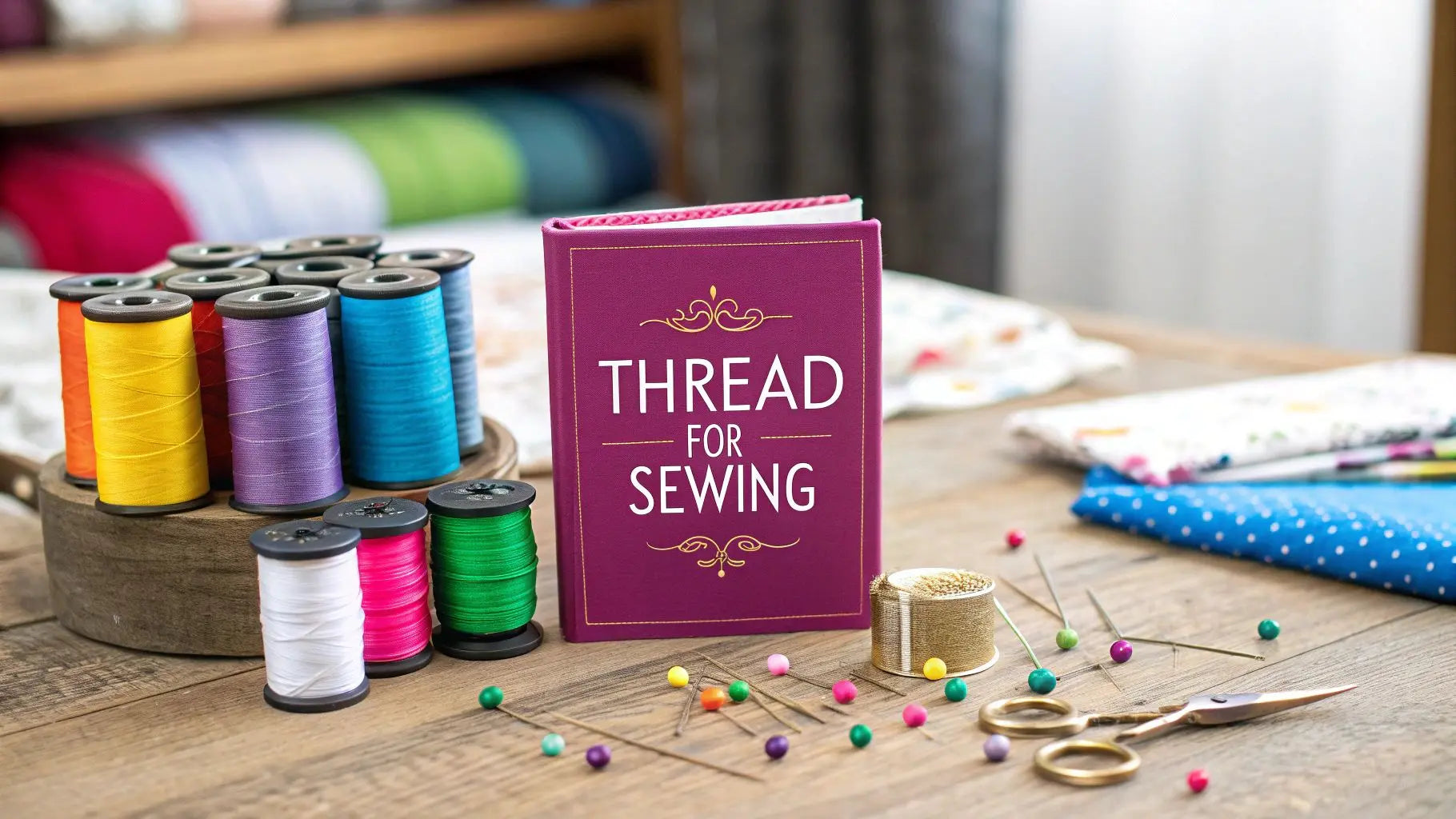
Welcome to the world of sewing, a craft where the smallest components often make the biggest difference. The thread for sewing is a perfect example—it's the unsung hero of every single project, the literal backbone holding your beautiful creations together. Finishing your next sewing project starts with understanding this crucial element.
Think of thread as the mortar between your fabric bricks. Get it right, and you’ve built strength and beauty that will last for years. Get it wrong, and you're setting yourself up for frustration and a project that just won't hold up. This guide will give you the educational foundation to choose correctly every time.
Why Your Thread Choice Is Everything
Picking the right thread is so much more than just finding a color that matches. It’s about understanding how that one little strand will work with your fabric, your needle, and your machine to create seams that are as strong as they are lovely.
The wrong thread is the culprit behind so many common sewing headaches:
- Seams that pucker and look wavy
- Thread that constantly snaps while you're sewing
- Stitches that pop the minute they’re put under a little stress
- Finished projects that wear out way too soon
This guide is your map to navigating the massive world of sewing thread. We're going to dive into everything from the basics of fiber types and thread weight to the nitty-gritty of pairing the perfect thread with the right needle and fabric. You'll learn not just what to choose, but why, so you can create beautiful, durable projects every single time.
A well-chosen thread is the foundation of any quality project. It ensures all the love and effort you pour into cutting and stitching results in a piece that truly stands the test of time.
Whether you're piecing a quilt top or sewing a new dress, getting a handle on thread is a total game-changer. For instance, that perfect finish when you learn how to bind a quilt by hand absolutely depends on having the right thread for the job.
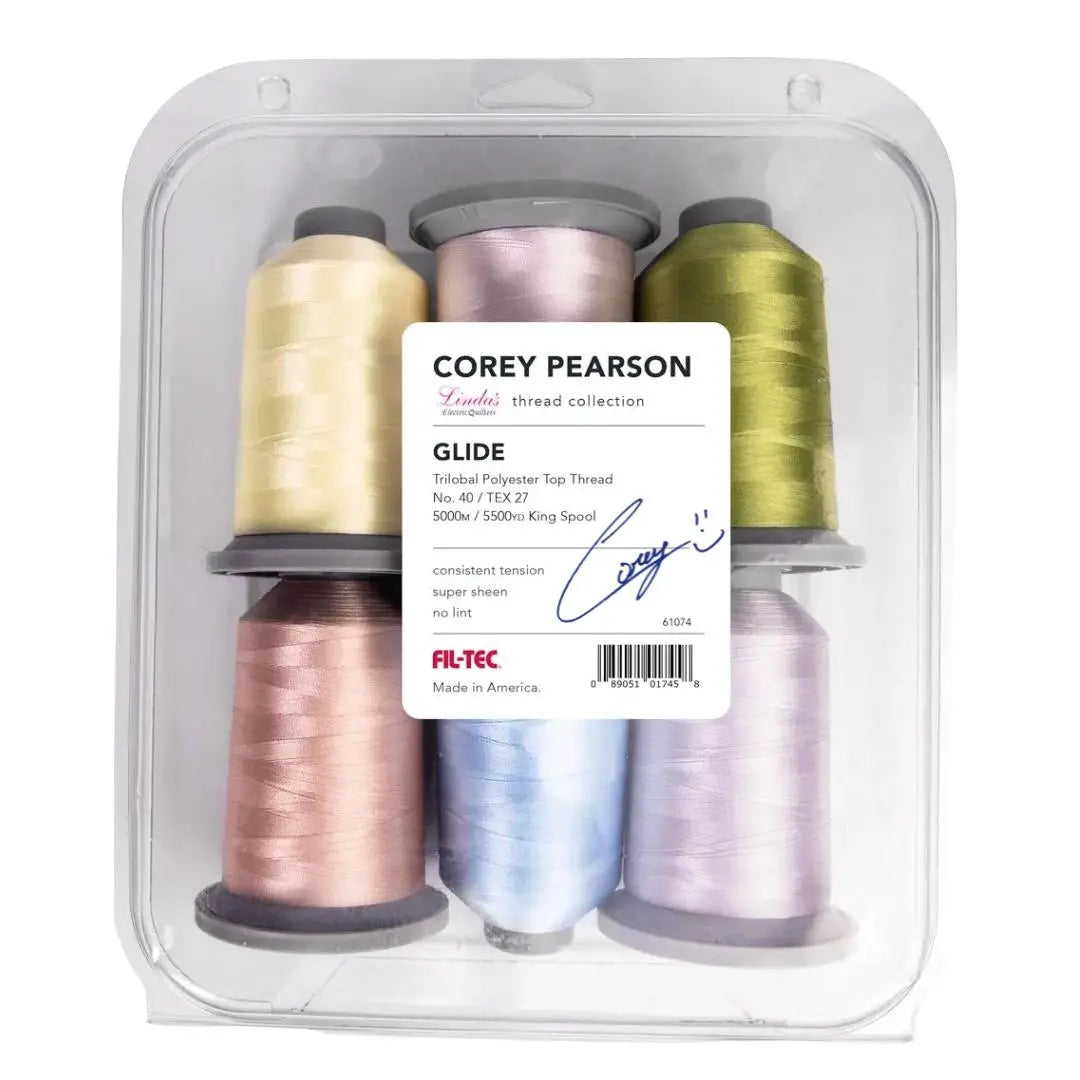
So, let's get you ready to take your sewing from "homemade" to "high-quality," all starting with that one perfect spool of thread from Linda's.
Exploring Different Sewing Thread Fibers
Picking the perfect thread for your project starts with understanding its fiber. Just like fabric, the fiber a thread is made from gives it a distinct personality—it determines its strength, behavior, and the projects it was born to tackle. Getting this right is the first step toward seams that not only look fantastic but are built to last.
Think of sewing thread fibers as falling into two big families: natural and synthetic. Each has its own strengths and weaknesses, and you'll choose one over the other for specific reasons—kind of like picking the right tool for the job from your toolbox.
Natural Fibers: The Classic Choice
Natural fibers come from plants and animals, and in our sewing world, the undisputed king is cotton. Quilters and anyone working with natural-fiber fabrics absolutely swear by it, and for good reason.
Picture cotton thread as a sturdy, dependable oak tree. It’s strong, but it has almost no stretch. This lack of "give" is a quilter’s best friend, helping you maintain those razor-sharp, precise seam allowances without any pulling or distortion. It also has a lovely, soft matte finish that just melts into cotton fabrics.
One of cotton thread’s biggest superpowers is its high heat resistance. You can crank up your iron and press those seams flat without a single worry about the thread melting. This is a non-negotiable for getting crisp, perfect quilt blocks.
When you're sewing with 100% cotton fabric, using a cotton thread is almost always the way to go. It just makes sense—the fabric and thread will wear, age, and even shrink at a similar rate, keeping your finished project happy and harmonious for years to come.
Synthetic Fibers: The Versatile Workhorse
While cotton certainly has a special place in our hearts, synthetic threads have really taken over the main stage. In fact, threads like polyester and nylon make up roughly 80% of all sewing threads sold across the globe, with natural fibers accounting for the other 20%. The garment industry, in particular, relies on their incredible versatility.
Let's look at the most common synthetics you'll run into:
-
Polyester: If cotton is the sturdy oak, polyester is like flexible bamboo. It’s incredibly strong and has just a little bit of stretch, making it super resilient. This is why all-purpose polyester is the go-to thread for a massive range of projects, from sewing clothes to home decor.
-
Nylon: This is the heavyweight champion. Known for its incredible strength and elasticity, nylon is the thread you reach for when durability is everything. Think outdoor gear, luggage, and heavy-duty upholstery where a broken seam is not an option.
The subtle differences between these fibers can make a huge impact on the final look and feel of a project, especially for designers and brands focused on showcasing intricate fabric details through professional-quality images. The right thread choice simply elevates the entire piece.
To make things a little easier, here's a quick rundown of how these fibers stack up against each other.
Comparing Common Sewing Thread Fibers
This table is your cheat sheet for quickly comparing the big three thread fibers. Keep it handy!
| Fiber Type | Key Characteristics | Best For Projects Like... | Considerations |
|---|---|---|---|
| Cotton | Soft, no stretch, high heat resistance, matte finish | Quilting, piecing, sewing with 100% cotton fabrics | Not as strong as polyester; can break under high tension. |
| Polyester | Strong, durable, slight stretch, resistant to UV/mildew | General apparel, knits, wovens, most all-purpose sewing | Can melt under very high heat; slight stretch may not be ideal for precision piecing. |
| Nylon | Very strong, high elasticity, durable | Upholstery, outdoor gear, bags, heavy-duty fabrics | Too strong for delicate fabrics; can melt easily; high stretch can cause puckering. |
So, how do you choose? It always comes back to your project. Are you piecing a precious heirloom quilt out of beautiful cotton prints? Or are you sewing a stretchy knit top that needs to move with you? When you match the thread's fiber to the fabric's function, you're setting yourself up for sewing success from the very first stitch.
Ready to find the perfect fiber for your next creation? At Linda's, we offer an amazing selection of high-quality cotton and polyester threads from top brands like Gutermann and Mettler. Explore our collection today and give your project the strong, beautiful foundation it deserves.
Cracking the Code on Thread Weight and Size Labels
Have you ever found yourself standing in the sewing aisle, just staring at a wall of thread, feeling like you need a secret decoder ring? Those little numbers on the labels—50 wt, 40/2, or Tex 30—can feel like a completely different language. If you've ever felt that way, you're not alone. Let's break it down together.
Getting a handle on these numbers is one of the most important steps to picking the right thread for any project. Once it clicks, you'll be able to walk into any shop, grab a spool, and know exactly what you're holding and how it's going to behave. It’s a game-changer that takes the guesswork out of your sewing.
The chart below gives a great overview of the two main families of thread: natural and synthetic.
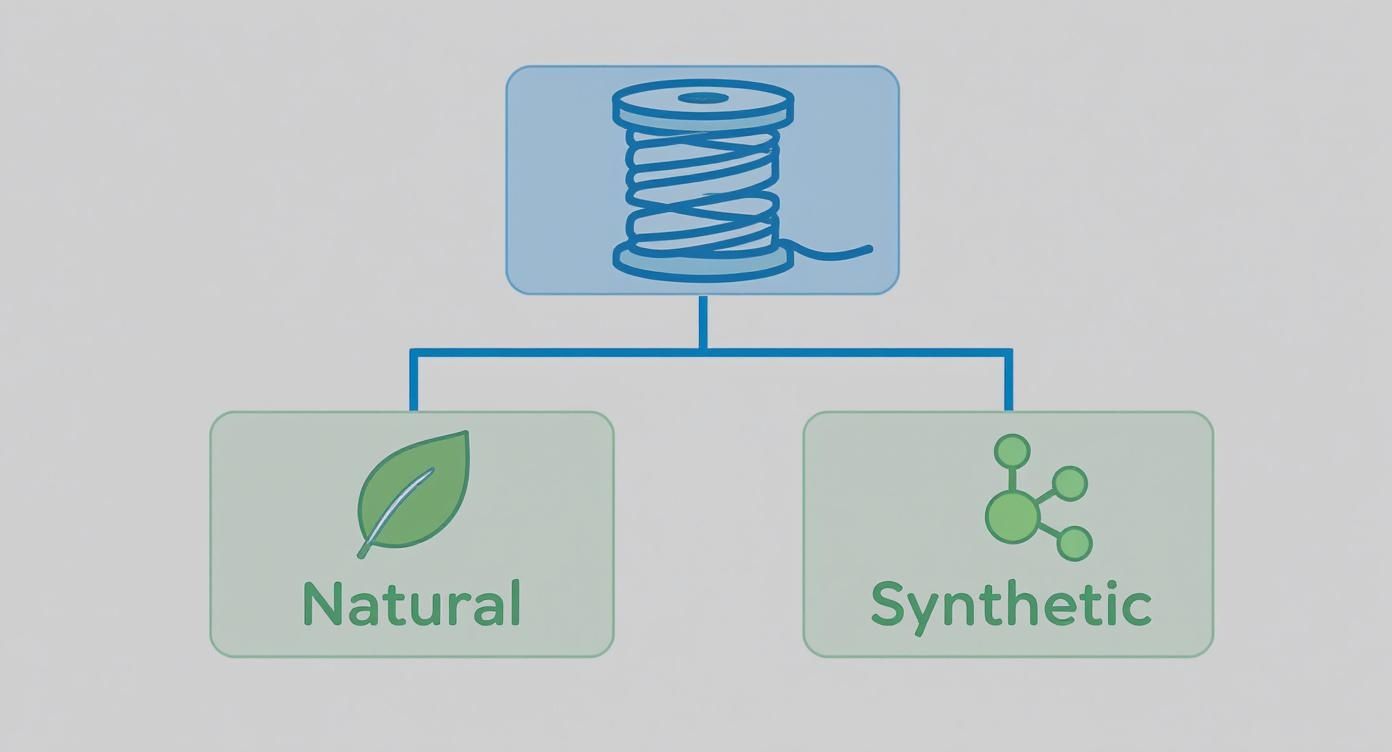
This helps you see the first big difference in threads—the fiber itself—which is the foundation for everything else, including its weight.
What Does the Weight (wt) System Mean?
The system you'll see most often, especially if you're a quilter or home sewer, is the weight system (or "wt"). The basic rule is simple, but it feels backward at first: the higher the number, the finer the thread.
Just think of it this way: a higher number means it takes more length of that thread to add up to a specific weight (like a kilometer).
- An 80 wt thread is super fine, almost like hair. It's the perfect choice for delicate work like heirloom sewing, invisible appliqué, or for the bobbin when you're doing dense machine embroidery.
- A 50 wt or 40 wt thread is your reliable, everyday workhorse. This is what you’ll grab for piecing quilts and most garment sewing.
- A 12 wt thread is thick and beefy. You'd use this to make a statement with decorative topstitching on a pair of jeans or for big-stitch quilting that you really want to pop.
The weight system is your best clue for how visible and strong a thread will be. A low number like 12 wt is thick and designed to be a feature, while a high number like 80 wt is meant to disappear into the fabric.
If you want to go even deeper on which weights are best for specific projects, our comprehensive guide to sewing thread sizes is a fantastic resource to bookmark.
Other Systems: Tex and Denier
As you explore more specialized sewing, you might run into other sizing systems like Tex and Denier. These are more common for industrial threads, but it's good to know what they mean. Unlike the weight system, these are much more straightforward: the higher the number, the thicker the thread.
The Tex system, for example, is based on how many grams 1,000 meters of thread weighs. So, a Tex 30 is heavier and thicker than a Tex 20. This direct, logical system is why it’s preferred in manufacturing, a global market valued at USD 3.66 billion.
Here’s a quick cheat sheet to keep them straight:
| System | Logic | Higher Number Means... | Common Uses |
|---|---|---|---|
| Weight (wt) | Indirect (Counterintuitive) | Thinner Thread | Quilting, Home Sewing |
| Tex | Direct (Logical) | Thicker Thread | Industrial, Upholstery |
| Denier | Direct (Logical) | Thicker Thread | Embroidery, Industrial |
Understanding these labels gives you real power as a maker. You’re no longer just grabbing a spool because the color looks right; you’re choosing a thread with the exact thickness and character your project needs. Now you're ready to find that perfect thread at Linda's and give your project the beautiful finish it deserves.
Matching Your Thread, Needle, and Fabric
Ever had a sewing session go completely sideways? Skipped stitches, thread that shreds for no reason, and seams that pucker and bunch up? It's enough to make you want to throw your machine out the window. More often than not, the culprit isn't you or your machine—it's a simple mismatch between your thread, needle, and fabric.
Think of these three components as a team. For a perfect stitch, they all need to be working together in harmony. Get the combination right, and your sewing will be smooth, strong, and beautiful. Get it wrong, and you're in for a world of frustration.
The core idea is pretty simple: the thread must pass smoothly through the needle's eye, and the needle must pierce the fabric without a struggle. Let's break down how to make that happen every single time.
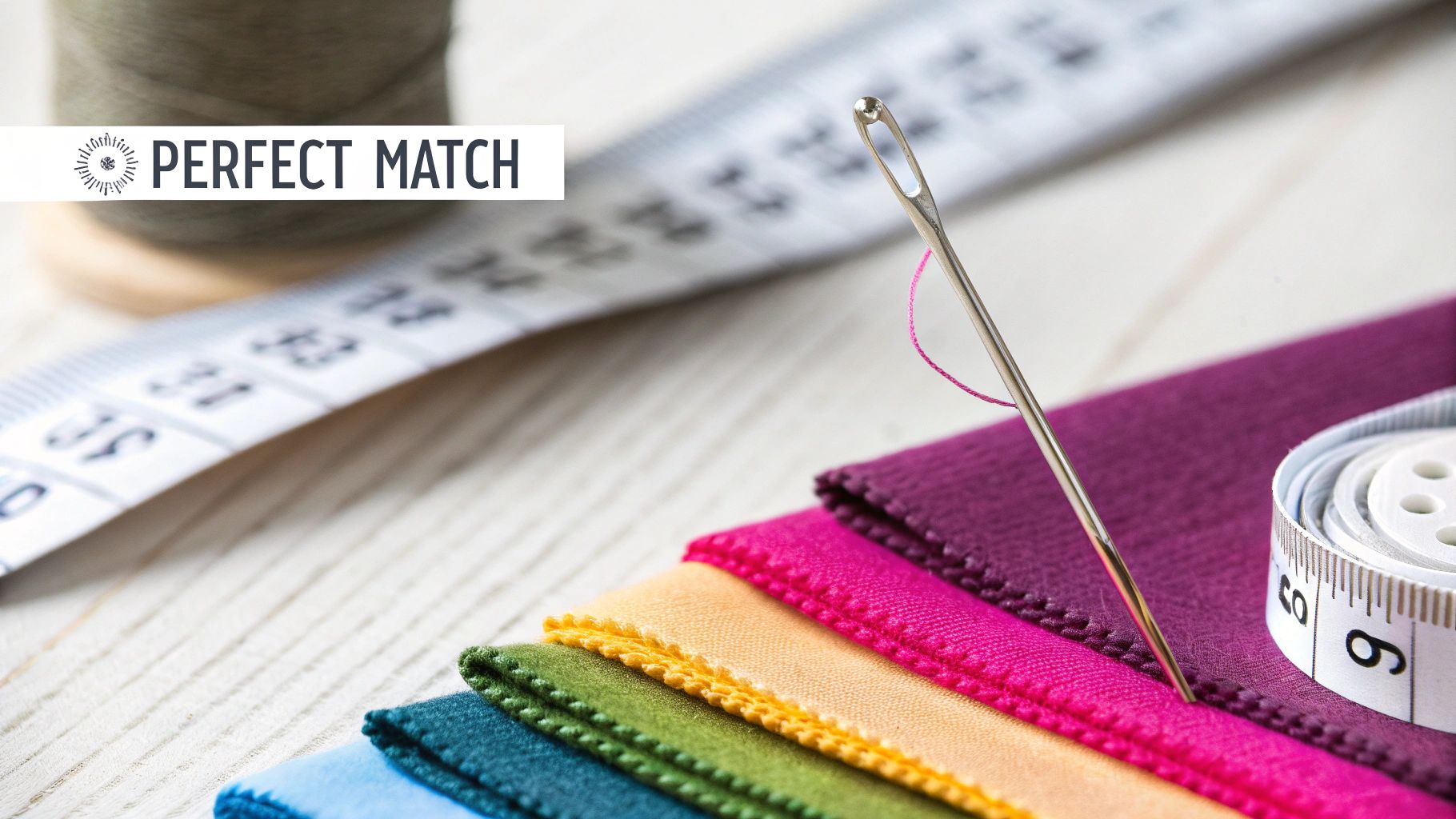
The Needle and Thread Partnership
First things first, your needle and thread have to get along. If you try to force a thread that's too thick through the eye of a needle, you create a ton of friction. That friction builds up heat, and before you know it, your thread is shredding and snapping mid-seam—especially polyester threads.
On the flip side, using a thread that’s way too thin for the needle is just as bad. It will flop around loosely in that oversized eye, which messes with the machine's ability to form a proper tension loop. The result? Messy, inconsistent, and weak stitches.
Here's a quick visual check: hold the needle up to a light source. The thread should fill about 40% of the eye. If it looks like it's being squeezed through, or if it looks lost in a giant hole, you need to change either your thread weight or your needle size.
This balance is absolutely vital, especially when you're choosing the best material for quilts. A quilt is a long-term project, and you need that fabric, batting, needle, and thread to cooperate perfectly for a piece that will last for generations.
Pairing Needles with Fabric Types
Once your needle and thread are happy together, it's time to make sure that needle is the right one for your fabric. This is a step so many people skip, but it makes a massive difference. Needles aren't one-size-fits-all; they have different points designed for specific jobs.
- Universal Needles: Your go-to for most projects. With a slightly rounded point, they handle woven fabrics like quilting cotton, linen, and broadcloth like a champ.
- Ballpoint/Jersey Needles: If you're sewing knits, these are non-negotiable. The rounded tip is designed to push the fabric's fibers aside instead of piercing them, which prevents those dreaded runs and holes in your t-shirts and leggings.
- Microtex/Sharps Needles: Got some slick, tightly woven fabric like silk, microfiber, or batiste? A Microtex needle has an extra-fine, sharp point that slices through cleanly without snagging or pulling.
- Leather Needles: These mean business. The wedge-shaped point is designed to cut, not pierce, which is what you need for getting through dense materials like leather, suede, or vinyl without a fight.
Trying to use a sharp needle on a knit fabric is a classic mistake. It can literally sever the tiny loops of the fabric, creating small holes that will unravel and grow with wear and washing. It’s a tiny detail that has a huge impact on how well your finished project holds up.
A Quick Reference Guide
To make things even easier, here’s a handy little chart you can refer back to. It’s a great starting point for matching common fabrics with the right needle and thread.
| Fabric Type | Best Needle Type | Recommended Thread Weight | Project Example |
|---|---|---|---|
| Quilting Cotton | Universal or Quilting (80/12) | 50 wt Cotton or Polyester | Creating a quilt top |
| Knit Jersey | Ballpoint or Stretch (75/11) | 40 wt Polyester | Sewing a t-shirt or leggings |
| Silk or Chiffon | Microtex/Sharp (60/8 or 70/10) | 60-80 wt Polyester or Silk | Making a delicate blouse |
| Denim or Canvas | Jeans/Denim (90/14 or 100/16) | 30-40 wt Polyester (Topstitching) | Hemming a pair of jeans |
| Leather or Vinyl | Leather (100/16 or 110/18) | 30 wt Polyester or Nylon | Crafting a handbag |
When you take a moment to get these three elements lined up—your fabric, your needle, and your thread for sewing—you’re setting yourself up for success. You’ll spend far less time battling your machine and more time just enjoying the creative flow of bringing your project to life.
Choosing the Right Thread for Your Project
Alright, we've covered the basics. Now for the fun part: putting that knowledge to work on a real project. It’s one thing to understand thread theory, but it’s another to confidently walk over to your thread rack and grab the perfect spool for the project right in front of you.
This is where you really level up your craft. Matching your thread to your project—whether for looks, strength, or function—is what separates good results from great ones. It's how you make things that not only look fantastic but also last.
Let's break down how the pros pick the right thread for sewing in a few popular areas.
Perfect Pairings for Quilters
For quilters, everything is about harmony between the fabric and thread. That's why 100% cotton thread is the undisputed champion for piecing quilt tops. Think of it as creating a perfect partnership.
When you use cotton thread with cotton fabric, they behave as a team. They'll shrink, stretch, and wear at the same rate through countless washes and ironings. This means your seams will age just as gracefully as your fabric, preventing any weird pulling or puckering years down the road.
Most quilters swear by a medium 50 wt cotton thread. It’s the sweet spot—strong enough for a durable seam but fine enough that it won’t add extra bulk.
But quilting is about more than just piecing blocks together; it’s an art. And that's where the more creative threads get to shine.
- Variegated Threads: These threads are dyed with multiple colors along a single strand. When you stitch with them, they create a gorgeous, dynamic effect that can completely elevate the texture of your quilting.
- Decorative Threads: If you want your stitches to make a statement, grab a thicker thread. A bold 12 wt cotton, for example, is perfect for "big stitch" hand quilting, turning your stitches into a prominent design feature.
For a quilter, thread is both a tool for construction and a paintbrush for creativity. The right spool can either disappear seamlessly into your work or stand out as the star of the show.
If quilting is your passion, you'll love our deep dive into the best thread for quilting, which has even more pro tips and recommendations.
Essential Threads for Apparel Sewing
When you're making clothes, your seams have a tough job. They need to handle stretching, moving, and plenty of trips through the laundry. That's why all-purpose polyester thread is the hands-down winner for sewing garments.
Polyester has strength and a little bit of natural stretch, making it the ideal choice for almost any fabric you can throw at it, from crisp wovens to stretchy knits. A good 40 wt polyester thread will get you through the vast majority of your apparel projects.
But what about those special cases?
Project Spotlight: Activewear Leggings
- The Challenge: You need seams that can stretch as much as the fabric without snapping. Standard polyester might not have enough give for a super-stretchy knit.
- The Solution: This is a job for woolly nylon thread in your serger loopers or a dedicated stretch thread. This stuff is texturized and has incredible stretch and recovery, creating seams that move right along with you.
Project Spotlight: A Delicate Silk Blouse
- The Challenge: A standard thread can look chunky and cause puckering on fine fabrics like silk or chiffon. It just overpowers the delicate material.
- The Solution: Go fine. A 60 wt or even 80 wt polyester thread is so delicate it practically melts into the fabric, giving you beautiful, flat, nearly invisible seams that let the fabric drape perfectly.
High-Impact Threads for Machine Embroidery
Machine embroidery is all about the "wow" factor. You want designs that are vibrant, shiny, and demand attention. Here, a thread's appearance is every bit as important as its strength.
The two undisputed kings of the embroidery world are rayon and polyester.
- Rayon Thread: This is your go-to for that classic, high-sheen, silky finish. Rayon gives embroidery a beautiful, luxurious luster that’s hard to beat.
- Polyester Thread: While still nice and shiny, polyester’s true strength is its incredible durability. It's colorfast and can stand up to heavy laundering and even bleach, making it perfect for kids' clothes, towels, and anything else that will see a lot of wear.
For most designs, a 40 wt in either fiber is the standard. It provides excellent coverage to fill in designs while still being fine enough to stitch out crisp details.
No matter what you love to create, using the right thread is a game-changer. When you're ready to find the perfect match for your next project, explore the incredible selection of Gutermann and Mettler threads at Linda's. We've got just the thing for any quilt, garment, or embroidery design you can dream up.
How to Fix Common Sewing Thread Problems
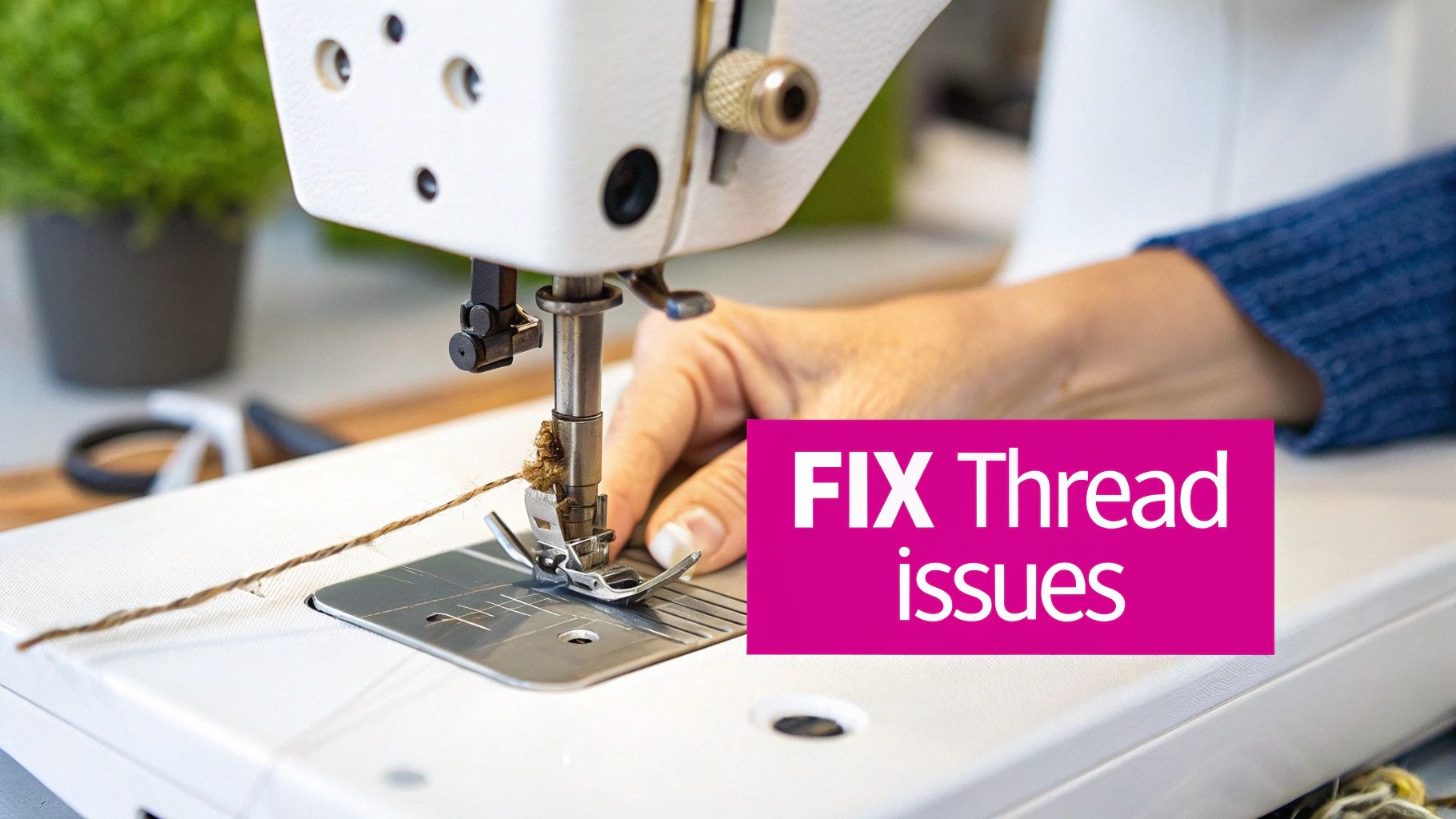
We've all been there. You're in the zone, sewing along beautifully, and then... snap. The thread breaks, your seams start to pucker, or the machine starts making a noise that just doesn't sound right. It’s frustrating enough to make you want to walk away.
But don't give up! The good news is that most of these pesky thread problems are surprisingly easy to fix once you know what to look for. Think of yourself as a sewing detective—your machine and thread are giving you clues, and learning to read them is a skill every sewist needs.
Let's break down some of the most common culprits and get you back to smooth, happy stitching in no time.
Why Is My Thread Breaking?
Nothing kills the creative flow faster than a thread that keeps breaking. Before you throw the spool across the room, take a deep breath and run through this quick checklist. The problem is usually simpler than you think.
- Old or Poor-Quality Thread: Yes, thread has a shelf life! Over time, it can become brittle and lose its strength. A quick way to test it is to pull off a foot-long piece and give it a sharp tug. If it snaps with barely any effort, it’s past its prime and won't stand up to the tension of your machine.
- The Wrong Needle: This is a huge one. Using a needle that's too small for your thread is like trying to squeeze a camel through... well, you know. The friction will shred and eventually snap the thread. Make sure the needle's eye is large enough for your thread for sewing to glide through effortlessly.
- Machine Tension Issues: If your upper tension is cranked too high, it's constantly pulling and straining the thread. Start by completely re-threading your machine (always with the presser foot up!) and then try lowering the tension dial a notch or two.
How to Stop Seams from Puckering
Ugh, puckered seams. Those tiny, wavy gathers can make an otherwise perfect project look homemade in all the wrong ways. Puckering happens when your thread pulls the fabric too tightly, and it's almost always a tension problem.
Your first stop should be the top tension dial on your machine. It’s likely set too high, especially if you’re working with lightweight fabrics like voile or chiffon. These delicate materials just can’t handle aggressive tension and will pucker at the slightest provocation.
The real culprit behind puckering is often an imbalance between the top thread and the bobbin thread. If tweaking the top tension doesn't solve it, your bobbin might be the one causing trouble. Learning how to adjust bobbin tension is a game-changing skill for any sewist.
Another thing to check is your thread weight. Using a heavy-duty thread on a lightweight fabric is a recipe for disaster. The bulky thread will physically pull on the delicate fabric fibers, causing them to bunch up. A good rule of thumb is to always match your thread weight to your fabric weight.
Solving Shredding and Skipped Stitches
Are you noticing your thread looks fuzzy and frayed as it feeds through the machine? Or are you seeing frustrating gaps in your stitch line where the machine just didn't catch? These two issues often go hand-in-hand and point to the same suspect.
Nine times out of ten, a dull or damaged needle is to blame. Even a microscopic burr on the needle's tip can snag and shred your thread with every single stitch. As a general rule, you should pop in a fresh needle after every 8-10 hours of sewing.
That same dull needle also causes skipped stitches. Instead of cleanly piercing the fabric, a worn-out needle pushes the fabric down into the machine. This prevents the hook from catching the thread loop to form a proper stitch. The fix is wonderfully simple: change your needle!
Troubleshooting is just part of the journey. Every snag and snap is a lesson that makes you a better, more intuitive sewist. By learning to spot these common problems, you turn frustration into knowledge.
Your Sewing Thread Questions Answered
Even after you've been sewing for a while, you'll still run into questions mid-project. It happens to all of us! Let's tackle some of the most common ones we hear about choosing the right thread for sewing.
Can I Use All-Purpose Polyester for Everything?
All-purpose polyester is an absolute workhorse, and it's my go-to for a ton of projects, especially anything with synthetic or blended fabrics. That bit of stretch and serious strength makes it a rockstar for garment seams that need to last.
But is it the perfect choice for everything? Not always. If you're quilting with 100% cotton fabrics, many quilters (myself included) swear by cotton thread. This lets the thread and fabric age, wear, and shrink together beautifully. And if you’re working with something super delicate like silk chiffon, a much finer thread (like a 60-80wt polyester or even silk) will give you a nearly invisible seam that doesn’t overpower the fabric. So while polyester is a fantastic default, sometimes a specialty thread just makes a project sing.
How Do I Know If My Thread Has Gone Bad?
Oh, thread absolutely has a shelf life. Over time, sunlight and dust can make it brittle and weak. There’s a super simple way to check if a spool is still kicking: the "snap test."
Just unwind about a foot of thread and give it a quick, sharp tug between your hands. If it breaks with barely any effort, it's past its prime. Using it in your machine will lead to nothing but headaches and snapped threads. Good, healthy thread should put up a fight! If you have a gorgeous vintage spool that fails the test, don’t toss it—it’s perfect for hand-basting or other crafts where strength isn't critical.
A quick snap test can save you hours of troubleshooting. Never risk the integrity of a project you've poured hours into with old, brittle thread.
Does Thread Color Really Matter for Hidden Seams?
Honestly, for construction seams that no one will ever see, a perfect color match isn't a big deal. I keep a good stock of neutral colors like gray, beige, and off-white on hand because they blend into almost anything without a fuss.
Where you have to be careful is with high-contrast pairings, like using black thread on a white shirt. Sometimes, that dark thread can create a subtle "shadow" that actually shows through the light fabric, making your seam lines visible from the outside. A great rule of thumb is to pick a thread that’s one or two shades darker than your fabric—for whatever reason, a darker thread tends to disappear into the seam better than a lighter one.
Ready to find the perfect thread for your next masterpiece? At Linda's Electric Quilters, we've got you covered. Whether you need a trusty all-purpose polyester, a beautiful cotton for your next quilt, or something special for a unique project, our selection is second to none. Give your work the high-quality finish it deserves. Explore our threads at lindas.com.