
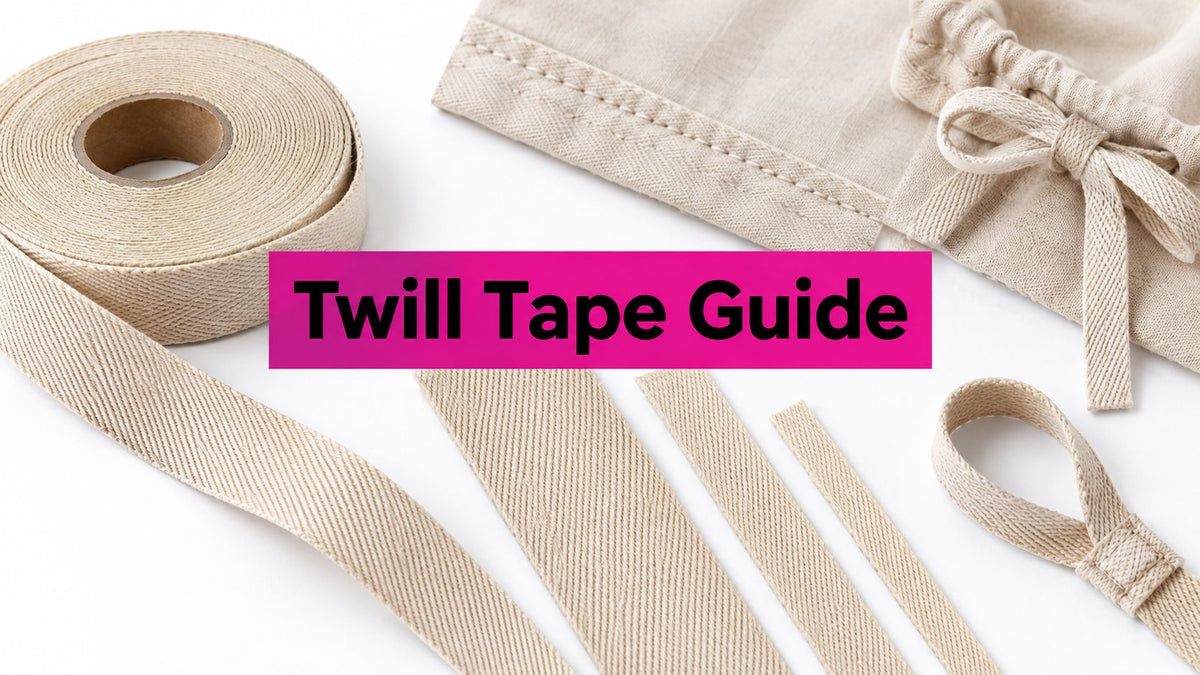
Could two rolls labeled cotton twill tape behave differently in the same project? Absolutely. Twill tape for sewing should be chosen by width, construction, and washing behavior, not just fiber name. A narrow, supple tape might suit a quilt label, while a handle needs enough body and a well-designed attachment seam. Before cutting your finished pieces, test the tape beside your project fabric so shrinkage, bulk, or dye transfer doesn't spoil the result.
What Twill Tape Is and How Its Weave Works
Twill tape is a flat, narrow woven strip whose diagonal ribs, called wales, form through an offset pattern of yarn floats and interlacings. Unlike fabric strips cut from yardage, it's woven as a narrow textile with finished edges.
The diagonal structure matters when you're handling the tape. The Museum of Fine Arts textile reference explains that twill has fewer interlacings than plain weave, generally allowing better drape while retaining a durable structure. In practice, that makes a flexible woven strip useful where a stiff trim would fight the shape of an edge.
Look closely at the diagonal texture before choosing your tape.
What does twill tape do?
The twill tape reference identifies its main sewing roles as reinforcing seam allowances, stabilizing edges and facings, forming casings, and making durable ties or loops. Its flat shape is easier to position beneath a presser foot than round cord, but that doesn't make the materials interchangeable.
Twill isn't a single fixed construction. The Museum of Fine Arts weaving reference lists float arrangements including 2:1, 3:1, and 6:2, with warp-faced, weft-faced, or even-sided results. Consequently, tapes carrying the same general name can have different surfaces and hand, meaning how they feel and bend.
Herringbone twill reverses the diagonal direction into a repeated chevron. It's related to regular twill tape, not a separate fiber.
Practical rule: Feel the tape, fold it, and inspect its edges. Fiber and width won't tell you everything about thickness, firmness, or how neatly it will stitch.
Twill Tape Widths and Lengths by Project
Twill tape widths and typical uses
| Width (inch and mm) | Typical project use | Published tensile reference |
|---|---|---|
| 1/4 in (6 mm) | Fine piping, loop ties, label tabs | No rating established for this general width |
| 1/2 in (13 mm) | Casings and drawstring channels | No rating established for this general width |
| 1 in (25 mm) | Bag straps and sturdy ties | Test the selected construction and attachment |
| 1-1/8 in (28.6 mm), heavy 2/2 cotton twill | Load-bearing handles and ties | 260 lb tensile, product-specific |
| 2-1/2 in (63.5 mm), same listed thickness and weave | Wide straps and quilt-frame tie-downs | 625 lb tensile, product-specific |
Treat the smaller widths as starting points for fitting a project, not certified applications. The heavy-tape tensile figures describe particular specified constructions, not everything sold at those widths, and they aren't safe working-load ratings for a finished bag.
How do you choose the right width?
Lay a sample over the actual seam allowance. You need room for secure stitching without making the tape protrude into a facing, interfere with a fold, or crowd the finished edge.
For garment work, Mood Fabrics' cotton twill tape specification identifies 3/8-inch tape for reinforcing hems, seams, and waistbands, as well as forming bodice boning channels. That's a useful intermediate size when a wider strip would add unwanted bulk.
For casings, check the finished internal opening, not just the tape's purchased width. Stitching takes up space, and the drawstring must still move freely after laundering.
- Measure the route: Follow the seam or casing line with a flexible tape measure.
- Include the ends: Allow for turned-under ends, attachment areas, and knots.
- Buy testing allowance: Add enough material for laundering samples and stitched trials rather than purchasing only the finished length.
Machine transport is a separate equipment decision from tape selection.
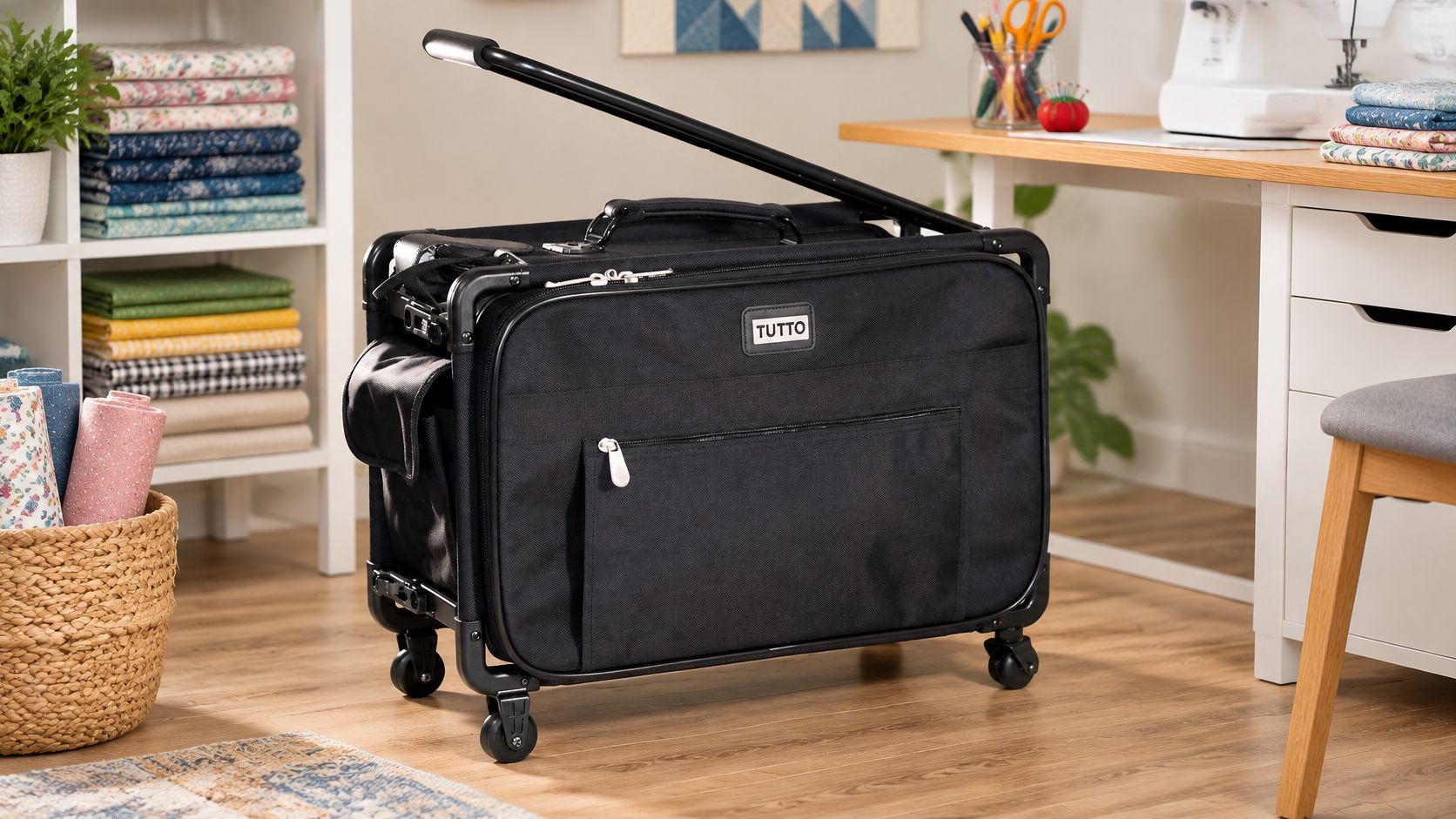
If you're assembling a portable sewing setup, the Tutto Sewing Machine Case On Wheels Medium 20in Black has top and front openings, storage pockets, and inside straps to secure a machine. Its straps aren't a specification for homemade twill-tape handles.
Fiber Choices for Washing, Strength and Feel
Fiber percentage alone doesn't predict performance. A loose cotton tape and a densely woven cotton tape may share a fiber label but behave differently under the presser foot or in a stitched attachment. Finish, yarn size, and weave density also deserve attention.
Twill tape fibers compared
| Fiber | Shrinkage | Feel and handling | Best use |
|---|---|---|---|
| Cotton | Shrinks unless preshrunk; verify the finished tape | Soft, presses well, accepts marking | Quilt labels, garment edges, casings |
| Linen | Allow for shrinkage; test before cutting | Crisp, firm hand | Heirloom garment ties and edge finishes |
| Polyester | Generally low; confirm with a wash sample | Smooth, shape-holding, sometimes slick | Washable ties and bag projects; verify outdoor suitability |
| Wool | Can felt or shrink with heat and agitation | Springy, needs gentle care | Tailored garment trims |
| Cotton-polyester blend | Low to moderate; test the specific blend | Often soft with some give | Washed quilts, bags, and binding |
These are selection tendencies, not guarantees of tensile strength, colorfastness, or weather resistance. Natural doesn't automatically mean safer or more durable, and synthetic doesn't automatically mean suitable for every high-stress application.
What matters beyond fiber content?
SewGuide's sewing-tape guide provides context for reinforcement, casings, and finishing uses. For repeatedly washed projects, turn that general guidance into a project-specific check: inspect thread density, compare wet and dry hand, and examine abrasion where the tape rubs against an opening.
A quilt label needs compatible laundering behavior. A bag handle also needs comfortable edges and a reliable attachment, while a garment tie needs to knot without becoming awkwardly stiff.
Before buying, establish:
- Fiber content: What exactly is the tape made from?
- Construction: What are its thickness, weave, and edge firmness?
- Finish: Is it preshrunk, coated, dyed, or otherwise treated?
For an initial care trial, wash cotton and linen gently in cool water, air dry, and press at a fiber-appropriate setting. Polyester and blends may tolerate warm washing if their care instructions allow it; keep wool cool and dry it flat. Don't assume sealing a synthetic end makes it resistant to a hot iron.
Alternatives and How to Choose Your Tape
Choose twill tape for sewing by deciding what the strip must do. A material that makes an attractive tie may be wrong for a curved binding or an elasticized waistband.
- Choose width by load and bulk: Fit the tape to the attachment area, not merely the appearance you want.
- Choose fiber by care and hand: Match the finished project's washing routine and how the tape will feel against skin.
- Confirm construction before cutting: Check thickness, weave, finish, and whether the machine can stitch the full assembly cleanly.
Is bias binding the same as twill tape?
No. Stretch and curve conformity are the deciding differences. Bias binding is cut diagonally across fabric grain so it can accommodate curves; twill tape is a narrow woven textile designed to retain its general line.
For a rounded neckline, test whether the tape lies flat without pulling the fabric inward. If you have to force it into place, bias binding may be the better finishing material.
When should you use elastic, ribbon, or cord?
Recovery calls for elastic. A waistband or gathered cuff that must expand and return needs elastic rather than a stable tape, although tape may form the channel around it.
Crispness and decoration may favor grosgrain ribbon. Grosgrain is woven too, so don't assume all ribbon is weak or purely decorative; select a product with appropriate specifications if it will carry stress.
Profile and bulk on curves may favor round cord or piping. Cord works well where you want a rounded tie or raised piping detail, but it creates a different shape beneath stitching than a flat strip.
Choose the material for its job before matching its color. A beautiful trim won't compensate for the wrong stretch, recovery, or thickness.
Twill tape remains a practical candidate for stable straight seams, firm channels, and ties with tested attachments. Before committing, place your alternatives on the project scrap and compare the folded bulk. That small check is especially useful when batting loft or several fabric layers will make the finished seam thicker than the flat pattern suggests.
Where Twill Tape Stabilizes Seams, Ties and Casings
The most useful applications become clearer when you follow the path of the stress. Is the fabric stretching along an edge, rubbing around a drawstring, or carrying force through a handle attachment?
The diagram groups the main jobs by how the tape supports the project.
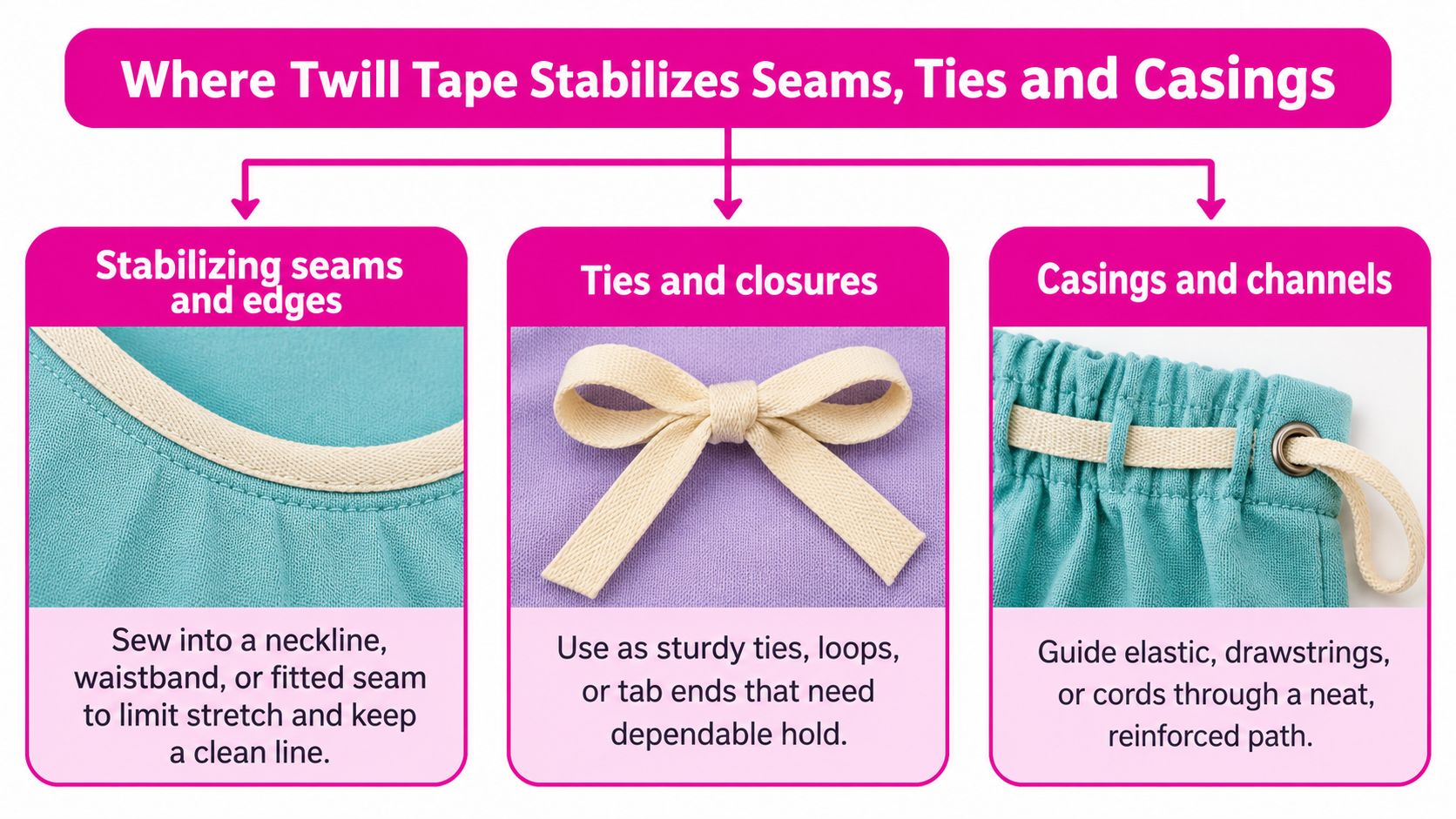
Where should the tape sit?
For seams and edges, position the tape within the planned seam allowance so the stitching secures it without changing the intended finished line. On a fitted waistband, baste first and check the fit before securing the tape permanently.
For casings, use the tape as a channel or reinforcement according to the pattern. Keep the opening clear, turn under exposed ends, and check that the cord moves without catching on the stitching.
For ties and handles, consider the attachment as part of the structure. A strong strip attached to a small patch of weak fabric can still tear away.
Why isn't width enough for a handle?
The U.S. government cotton-tape specification lists the heavy constructions in the width table at 260 pounds tensile strength for 1-1/8-inch tape and 625 pounds for 2-1/2-inch tape, with the same listed 0.042-inch thickness and 2/2 weave. These are product-specific tensile values, not ratings for sewn handles.
The stitched assembly can fail at several places:
- Seam design: The attachment may concentrate force in too small an area.
- Stitch density: Excessive perforation can weaken the materials.
- Needle damage: A poorly matched needle can cut or distort yarns.
- Substrate and edges: Fabric may tear, or an unfinished end may unravel.
The tape is the rope, but the stitching is the knot. Pull-test a representative assembly before using it for a bag strap, furniture tie, or quilt-frame connection. For longarm work, follow the frame manufacturer's attachment and tensioning instructions rather than substituting tape based on a tensile number.
Preshrink, Test and Stitch Twill Tape
Test twill tape for sewing as part of the complete fabric assembly. Washing a loose strip tells you about the tape, but stitching it to a scrap reveals puckering, needle damage, and incompatible dimensional change.
Use this visual sequence as a reminder of the preparation order.
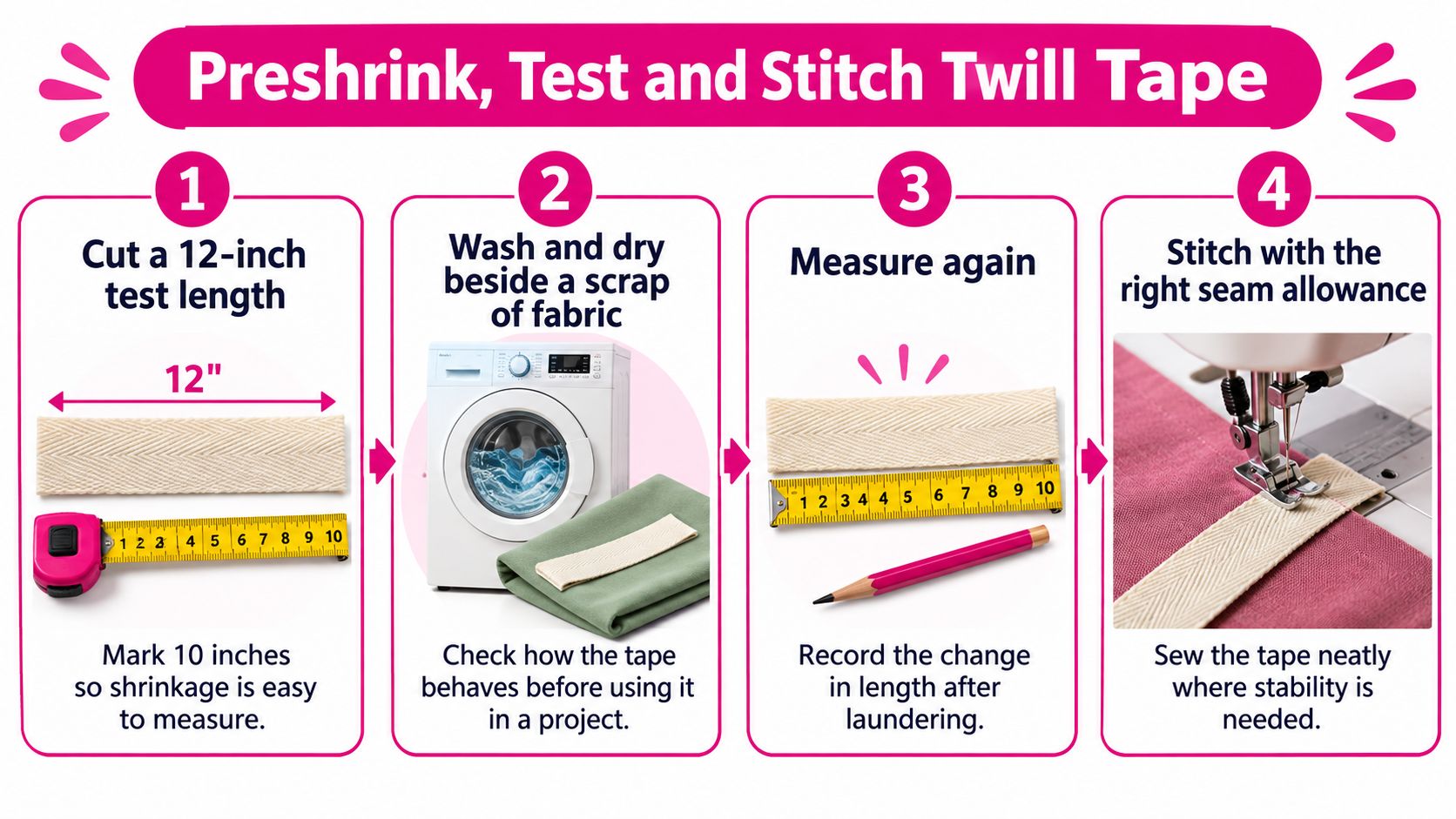
- Prepare a measurable sample. For a convenient home test, cut a 12-inch piece and mark a 10-inch interval along its length. Measure between the marks, not potentially frayed cut ends.
- Launder beside project fabric. Use the care routine the finished item will receive, including its drying method. A gentle sample wash won't tell you how the assembly behaves in a hotter routine.
- Measure again without stretching. Record the change and compare the tape with the fabric scrap. If either continues changing after laundering, stabilize the material before final cutting or choose a more compatible combination.
- Press the tape flat. Use a temperature suitable for the fiber, with steam only where appropriate. Let it cool before measuring or cutting so you aren't working with a warm, distorted strip.
- Finish the ends appropriately. Turn under and stitch cotton ends. Heat-seal a synthetic end only when the manufacturer permits it, using a heated cutting tool on a heatproof surface and keeping the melted edge away from skin.
- Check dye, folds, and stitching. Press a damp tape sample against light scrap fabric to check transfer, then assess whether a folded end stays manageable. Sew the planned layers with the intended needle, thread, and stitch length, then pull firmly and inspect the attachment.
Pro-tip: Mark which edge of the tape faces the fabric before removing a successful sample. Reproduce its orientation, seam allowance, and folded-end arrangement in the finished project instead of relying on memory.
Don't try to make diagonal wales parallel to a straight seam by twisting the tape. Keep the tape's length aligned with the intended stitching route.
For additional sewing education, use the video tutorial below alongside your sample work. Check its demonstrated topic before treating it as preshrinking guidance; a video isn't confirmation that a particular tape has been tested.
Twill Tape Questions Answered
Can I iron twill tape?
Yes, provided you use a setting appropriate for its fiber and finish. Test a spare piece first, use a pressing cloth when needed, and keep synthetic tape cooler to avoid melting or glazing.
Does twill tape stretch?
Twill tape generally has limited lengthwise stretch, but it isn't completely rigid. Don't confuse flexibility with elastic recovery: a tape may bend comfortably around an edge without stretching and springing back like elastic.
Can I use twill tape for quilt labels?
Yes, preshrunk cotton twill tape is a useful candidate for quilt-label tabs or attachment strips. Test it with the quilt fabric, secure exposed ends, and keep the attachment clear of any label wording you want to remain visible.
How do I stop twill tape from fraying?
Fold and stitch natural-fiber cut ends, or enclose them within a seam. Some synthetic tapes can be heat-sealed when their manufacturer permits it, but a melted end may feel hard, so folding and stitching can still be preferable for skin-contact projects.
Keep a labeled sample with your project notes once you've found a suitable tape. Record its fiber, finished width, care routine, and attachment method so your next repair or matching accessory doesn't depend on finding an identical-looking roll.
Linda's Electric Quilters offers fabric, thread, batting, and notions, including needles, clips, quilt labels, and sewing machine aids for finishing your project. Visit Linda's Electric Quilters, explore the Notions category, and gather your finishing supplies after choosing and testing the tape width and fiber that suit your project. Put your sample beside the machine and finish that label, casing, or set of ties this week.


