
Hey everyone. Today we're talking about needles, and why I wouldn't use one needle type for everything you sew.
I know why it tempts you. I really do. The universal needle is already in the machine. It sewed your last project just fine. Changing it means stopping, finding the right pack, and reading tiny numbers. So you think, it'll probably work. Folks, probably is where the trouble starts.
Here is the plain truth. A needle is not just a needle. The point matters. The size matters. A universal point is slightly rounded. It is made to handle a little of everything. That also means it is perfect for almost nothing special. Knits need a point that slides between loops. Silk needs a slim, sharp point. Denim needs strength. Leather needs a cutting point. One needle cannot do all those jobs well.
The story
I learned this watching the same machine act like three different machines. Same sewist. Same thread. Same careful hands. Only the fabric changed.
First came a knit top. With a universal 80/12 in the machine, stitches skipped every few inches. Worse, tiny holes showed up along the seam. That sharp-ish point was cutting knit yarns instead of parting them. After washing, those little holes can grow into runs. You do not see the full damage that first day.
Then came a light, tightly woven fabric. Same needle, new problem. The seam puckered. The stitches looked pulled and uneven. The needle was just too blunt and too big for that fine weave. It was pushing the fabric instead of piercing it clean.
Then denim told the last part of the story. That same all-purpose needle flexed on the thick layers. Stitches wandered. One needle bent. Oh my goodness, y'all. The machine was not broken. The thread was not cursed. The needle was simply wrong for the job, three times in a row.
That is the lesson that stuck with me. When a seam goes wrong, we blame tension first. We blame thread second. We should check the needle much sooner. It is doing more work than most folks realize.
What I do instead
First, I match the point to the fabric. For knits, I reach for a ballpoint, also called a jersey needle. Its rounded tip slips between the loops. For very stretchy knits, I use a stretch needle, often in 75/11 or 90/14. Those two changes alone fix a lot of skipped stitches.
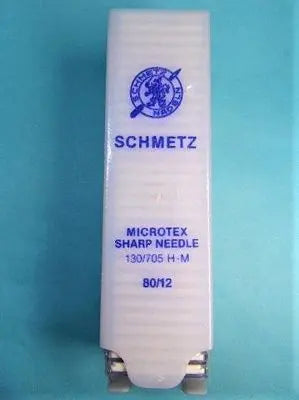
Second, for wovens and silk, I use a Microtex, also called a sharp. It has a slim, acute point. I like a 60/8 or 70/10 for chiffon and silk. I like a 70/10 or 80/12 for fine, tightly woven cotton. You get cleaner holes, less puckering, and straighter stitches. Just like that.
Third, I size up for heavy fabric, on purpose. For denim and canvas, I use a denim needle in 90/14 or 100/16. It has a stronger shaft and a sharp point. It does not deflect as easy on thick layers. For a normal medium cotton, an 80/12 is still a fine home base. The size follows the fabric weight. Lighter fabric, smaller number. Heavier fabric, bigger number.
Fourth, leather gets its own needle, and only that needle. A leather needle, usually 90/14 to 100/16, has a wedge-shaped cutting point. Remember, every hole in leather is permanent. So I test on an offcut first. Always. No exceptions on leather, folks.
Fifth, I keep them sorted and labelled. Needles live in their packs, not loose in a drawer. Some folks use a labelled needle book. Some folks use small boxes by type and size. My preference is the original pack, so the type and size are right there in print. But completely up to you. The system matters less than having a system.
And I test before I commit. I fold a scrap to the same layers I will sew. I run a short seam at my normal stitch length, about 2.5 millimeters for most garment seams. Then I look at both sides. Clean on top and bottom? Good. Skips, puckers, or holes? I change the needle first, before I touch tension.
Now hear me on this part. It doesn't have to be perfect. You're your own worst critic here. You do not need every needle ever made. Start with three types in your box: ballpoint for knits, Microtex for fine wovens, and denim for heavy work. Add leather only if you sew leather. Take your time. It's not a race. A two-minute needle change can save a whole garment.
This post is part of my What I Wouldn't Do as a Sewist series, where I share the lessons I learned the hard way so you don't have to.
Don't take my word for it — Melissa at Melly Sews walks through it in How to Choose a Sewing Machine Needle, matching your needle to your fabric, its thickness, and your thread.
Shop the Schmetz Magazine Microtex sz12/80 at Linda's Electric Quilters.
Thanks for hanging out with me today, folks. Check the point. Check the size. Then sew with confidence. If I can do this, y'all can do it. We'll see you next time. Bye.
— Corey, Chief Quilter, Linda's Electric Quilters


