
Hey everyone. Today you'll learn how to turn a thrifted quilt top into a cozy jacket, with wool batting inside and bound seams instead of a lining.
Here we go. You know that quilt top at the thrift store. Pretty blocks. Good colors. Maybe one corner is a little wonky. It deserves better than sitting in a bin. Make it a jacket you actually wear. The wool batting does two jobs at once here. It gives you warmth without a lot of weight. And it gives the top just enough body to hang like a real coat, not a floppy blanket.
Why wool? Wool breathes, y'all. It warms you outside without roasting you inside. It has a little spring, too, so quilting lines read really, really pretty. For a jacket, pick low to medium loft. Too puffy and you feel like a marshmallow. One layer is my sweet spot.
We skip the lining on purpose. Bound seams do that job. Every raw edge gets wrapped in binding. Clean finish, no slippery layer to fight. Just like that, the inside looks finished too.
Materials
- One thrifted quilt top, big enough for your pattern pieces — lay the pattern out before you buy
- Wool batting, low to medium loft, cut to match the top
- Backing fabric: quilting cotton or flannel, same size as the top
- A simple open-front jacket pattern with few pieces — front, back, and sleeves are easiest
- Double-fold bias binding, about 6 to 8 yards — make your own at 2 1/2 inches wide
- Thread, 50-weight, and a size 90/14 topstitch needle
- Walking foot, clips, chalk, a ruler, and sharp scissors
- Optional: one large button, a toggle, or a fabric tie for the front closure
How to Do It
- Check that top first. Hold it to the light. Look for thin spots and open seams. Restitch loose piecing at 2.0 mm. Press it flat.
- Build your sandwich. Backing fabric wrong side up. Wool batting in the middle. Quilt top right side up. Smooth from the center out. Pin or spray-baste well. This sandwich is now your jacket fabric.
- Quilt it lightly before you cut. Keep lines 2 to 4 inches apart, at 3.0 mm with your walking foot. Wool needs less quilting to stay put, and light quilting keeps it drapey. I stitched in the ditch, then added one echo. Super duper easy.
- Lay your pattern pieces on the quilted sandwich. Think about block placement. Center a pretty block on each front if you can. Cut all pieces, and mark notches with chalk.
- Sew the shoulder seams and side seams with a 1/2 inch seam allowance. Go slow over thick intersections. Slow down or the needle snaps. Backstitch at the start and end of each seam.
- Bind every seam. Open the allowances flat. Wrap binding around both together, or bind each alone for a flatter finish. Stitch close to the edge. This step replaces the lining. Take your time. It is not a race.
- Set the sleeves the same way, then bind the armhole seam too. It is a little bulky. Clips help more than pins. Completely up to you if you bind it in one pass or two.
- Bind the outer edges: front opening, neck, hem, and cuffs. Miter corners as best you can. Add your button, toggle, or tie. Try it on and smile.
Tips and Variations
Choosing wool weight. For a jacket over a sweater, pick thinner, lower-loft wool. For deep winter, you can double it, but test a sample first. Seams get thick fast.
Using a finished quilt instead. That works too. Skip steps 2 and 3 if it is already quilted and sound. Just check the batting is not lumpy or shifted.
My mistake, so you can skip it. My first one, I cut the pieces before quilting. The layers shifted a quarter inch. One sleeve was shy. Quilt first, cut second. I learned that one the honest way.
Pockets. Cut two squares from leftover sandwich, bind the top edge, and topstitch them on as patch pockets. Everybody loves a pocket.
And listen. That thrifted top will not be perfect. A point might be clipped. A seam might wave a tiny bit. You're your own worst critic. Nobody at the grocery store is checking your binding. If I can do this, y'all can do it.
Thanks so much for sewing along with me today. We'll see you next time. Bye.
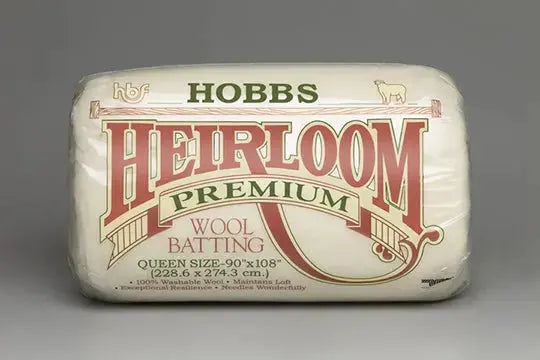
Shop Hobbs Heirloom Wool Batting Package — Queen 90" × 108" at Linda's Electric Quilters.


