
Hey everyone. Today you're going to learn why your batting choice decides how your hand quilting feels — before you ever take a stitch.
Here's the little-known thing. Hand quilting has batting rules. They are not written on most packages. But your hands will learn them fast.
Pick a thick, dense batting. Your rocking stitch turns into a wrestling match. Pick a low-loft batting with no scrim. The needle glides. Same hands. Same needle. Completely different afternoon.
Why It Happens
Here we go. A hand-quilting needle is short and small. Most folks use a between, size 7, 8, or 9. That little needle has to dive through three layers. Then it has to come back up. Over and over. Thousands of times.
Loft fights you first. High loft means a longer trip through the sandwich. Your stitches get uneven. Your fingers get sore. Low loft shortens the trip. Just like that, the rhythm comes back.
Scrim fights you second. Remember, scrim is that thin net layer inside some battings. It is great for strength. It is great for wide quilting distances. But every stitch has to punch through that net. Your needle feels it. Your fingertips feel it more.
Fiber fights you third. Wool and cotton are friendly fibers. They separate around the needle and let it pass. Dense polyester is springier. It pushes back. Some poly battings quilt just fine by hand. But the dense ones? They will wear you out.
What to Do About It
Start with low loft. Say it plain. For hand quilting, thinner is kinder.
Next, check for scrim. Read the package. Look for words like needle-punched without scrim. Or ask before you buy. If a batting brags about quilting lines 8 to 10 inches apart, it probably has scrim. That brag is a clue. Hand quilting does not need it. Your stitches are much closer than that.
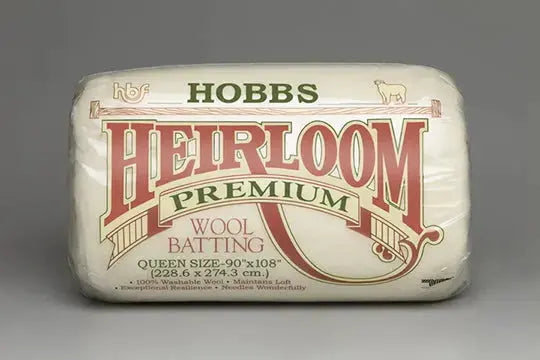
Then pick a fiber your needle loves. Wool is my favorite for hand work. It is soft. It is light. It has a little natural crimp. The needle slips through really really easy. Cotton is a close second. It glides well and gives that soft, traditional hand.
Now do a test. Baste a small sandwich, about 10 inches square. Use your real top fabric. Use your real backing. Quilt it for ten minutes. Count your stitches. Aim for a comfortable 8 to 10 stitches per inch. If you cannot hold that pace without pushing hard, the batting is wrong. Not you. The batting.
And please hear this. It does not have to be perfect. You're your own worst critic. Hand quilting is slow on purpose. Take your time. It's not a race. If I can do this, y'all can do it.
When It Matters Most
It matters most on a big quilt. A throw will forgive a tough batting. A queen will not. Your hands multiply every hard stitch by thousands.
It matters for heirlooms too. Wool and cotton age soft. They drape over a bed like a quilt should. They also forgive a slightly uneven stitch. The softness hides a multitude of learning moments. Ask me how I know. I have made those stitches. I have also unpicked them.
It matters less for wall hangings. Those are small. They are quilted less. A slightly firmer batting can be completely up to you there.
One more note, folks. Save the scrim battings for machine quilting. Save the high-loft poly for tied quilts. We're not reinventing the wheel here. We're just matching the batting to the job.
Thanks for spending a little time with me today. We'll see you next time. Bye.
Shop Hobbs Heirloom Wool Batting Package — Queen 90" × 108" at Linda's Electric Quilters.


