
Table of Contents
- What Makes a Thread Ideal for Longarm Quilting?
- Thread Weight Explained: 40wt vs 50wt for Longarm Machines
- Polyester vs Cotton Quilting Thread: A Head-to-Head Comparison
- Why Glide Thread for Longarm Is a Top Contender
- Top Picks: Best Threads for Your Longarm Machine
- Longarm Quilting Thread Tension Tips for Different Fibers
- Thread Storage, Cost, and Eco-Friendly Options
- Final Verdict: Choosing Your Perfect Longarm Thread
- Frequently Asked Questions
Last Updated: September 8, 2026
What Makes a Thread Ideal for Longarm Quilting?
The best thread for longarm quilting machines balances strength, low lint, and consistent feed at high speeds. Industry guidance consistently identifies 40wt and 50wt options as the most common choices, with 50wt described as the "sweet spot" that balances durability without adding bulk to the quilt Grace Frame's longarm thread guide. The real differentiator comes down to fiber type and how the thread is manufactured.
A thread that performs on a domestic machine can snap or shred on a longarm running at 2,000 stitches per minute. The longer thread path, higher speeds, and moving frame demand consistent diameter, minimal lint, and tensile strength.
Thread Weight Explained: 40wt vs 50wt for Longarm Machines
Thread weight refers to the thickness of the thread, where a lower number means a thicker thread. For longarm quilting, 40wt and 50wt cotton threads are the most widely used options on the market WonderFil's longarm thread selection guide.
Here's how they break down in practice:
- 40wt thread is thicker and more visible, providing excellent stitch definition for decorative quilting where the thread is part of the design. It stands up well to dense quilting without breaking.
- 50wt thread is finer and recedes into the fabric, letting the quilting texture shine. Stitch quality is smoother and less likely to create bulk at seam intersections.
The choice depends on project demands: heavily quilted heirloom pieces benefit from 50wt's subtlety; bold, open patterns showcase 40wt's definition.
| Thread Weight | Best Use | Visibility | Durability |
|---|---|---|---|
| 40wt | Decorative stitching, bold designs | High, thread is part of the design | Excellent for dense quilting |
| 50wt | Texture-focused quilting, fine details | Low, recedes into fabric | Strong, but thinner profile |
| 100wt | Micro-quilting, heirloom pieces | Minimal, texture only | High strength despite fine size |
Polyester vs Cotton Quilting Thread: A Head-to-Head Comparison
Polyester has become the dominant choice for longarm machines, and for good reason. Modern polyester threads run smoothly at the high speeds longarm machines require, produce minimal lint, and maintain consistent tension across thousands of yards Linda's Electric Quilters thread selection guide. The trilobal construction of premium polyesters like Glide reflects light beautifully, giving stitches a subtle sheen that many quilters love.
Cotton has loyal advocates for its traditional feel and matte finish. High-quality options like Aurifil's Mako use long-staple Egyptian cotton, reducing lint, but even the best cotton produces more lint than polyester.

The choice comes down to priorities: speed and minimal maintenance favor polyester; a traditional matte finish and occasional cleaning favor quality cotton.
Why Glide Thread for Longarm Is a Top Contender
Fil-Tec Glide has earned its reputation as a top choice for machine quilting due to its smooth feed, minimal tension issues, and vibrant color options Missouri Star Quilt Co.'s thread review. The 40wt polyester construction is specifically engineered for the demands of longarm machines, and its trilobal finish creates that desirable subtle sheen without looking plastic.
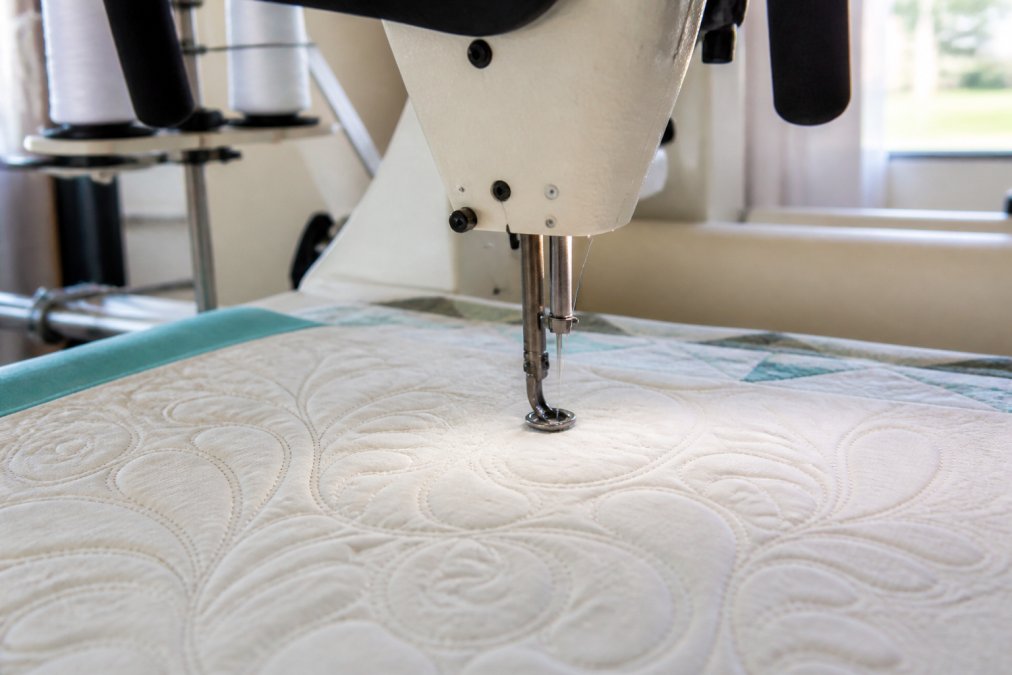
Glide's uniform diameter across the 5,500-yard king spool keeps tension stable from first to last stitch, with no fuzzy buildup or mid-pantograph breakage. For a thread that simply works, Glide is the benchmark, ideal for new longarm owners.
Top Picks: Best Threads for Your Longarm Machine
These are some threads we consistently recommend. Each serves a specific purpose.
Longarm Quilting Starter Bundle: Hobbs 80/20 Batting + White Glide Thread
Price: $229.99 | Best for: New longarm owners building their supply kit
This bundle pairs the two most-purchased items by longarm quilters: a 96-inch Hobbs 80/20 Heirloom Batting roll (30 yards) and a 5,500-yard White Glide king spool. The batting delivers a soft hand with minimal shrinkage; the Glide provides crisp stitch definition.
Longarm Quilting Starter Bundle - Hobbs 80/20 Batting Roll + White Glide Thread
Aurifil Mako Cotton 3-Ply Longarm Thread
Price: $38.00 per 3,280-yard spool | Best for: Quilters who prefer cotton's traditional feel
Aurifil's Mako is made for high-speed longarms. The 3-ply construction adds strength over 2-ply, and long-staple Egyptian cotton is virtually lint-free. It also performs well for machine embroidery, thread painting, and garment sewing.
Mako Cotton 3-ply Longarm Thread 40wt 3280yds White
Signature 40wt Cotton Quilting Thread
Price: $26.99 to $33.14 | Best for: Budget-conscious quilters who want cotton's matte finish
Signature's 3-ply, 100% cotton performs well on longarm and home machines with excellent sewability at high speeds, ideal for projects wanting dimension and texture. The 6,000-yard black spool at $26.99 offers exceptional value for dark-fabric work.

Cotton Quilting Thread 3-ply 40wt 6000yds Black
Longarm Quilting Thread Tension Tips for Different Fibers
Tension issues are the most common frustration, often from a mismatch between fiber and settings. Polyester has more elasticity than cotton, needing different adjustments. The fix is systematic diagnosis. preventing fabric pilling.
Diagnosing Tension by Fiber Type
Switching from cotton to polyester, loosen top tension slightly; polyester's give needs less drag. Switching to cotton typically requires tightening to compensate for its lack of stretch. The symptom tells you where the problem lives:
| Symptom | With Polyester Thread | With Cotton Thread | Likely Fix |
|---|---|---|---|
| Loops or thread nests on quilt back | Top tension too loose; thread is being pulled through the tension discs unevenly | Top tension too loose; cotton's lack of stretch means it won't self-correct | Tighten top tension in 1/8-turn increments; check that the thread is seated fully between the tension discs |
| Top thread visible as dots on the back | Bobbin tension too tight | Bobbin tension too tight, or bobbin thread is a heavier weight than the top thread | Loosen bobbin tension slightly; verify bobbin and top thread weights match |
| Thread breaks at the needle eye | Needle eye is too small for the thread; burr on the needle eye | Needle eye is too small; cotton is less forgiving of sharp angles in the thread path | Move up one needle size (e.g., from 3.5 to 4.0 longarm needle); check needle for burrs with a cotton swab |
| Thread shreds or frays before the needle | Burr on a thread guide or the hook assembly | Burr on a thread guide; cotton fibers catch more easily on rough spots | Run a cotton swab along the entire thread path to locate the burr; polish with a fine emery board |
| Skipped stitches, intermittent | Tension too tight, causing the thread to stretch and snap back | Tension too tight; cotton has no stretch and will break cleanly | Loosen top tension; check that the thread is not wrapped around the tension spring more than once |
| Uneven stitch length on the back | Bobbin tension inconsistent; bobbin case needs cleaning | Bobbin tension inconsistent; lint from cotton top thread has built up in the bobbin area | Remove bobbin case, clean with compressed air, and re-test tension with a drop test |
The Bobbin Thread Weight Connection
Mixing fiber types between top and bobbin causes tension headaches, different diameters and stretch mean neither side is balanced. Matching bobbin to top thread's fiber and weight eliminates 80% of tension problems. If mixing, use 50wt polyester bobbin with 40wt cotton top.
Tension Adjustments by Machine Type
Electronic tension systems (newer APQS, Handi Quilter, Gammill) compensate for stretch in real time, so fiber changes may need no manual adjustment. Mechanical systems need a manual change each time.
Thread Breakage: Fiber-Specific Causes
Thread breakage is fiber-dependent. With polyester, check for burrs on the needle plate or guides, it snaps on sharp edges. With cotton, the issue is likely excessive tension or too-small needle; cotton also breaks on sharp angles, so consider a thread stand or re-routing. A less obvious cause is a dulled needle, replace longarm needles every 8 to 12 hours of stitching.
Thread Storage, Cost, and Eco-Friendly Options
Most quilters ignore thread storage until a spool turns brittle or dusty. Storage directly affects longarm performance.
Thread Storage: The 12-Month Rule
Thread has a finite usable life. Cotton becomes brittle and dry in heat and low humidity; polyester becomes tacky and attracts dust in high humidity.
To maximize thread life:
- Store spools upright in a closed container. Stacking spools flat deforms the thread's cross-section, causing tension fluctuations.
- Keep the environment between 60°F and 75°F with 40-50% relative humidity. Avoid garages, basements, and attics.
- Protect from UV light. Direct sunlight degrades dyes and polymer structure; even indirect sunlight causes fading over months.
- Use silica gel packets in humid climates, replacing them every 3 months.
- Do not store thread on the machine. Heat and dust accelerate degradation.
Cost-Per-Yard: The Real Math
On cost, the economics favor quality. On cost, the economics favor quality. Consider the full cost of a thread failure mid-quilt:
| Cost Factor | Premium Thread (e.g., Glide, Aurifil) | Budget Thread |
|---|---|---|
| Price per 5,500-yard spool | $45-$60 (Glide king spool) | $5-$10 (250-500 yard spools) |
| Yards needed for a queen quilt (1,500 yards) | 1,500 yards | 1,500 yards |
| Spools needed | 1 partial spool | 3-6 spools |
| Thread cost for the quilt | $12-$16 | $15-$30 |
| Time lost to thread changes | 0 minutes | 10-20 minutes per change |
| Time lost to lint cleaning | 5 minutes per quilt | 30-60 minutes per quilt |
| Risk of mid-quilt breakage | Low | High |
| Effective cost per usable yard (including time) | 1.2-1.5 cents | 3-5 cents |
The math is even more lopsided on a longarm, where a mid-pantograph break means stopping, rethreading, and potentially ripping out stitching.
Eco-Friendly and Sustainable Options That Work
For environmentally conscious quilters, several manufacturers offer eco-friendly options. For environmentally conscious quilters, several manufacturers offer eco-friendly options. Some polyester manufacturers have introduced recycled-content threads, though availability in longarm-specific weights and spool sizes remains limited. Here's what's available in longarm-compatible formats:
- Aurifil Mako Cotton (40wt and 50wt): Long-staple Egyptian cotton, grown without GMO seeds. Low-impact dyes, OEKO-TEX certified. Available in 5,500-yard cones that fit longarm spool pins.
- Glide by Fil-Tec: Not marketed as eco-friendly, but its process is solvent-free and the company recycles production waste. The 5,500-yard king spool uses less plastic per yard than smaller spools.
- Recycled polyester options: A few smaller manufacturers offer recycled PET thread, but most are only available in 40wt on 1,000-yard spools, not practical for longarm use where a single quilt can consume 2,000 yards.
The most eco-friendly choice for longarm quilters is actually premium polyester. It also produces virtually no lint, meaning less energy spent on cleaning.
Final Verdict: Choosing Your Perfect Longarm Thread
The best thread for longarm quilting machines isn't a single product, it's the one that matches your machine, your project, and your priorities. If you value minimal maintenance and consistent performance at speed, a 40wt polyester like Glide is the clear winner. If you prefer cotton's traditional matte finish, Aurifil's Mako delivers premium quality with minimal lint.
For new longarm owners, the Longarm Quilting Starter Bundle from Linda's Electric Quilters eliminates guesswork by pairing the industry-standard Hobbs batting with the best-selling Glide thread color. What matters most is that you test threads on your own machine and find what works for your quilting style. The right thread makes quilting feel effortless; the wrong one turns every session into a battle with your tension dials.
Frequently Asked Questions
What type of thread is best for long arm quilting machines?
40wt and 50wt threads are the most common and reliable choices for longarm quilting. 50wt polyester offers a balanced profile that resists breakage at high speeds, while 40wt provides a slightly more visible stitch. Glide thread for longarm machines is a top pick due to its lint-free, trilobal polyester construction, which ensures smooth feeding and consistent tension across all major machine brands.
Is polyester or cotton thread better for longarm quilting?
Polyester is generally better for longarm machines because it is stronger, lint-free, and performs consistently at high speeds. Cotton offers a traditional matte finish but produces more lint, requiring more frequent machine maintenance. For dense quilting where texture matters, fine 100wt polyester excels. If you prefer cotton, Aurifil's Mako 3-ply is designed for high-speed longarm use.
What is the difference between 40wt and 50wt quilting thread?
The difference is thickness. 40wt thread is thicker and more visible, making it ideal for decorative stitching and adding texture. 50wt is finer, making it the industry sweet spot when you want the quilting to blend into the fabric while maintaining durability. For longarm machines, 40wt polyester runs smoothly at high speeds, while 50wt is a versatile choice for most projects.
How do I prevent thread breakage on a longarm machine?
Thread breakage often stems from tension issues or lint buildup. Start by checking your tension settings and adjusting based on your thread fiber, as polyester requires different tension than cotton. Ensure your thread path is clean and use lint-free threads like Glide to reduce maintenance. Pairing your top thread with a matching bobbin thread also prevents uneven tension.
Can I use any thread brand in my longarm quilting machine?
Most longarm machines accept any quality thread, but the best results come from threads designed for high-speed use. Look for 40wt options like Glide or Aurifil Mako Cotton that specify longarm compatibility. Cheaper threads may have inconsistent thickness or high lint, leading to tension issues and breakage. Always test a new thread on a scrap quilt sandwich before starting your project.
Choosing the right thread transforms longarm quilting from a technical struggle into a creative flow. At Linda's Electric Quilters, we stock over 50,000 products including every thread mentioned here, backed by 700+ educational videos and the Crafters Roundtable podcast for expert guidance. Get started with Linda's Electric Quilters and find the thread that makes your machine sing.