
Quick Summary
Yes, for most standard king quilts. A standard king top measures about 108 inches wide, so a 108 inch wideback can run seamless across the full width. Oversized or custom kings may exceed 108 inches and need wider fabric or piecing.
- A standard king-size quilt measures about 108 inches wide and 90 to 110 inches long.
- Add 4 to 8 inches per side for longarm or frame loading before checking the width.
- A king backing needs about 3.25 yards of 108 inch wideback versus about 9.75 yards of 44 inch fabric.
- Oversized kings running 115 to 120 inches generally need wider fabric or piecing.
- Measure the finished top after quilting and binding before committing to a backing width.
Table of Contents
- What Size Is a King Quilt, and Does 108 Inches Cover It?
- How to Calculate Quilt Backing Yardage for a King Quilt
- Yardage Compared: 108 Inch Wideback Versus 44 Inch Fabric
- When a 108 Inch Wideback Falls Short
- Piecing Quilt Backing for King Size Without Wideback
- Longarm Quilting Backing Requirements to Plan For
- Choosing Your King Quilt Backing Fabric Next
- Frequently Asked Questions
What Size Is a King Quilt, and Does 108 Inches Cover It?
Last Updated: November 4, 2026
For most quilters, yes. A standard king-size quilt measures about 108 inches wide and 90 to 110 inches long, according to Missouri Star Quilt Co. guide to standard quilt sizes. That width matches a 108-inch wideback, so the backing can usually run seamless across the full quilt without a seam down the middle.
The "enough" question depends on what you plan to make. A standard king built to fit a 76-by-80-inch mattress with a modest drop fits comfortably on a 108-inch backing. A custom king with extra drop, a wider overhang or a longer length can push past 108 inches, and then you need a different plan.
Here is how the sizing usually breaks down:
- Standard king top: about 108 inches wide, 90 to 110 inches long
- 108-inch wideback: covers the width with no seam for most standard kings
- Oversized or custom king: may exceed 108 inches and need 118 to 120 inch fabric or piecing
Measure your finished top before you buy anything. Width is what decides whether 108 inches is enough.
How to Calculate Quilt Backing Yardage for a King Quilt
The math is simpler than most quilters expect. Start with your finished top's width and length, then add the backing allowance you need for quilting and loading on a frame.
- Measure the finished top's width and length.
- Add 4 to 8 inches to each side for longarm or frame loading, or to each dimension for hand and domestic quilting.
- If the adjusted width fits within 108 inches, you can run the backing crosswise and buy by the yard.
- Divide the adjusted length by 36 to get the yards needed.
For a king quilt that is about 100 inches square, 108-inch wideback backing run crosswise typically needs about three yards of length once loading allowance is added.
If you want a quick check on your exact numbers, our backing yardage calculator guide walks through the same steps for any quilt size.
When you are ready to buy, our Wideback Fabric Per Yard listing shows the 108-inch options available by the yard, so you can order the exact length your math calls for.
Yardage Compared: 108 Inch Wideback Versus 44 Inch Fabric
The real advantage of wideback shows up in the yardage. Standard 44-inch fabric forces you to piece the backing together, which adds seams, labor and waste. Wideback removes most of that.
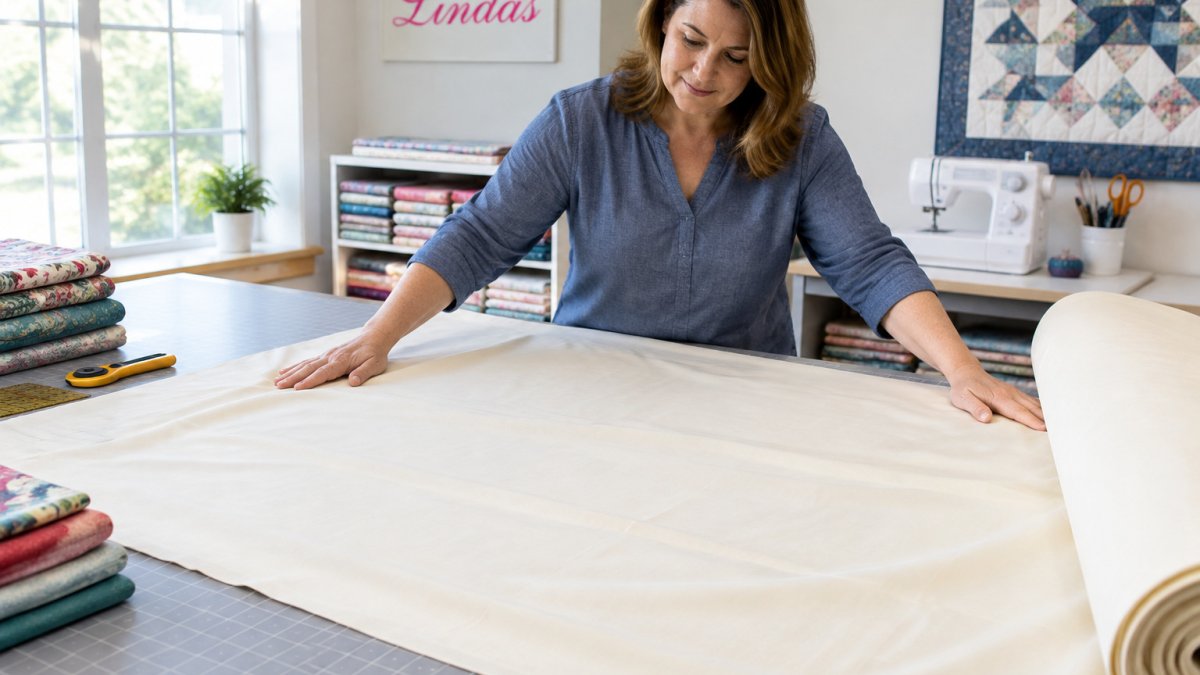
!A quilter's hands smoothing a length of cream wideback fabric across a large cutting table in a bright sewing room
A king-size backing made from 44-inch fabric can require about 9.75 yards. The same backing made from 108-inch wideback needs roughly 3.25 yards, according to a fabric yardage comparison analysis of standard and wideback fabric efficiency. That is a large drop in material and in seams.
Price matters too. Wideback runs about $18.19 per yard for premium quilting fabric, based on Linda's Electric Quilters' wideback pricing. Most of the cost difference comes from avoiding extra yardage and piecing time.
Our Multi Measure 108" wide fabric per yard gives you a 108-inch option for seamless backs on queen and king quilts. For a full breakdown of king backing sizes, see our King Size Quilt Backing Yardage: Calculate Exactly article.

The table below compares the backing yardage and cost for a king-size quilt made from standard fabric versus 108-inch wideback.
| Backing type | Yardage needed | Notes |
|---|---|---|
| 44-inch fabric | About 9.75 yards | Requires piecing and extra seams |
| 108-inch wideback | About 3.25 yards | Seamless across the full width |
| Wideback price | About $18.19 per yard | Premium quilting fabric |
When a 108 Inch Wideback Falls Short
Here is where the answer changes. A 108-inch wideback is not always enough.
Very large or custom king quilts can exceed 108 inches in width. King quilts running 115 to 120 inches generally need wider fabric or a different piecing method. In those cases, 108-inch backing will not cover the full width without a seam.
Handling is another practical limit. Working with 108-inch fabric can feel unwieldy if you do not have a large table for cutting and piecing. The width is manageable with enough floor or table space.
Watch out: do not assume the top's listed size equals its finished size. Quilting and binding can add or change dimensions, so measure the top after it is complete before you commit to a backing width.
Grey Heather Thatched Cotton Wideback Fabric per yard →
Piecing Quilt Backing for King Size Without Wideback
When your finished top runs wider than 108 inches, or you already own standard 44-inch fabric, piecing is the practical route. The goal is a backing that is wide enough, square enough to load, and seamed where the seam will not distract from the quilting.
Start by calculating the panel count from the adjusted backing width, not the top width. Add your loading allowance first (4 to 8 inches per side for longarm, less for domestic quilting), then divide by your fabric's usable width.
Common layouts and when each makes sense:
- Two-panel back with a vertical center seam: the simplest layout for tops up to about 84 inches wide when using 44-inch fabric. Cut two equal panels, sew with a half-inch seam, and press the seam open. The seam runs down the middle of the quilt, so it is most visible on solid backs and least visible on busy prints.
- Three-panel back with two vertical seams: the standard solution for king and oversized tops. Place the seams roughly one-third and two-thirds across the width so no single seam sits at the center. This spreads the visual weight and keeps the backing balanced on the frame.
- Horizontal seam: useful when your top is longer than it is wide and you want to avoid vertical seams entirely. A horizontal seam placed below the center line is less noticeable on many quilts, but it can interfere with directional prints and with pantograph alignment on a longarm.
- Off-center vertical seam: a common quilter's trick is to shift a single seam off center by 6 to 12 inches. The eye reads it as a design line rather than a mistake, and it avoids the bullseye effect of a perfectly centered seam on a solid backing.
Yardage for pieced backs is higher than most quilters expect. A 112-by-120-inch backing made from 44-inch fabric typically needs about 9 to 10 yards, depending on panel count and seam allowance, versus roughly 3.5 yards of 108-inch wideback for the same quilt.
Match fabric direction across every panel. If the print has a clear up-and-down, cut all panels in the same orientation and label the top edge of each with a pin or chalk mark before you sew.
Watch out: do not trim the backing to the top's exact size before quilting. Pieced backs can shift during sewing, and you need the loading allowance intact on all four sides.
If you are weighing piecing against buying wider goods, our Wideback Fabric Per Yard listing shows the 108-inch options, and our King Size Quilt Backing Yardage: Calculate Exactly article walks through the full yardage comparison for king-size tops.
Longarm Quilting Backing Requirements to Plan For
Longarm quilting changes the backing math more than any other step, and it is the most common reason a backing that measured correctly at the cutting table still comes up short on the frame.
Longarm quilting typically calls for 4 to 8 inches of backing beyond the top on each side, with more on the clamped sides. The exact number depends on the loading method:
- Leader-clamp loading: the backing is pinned or clamped to the leaders at the front and back of the frame. This method typically needs 4 to 6 inches beyond the top on the top and bottom edges, and 6 to 8 inches on the sides where the clamps grip.
- Zipper or canvas-leader systems: the backing is attached to zippered leaders, which can reduce the side allowance slightly but still require 4 to 6 inches on all sides so the quilt can be advanced without the backing pulling free.
- Red snapper or channel-lock systems: these grip the backing edge directly and generally want a full 6 to 8 inches on the clamped sides, because the grip consumes fabric that cannot be quilted.
Batting follows the same logic: cut it at least as large as the backing, and consider batting 2 to 4 inches larger than the top on all sides so it does not pull in during quilting. A backing that is exactly the top's size will not load, and a backing that is only 2 inches larger will often run out before the final row.
Plan the allowance before you buy, not after. Add the operator's requested allowance to both the width and the length of the finished top, then check whether the adjusted width still fits within 108 inches. If it does, wideback still works and you buy by the adjusted length.
A practical habit is to ask your longarm operator for their written backing requirement when you book the quilting, and to write that number on the project bag. Requirements vary by machine, frame, and operator preference, and the number that matters is the one your operator will actually use.
Watch out: do not assume a backing that worked on a domestic machine will work on a longarm frame. Domestic quilting needs only a few inches of margin, while a longarm frame can consume 6 to 8 inches per side, and the difference is enough to ruin a carefully planned backing.
For the layer between top and backing, our Batting collection covers the options that pair well with a king-size back, and our King Size Quilt Backing Yardage: Calculate Exactly article shows how the longarm allowance changes the final yardage.
Choosing Your King Quilt Backing Fabric Next
For most standard king quilts, a 108-inch wideback is enough. It saves yardage, cuts seams and gives a clean finish. Measure your top, add your loading allowance, and check whether the total width fits within 108 inches.
If your quilt is oversized, plan for 118 to 120 inch fabric or a piecing layout before you buy. Either way, the right backing starts with accurate measurements. Get those first, then choose your fabric.
Frequently Asked Questions
Can you use 108-inch fabric for a king-size quilt without piecing?
In most cases, yes. A standard king-size quilt measures about 108 inches wide and 90 to 110 inches long, so a 108-inch wideback fits the width with the length running along the fabric. The fabric is cut to length from the bolt, which typically gives a seamless back. Quilts that finish larger than the standard size, or tops that are very long, may still need piecing or a wider 118 to 120 inch fabric. Measure your quilt top before buying.
How much fabric do I need for a king-size quilt back?
A standard king-size quilt back usually needs about 3.25 yards of 108-inch wideback fabric. If you use standard 44-inch fabric instead, you would need around 9.75 yards to cover the same area, which is why wideback is often the more economical choice. Add extra length for loading onto a longarm frame or for trimming. Always confirm your exact dimensions before cutting.
What is the standard width of wideback quilting fabric?
Most wideback quilting fabrics are 108 inches wide, which is the most common width for backing large quilts. Some manufacturers offer 118 to 120 inch options for oversized projects. Wideback fabric is sold by the yard, and the 108-inch width covers the full width of a standard king quilt. Check the listing before purchasing to confirm the exact width.
How do you calculate backing yardage for a longarm quilting service?
Start with your finished quilt top measurements, then add extra length for the longarm frame. Many longarm quilters recommend allowing several extra inches on each side so the backing can be clamped and tensioned properly. Once you know the length you need, divide by 36 to convert inches to yards and round up. Ask your longarm service for their specific requirements before cutting.



