
Last Updated: November 4, 2026
Quick Summary
Interfacing weight should be equal to or slightly lighter than your base fabric, because heavier interfacing is the most common cause of ruined drape. Thin, soft fabrics need knit interfacing no heavier than 45 g/m2. Always fuse a test swatch and compare its hand and drape to the unfused fabric before cutting.
- Thin, soft fabrics need knit interfacing no heavier than 45 g/m2.
- Hand is how fabric feels; drape is how it hangs and folds.
- Run a crumple test for hand and a corner-hold test for drape.
- Sew-in interfacing lets fabric move more naturally than fusible.
- Most fusibles need 10 to 15 seconds of firm pressure per section.
Table of Contents
- Why Interfacing Weight Decides How Your Fabric Drapes
- The Hand vs. Drape Distinction Most Sewists Miss
- Sew-In vs Fusible Interfacing: How Each Changes Movement
- How to Match Interfacing Weight to Fabric Weight
- How to Apply Fusible Interfacing Without Flattening the Drape
- Choosing Heavy Weight Interfacing for Bags and Structured Projects
- Troubleshooting Bubbling, Delamination, and Stiff Results
- Picking Your Interfacing at Linda's Electric Quilters
- Frequently Asked Questions
Why Interfacing Weight Decides How Your Fabric Drapes
According to Threads Magazine's guidance on matching interfacing to fabric, thin, soft fabrics need knit interfacing no heavier than 45 g/m2, and that single number explains why so many projects go wrong.
At Linda's Electric Quilters, we hear the same story from quilters and garment sewists alike: the pattern was right, the seams were right, and the finished piece still hung like a board.
Most guides treat interfacing as an afterthought, a scrap of something ironed on to stop a facing from curling.
Below, we break down how weight, fiber, and application method interact, so you can predict the result before you cut.
The Hand vs. Drape Distinction Most Sewists Miss
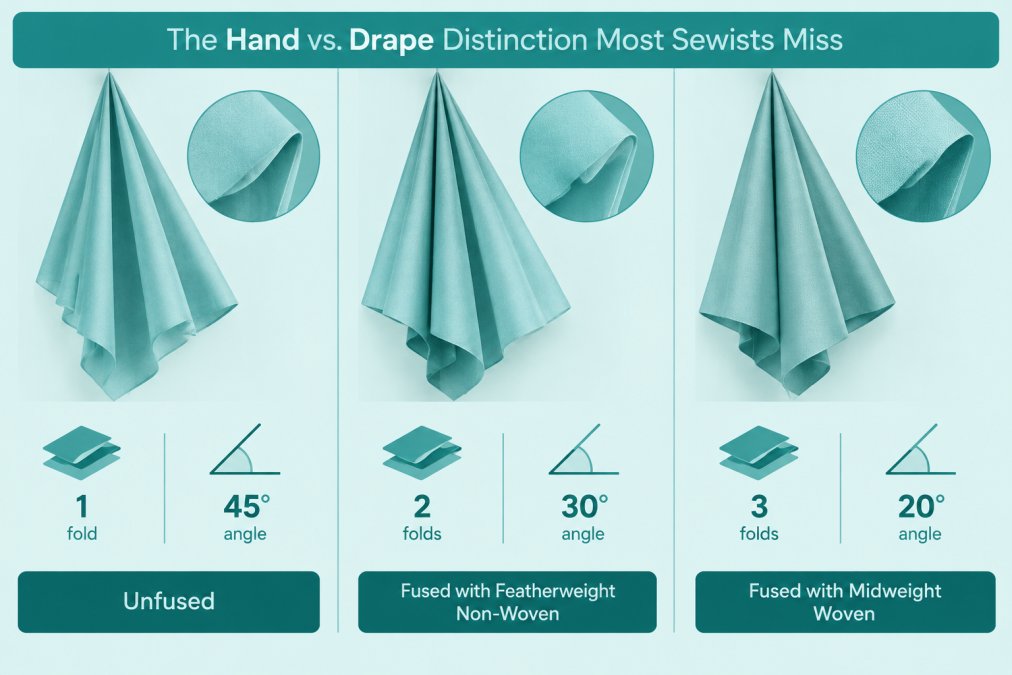
Hand is how a fabric feels when you touch and squeeze it. Drape is how it hangs and folds under its own weight.
A fabric can have a soft hand and poor drape, or a crisp hand and beautiful drape. Interfacing affects both, but at different rates.
Research published in Sage Journals' study on interfacing type and shear behavior found that interfacing type significantly affects the shear stiffness of fabric composites, with nonwoven interfacings showing distinct stiffness characteristics compared to other types.
The two-test protocol
Most guides tell you to "test on a scrap" and stop there. That is not enough to predict drape.
Test 1, Hand (the crumple test). Cut a 6-inch square of your base fabric and a matching square fused with the candidate interfacing.
Test 2, Drape (the corner-hold test). Hold each swatch by one corner and let it hang. Measure the angle of the fold that forms and count how many folds appear along the hanging edge.
What the numbers mean
There is no universal drape score, but the directional rule holds across fiber types: the stiffer the interfacing relative to the base fabric, the fewer folds and the wider the fold angle.
Why the distinction changes your buying decision
If your project lives or dies on drape, a bias-cut skirt, a fluid dress, a soft blouse, judge the swatch by the corner-hold test first.
Experienced sewists often keep a labeled swatch library: every interfacing they own, fused to a standard 6-inch square of muslin, tagged with weight and type. After a few projects, the library replaces the package label as the buying guide, because it shows hand and drape together.
Sew-In vs Fusible Interfacing: How Each Changes Movement
Fusible interfacing bonds to the fabric with heat and adhesive. Sew-in interfacing is stitched in place and never bonded, so it lets the fabric move more naturally.
WAWAK Sewing Supplies' comparison of fusible and sew-in interfacing notes that while fusible interfacing is often used for structure, it can alter the hand and drape of a fabric more significantly than sew-in alternatives, which allow for more natural movement. Our complete Pellon interfacing product guide lays out the full range of sew-in and fusible options so you can compare how each type behaves before you commit.
Fusible wins on speed and stability. It eliminates basting and pinning, and it holds facings and plackets exactly where you put them.
Best for fusible: collars, cuffs, waistbands, bag panels, embroidery backing. Best for sew-in: silks, crepes, challis, coating fabrics, and any project where drape is the whole point.
How to Match Interfacing Weight to Fabric Weight
Match interfacing to fabric by choosing a weight equal to or slightly lighter than the base fabric. Heavier interfacing than the fabric is the single most common cause of ruined drape.
The practical workflow:
- Weigh your fabric's character, not just its number. A lightweight linen and a lightweight jersey behave differently even at the same weight.
- Start lighter than you think. You can always add a second layer; you cannot remove a fused one.
- Fuse a test swatch. Cut a 6-inch square, fuse, cool, then compare hand and drape against the unfused fabric.
- Check the grainline. Woven interfacing should align with the fabric's grain; non-woven can be cut in any direction.
- Re-evaluate after cooling. Judge the swatch cold, not warm.
For a weight-by-weight reference that translates these rules into a specific product choice, our Pellon interfacing weight guide charts the options side by side.
| Fabric Weight | Interfacing Weight | Best Type | Example Use |
|---|---|---|---|
| Sheer, lightweight | Featherweight | Non-woven fusible | Blouses, dresses |
| Light to medium | Light to medium | Woven fusible | Collars, cuffs, bags |
| Medium to heavy | Medium | Woven or sew-in | Jackets, structured tops |
| Heavy, structured | Heavyweight | Fusible, wide board | Bags, placemats, headers |
How to Apply Fusible Interfacing Without Flattening the Drape
Fusible interfacing flattens drape when it is applied with too much heat, pressure, or steam. Control all three and the fabric keeps its movement.
Pellon® SF101 Shape-Flex® Cotton Woven Fusible Interfacing 20" x 10 yards Bolt. →
Our Pellon SF101 Shape-Flex guide walks through application step by step for a woven cotton fusible that adds crispness without stiffness. The core method:
- Pre-shrink the interfacing if the fabric will be washed. Skipping this causes bubbling later.
- Use a press cloth between iron and interfacing to prevent scorching and adhesive bleed.
- Press, don't glide. Lower the iron, hold, lift, move. Gliding stretches the fabric and distorts the bond.
Choosing Heavy Weight Interfacing for Bags and Structured Projects
Heavy weight interfacing is for projects that need to hold a shape rather than fall softly: bag panels, placemats, lamp shades, drapery headers, and director's chairs.
The Decor Bond heavy fusible wide board is exactly this kind of interfacing.
For bag makers, the layering matters more than the single weight. The StitchnSew sew-in fleece at $18.24 is a lightweight padded option that works as a lining for quilts.

Best for: bags, home decor, placemats, structured crafts. Skip if: you are making a garment that needs to move.
Troubleshooting Bubbling, Delamination, and Stiff Results
Most troubleshooting advice stops at "pre-shrink and press harder," treating three different failures as one problem. Bubbling, delamination, and stiffness have separate causes, and the fix for one can make another worse. Diagnose first, then treat.
Bubbling: moisture or shrinkage trapped under the bond
Bubbling shows as small raised pockets or a rippled surface after fusing.
The diagnostic: press the bubbled area flat with a cool iron. If the bubbles flatten and stay flat, the cause was moisture and the bond is intact.
Watch out: re-fusing a moisture bubble without drying the piece first traps the same steam again and makes the ripple worse.
Delamination: the adhesive never fully activated
Delamination is bubbling at a larger scale, whole sections of interfacing lift away, usually at edges or corners.
The diagnostic: peel a corner of the lifted interfacing. If the adhesive side looks glossy and smooth, it never flowed into the fabric, raise heat and dwell time. If it looks rough and fiber-covered, the adhesive grabbed but the bond failed later, usually from washing without pre-shrinking.
Stiffness: the wrong weight or the wrong type
Stiff results are not a bonding failure, they are a selection failure. If a lightweight fabric went rigid, the interfacing was too heavy or too non-woven for the drape you wanted. No amount of re-pressing fixes this; the only remedy is to remove the interfacing (difficult once fused) or choose a lighter or woven alternative next time. This is why the swatch test matters more than any troubleshooting step: the cheapest fix for stiffness is never fusing it in the first place.
The order of operations that prevents all three
- Pre-shrink the interfacing before fusing. Wash-and-dry or steam-shrink it, then fuse. This eliminates the shrinkage mechanism behind most bubbling.
- Dry both surfaces fully. Let the fabric and interfacing come to room dryness before the iron touches them.
- Raise the heat and increase dwell time. Most fusibles need 10-15 seconds of firm pressure per section.
- Re-fuse with a press cloth. A second pass at temperature often rescues a partial bond, but only after the piece is dry.
Stiff results are a different problem: wrong weight or wrong type. Our guide to eco-friendly interfacing options covers alternatives that behave differently, including lighter non-wovens and sew-in choices for heat-sensitive or recycled fabrics.
Picking Your Interfacing at Linda's Electric Quilters
The right interfacing matches your fabric's weight, respects its drape, and suits the structure your project needs. Get those three aligned and the rest of the sewing gets easier.
We stock over 50,000 quilting, sewing, and embroidery products, including the Pellon and HeatnBond interfacings covered here, plus a library of 700+ educational videos and the Crafters Roundtable podcast. Our Pellon SF101 Shape-Flex bolt at $37.81 and the HeatnBond light weight non-woven fusible at $7.19 cover the two ends of the weight spectrum most projects need.


Frequently Asked Questions
How do I know what weight of interfacing to use?
Start with the fabric, not the pattern. The industry rule is that interfacing should be equal to or slightly lighter than the base fabric, so a soft challis calls for featherweight and a cotton canvas can handle something heavier. Cut a 4-inch test square, fuse or baste it to a scrap, and let it hang next to the untreated fabric before you commit.
When should I choose sew-in versus fusible interfacing?
The sew-in vs fusible interfacing decision comes down to heat sensitivity and how much natural movement you want to keep. Sew-in is the safer choice for heat-sensitive fabrics, loose weaves, napped surfaces, and anything with texture or embellishment, because nothing is fused to the face. Fusible is faster and holds crisp shapes well, but For a garment that needs to float, sew-in usually wins.
What is heavy weight interfacing used for?
Heavy weight interfacing for bags and structured projects gives a panel the body to hold a shape rather than feel padded. Pellon Decor Bond, a 45-inch wide heavyweight iron-on, is built for placemats, director's chairs, lamp shades, drapery headers, and bag panels. It adds crispness rather than loft, so it is the wrong pick for anything that needs to drape. Save it for totes, bag bases, and home decor pieces that should stand up on their own.
How does interfacing affect the drape of a finished garment?
Interfacing adds stiffness, and stiffness is the enemy of drape. In practice, a heavier or nonwoven interfacing will make a skirt hang straighter and fold more sharply, while a lighter woven or sew-in option lets the fabric keep its natural float. Test on a scrap before you cut into your good fabric.
Can using the wrong weight of interfacing ruin a project?
Yes, and it usually shows up as a garment that feels like cardboard or a quilt block that will not lie flat. Too heavy an interfacing overpowers a light fabric, kills the drape, and can cause bubbling when the two materials shrink at different rates. Too light and you get no support at all. The fix is simple: always fuse a test swatch first, check how it hangs next to the untreated fabric, and size down rather than up if you are unsure.
How do I test interfacing weight before applying it to my project?
Cut a 4-inch square of your fabric and a matching square of interfacing, then fuse or baste them together following the manufacturer's instructions. Let the sample cool completely, then hold it next to an untreated scrap and compare how each one folds, hangs, and feels. Check for stiffness, shine, and any bubbling at the edges. If the treated sample feels board-like or will not drape, go down a weight. This five-minute test saves hours of rework.
Interfacing weight is not a detail you can guess at. It is the decision that determines whether your project drapes or stands up on its own. Get started with Linda's Electric Quilters and match your interfacing to your fabric with confidence, backed by our full catalog, our educational video library, and free shipping on all batting rolls.



