Good morning, quilters! Corey here.
One quilt. Two widths. And a surprisingly common question at the cutting counter: "What's actually the difference between regular quilting fabric and that extra-wide stuff?"
Choosing the right width can save you time, fabric, and a whole lot of extra seams—so let's break it down.
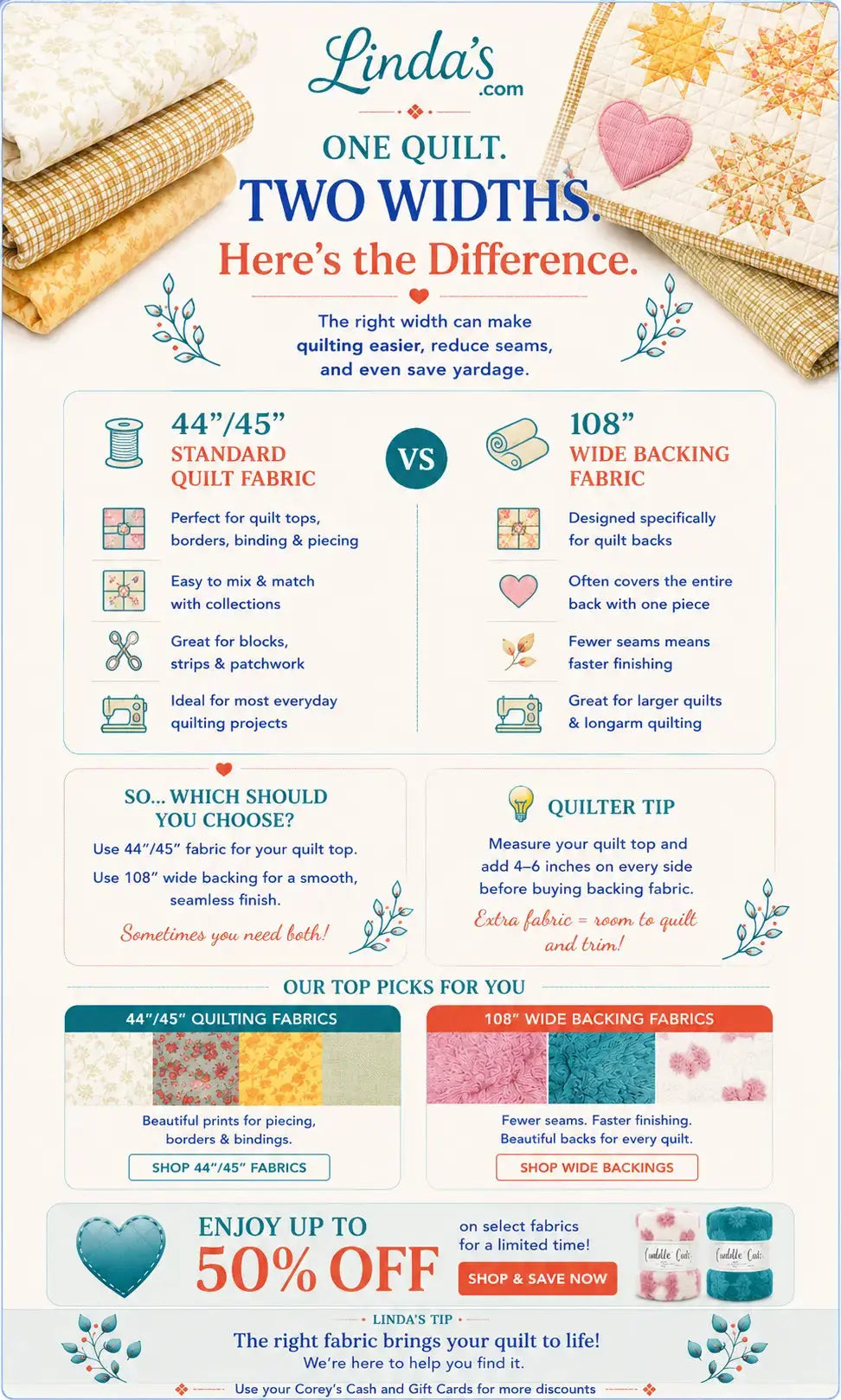
44"/45": the standard quilting fabric
This is the width nearly all quilting cotton comes in, and it's the workhorse of the quilting world.
Perfect for: quilt tops, borders, binding, and piecing. Blocks, strips, and appliqué shapes all cut efficiently from a 44" bolt, and the enormous range of prints and colors means you'll find exactly the fabric your design calls for.
The trade-off: when it's time to back a quilt bigger than a baby quilt, a 44" width means piecing two or three lengths together—measuring, matching, and sewing long seams down the back of your quilt.
108": the wideback
Wideback fabric exists to solve exactly that problem.
Perfect for: quilt backings with no piecing at all. At 108" wide, a single length covers a queen quilt in one seamless piece—no pattern matching, no bulky seam for your longarmer to quilt over, and no wrestling three yards of pieced backing into alignment.
The bonus: widebacks are often more economical than they look. Backing a 90" quilt takes about 3 yards of 108" fabric versus roughly 8 yards of standard width—so compare total cost, not price per yard.
The quick math
- Quilt top, borders, binding? 44"/45" every time.
- Backing a throw, twin, queen, or king? 108" wideback—one piece, zero seams.
- Backing a small baby quilt? Standard width works fine; one 44" length usually covers it.
- Longarm quilting? Longarmers love widebacks: flat, seamless backings load onto the frame beautifully.
Remember
It's not either/or—most quilts use both. The top gets the beautiful 44"/45" prints; the back gets one smooth piece of 108". If you want to see the options, browse our 43"/44"/45" fabrics for tops and our wideback fabrics for backings.
Happy Quilting!
From Corey.