
Hi Bestie,
You've finished the quilt top, stepped back to admire it… and now comes the question: "Do I add a border?"
Instead of automatically reaching for more fabric, take a look at what your quilt is missing.
Three Reasons a Border Might Be the Right Call
If the blocks feel crowded against the edge, a border can give them some much-needed breathing room.
If the quilt needs a few extra inches, a border is an easy, and beautiful, way to add them. (If you're not sure how much fabric that takes, stop guessing your quilt yardage first.)
And if your eye keeps wandering off the edge of the design, a border can give it a natural place to stop.
But What If None Of Those Are The Problem?
Then your quilt might already be telling you the answer.
If the design feels balanced and complete from edge to edge, you don't need to add a border just because that's how you've always done it. Some of the best "rules" in quilting are the ones we're happy to break.
Sometimes binding is all the finish a quilt needs. (And if bulky corners are what's been keeping you from a clean, border-free finish, this binding trick will help.)
Still Can't Decide? Audition It.
Lay strips of your potential border fabric alongside the quilt top, then step back several feet.
Look at the whole quilt, not just the fabric.
Now take the strips away and look again.
Which version makes the quilt itself look better? That's usually your answer.
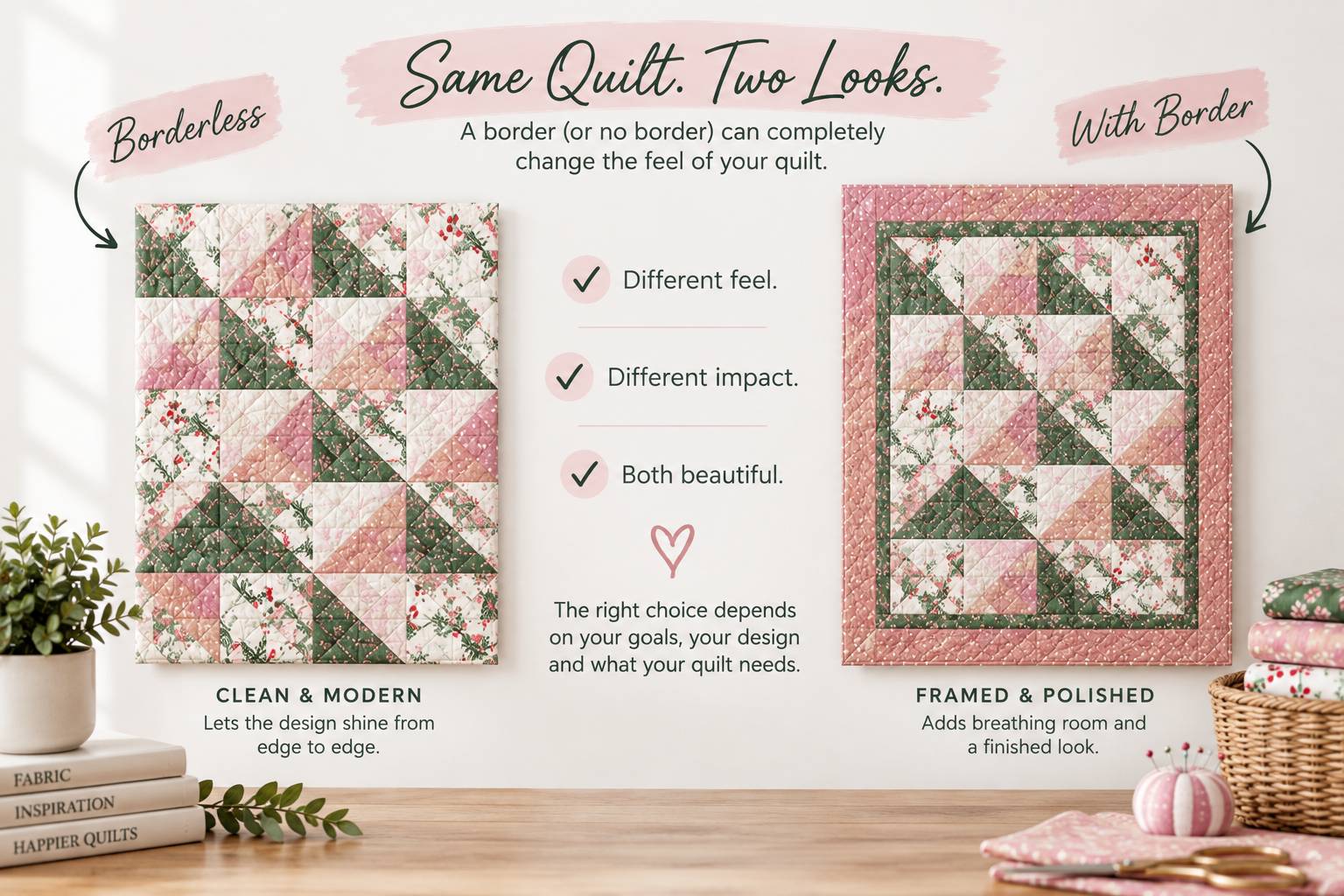
Why Stepping Back Works
Up close, your eye reads individual blocks and fabrics. From several feet away, it reads the whole quilt as one shape, which is exactly how it will be seen on a bed or a wall. A border changes that shape in two ways: it adds a resting place for the eye, and it shifts the balance between the pieced center and the edge. That is why the same top can look crowded without a border and calm with one, or busy with a border and clean without. Auditioning strips and then removing them lets you compare the two shapes directly instead of guessing. It's the same thinking behind every good quilt design decision: judge the whole, not the part.
Remember,
There's no rule that says every quilt needs a border. The best finish is the one that makes your quilt look and feel complete. So step back, trust your eye, and choose the finish that lets all that beautiful piecing shine.
Happy Quilting!
From Corey.
Fabric for Your Border Audition
If the audition says "yes, border," you'll want fabric you can cut into long, continuous strips without piecing. Our wideback fabric by the yard gives you up to 108" of uninterrupted length, and jelly rolls are already cut into 2.5" strips that are perfect for auditioning (and for narrow inner borders). Check this week's sales and deals before you order.
Frequently Asked Questions
Does every quilt need a border?
No. A border is a design choice, not a requirement. Add one when the blocks feel crowded at the edge, when the quilt needs extra inches, or when your eye needs a place to stop. If the design already feels balanced edge to edge, binding alone is a complete finish. See the quilting rule we're happy to break for more on when tradition can take a back seat.
How do I decide whether to add a border to my quilt?
Audition it. Lay strips of the border fabric alongside the finished top, step back several feet, and look at the whole quilt. Then remove the strips and look again. Whichever version makes the quilt itself look better is your answer. If you're torn between fabrics, that fabric is pretty, but will it actually work? walks through how to judge a fabric in context rather than on the bolt.
How wide should a quilt border be?
A common starting point is to make the border roughly the same width as one of your blocks or one of your block units, then adjust by auditioning. Wider borders calm a busy top; narrow borders act like a frame line. Cut border strips on the lengthwise grain when you can, and check the cutting mistake that gets worse with every block so a small width error doesn't multiply across a long strip. A 6.5" x 24" non-slip ruler makes long strip cuts far easier.
How much fabric do I need for a quilt border?
Measure the finished top through the center in both directions, add the border width to each side, and multiply by the number of strips you need, plus a little extra for squaring up. Stop guessing your quilt yardage shows the math step by step. Wideback fabric lets you cut long borders in one piece with no seams.
What if I add a border after my batting is already cut?
You have two options: cut a new piece of batting, or extend the existing batting with a continuous batting strip made for exactly this situation. The Add-A-Border Katahdin On-A-Roll guide explains how the strip attaches so the join disappears once the quilt is quilted.