If you've ever admired a handmade bag that stands up on its own — crisp sides, a base that doesn't sag, a flap that keeps its curve — there's a good chance Decovil is inside it. Pellon's Decovil family is a one-sided fusible interfacing with a leather-like handle, and it's the structure layer that separates a floppy tote from a bag that looks professionally made.
Decovil vs. Decovil Light: which one?
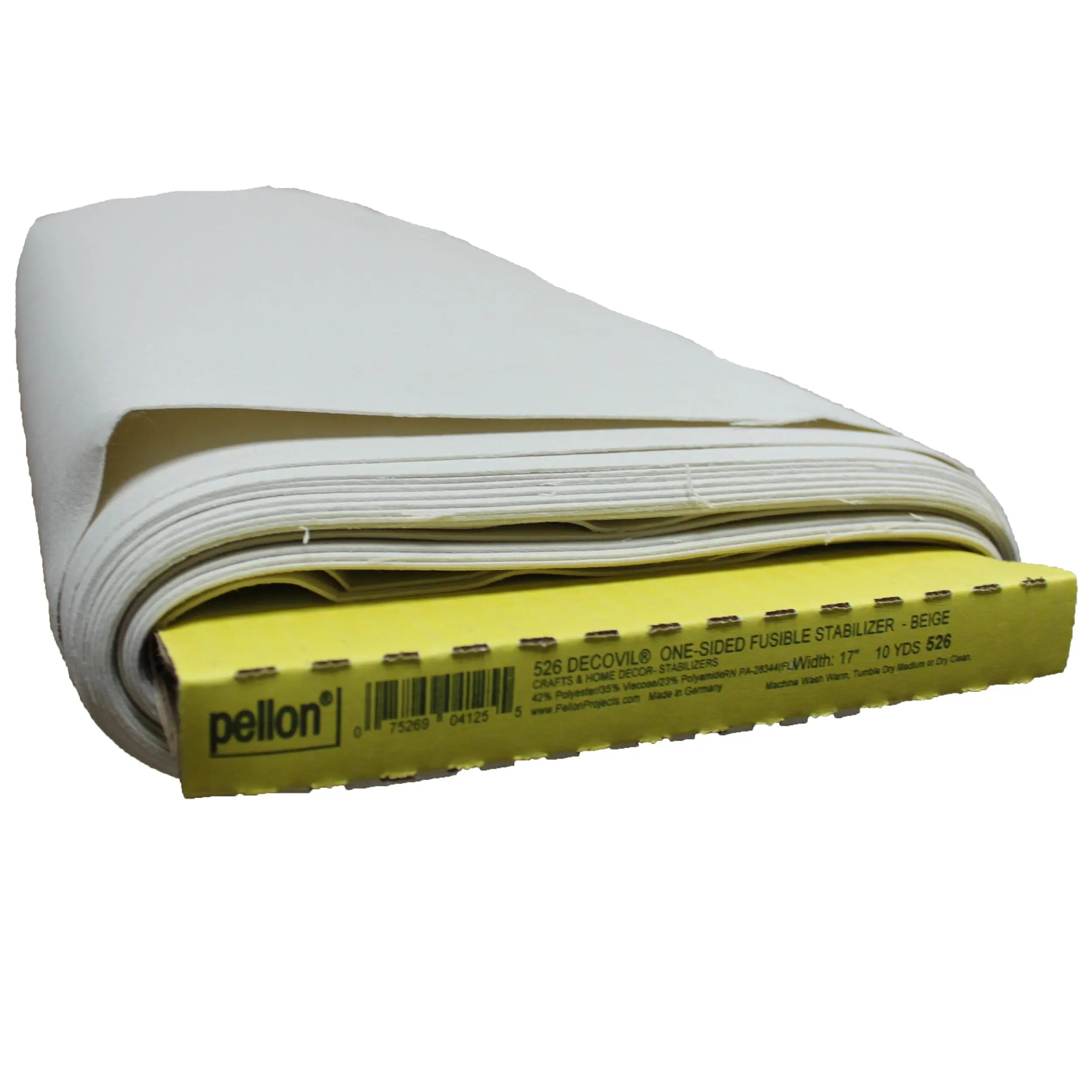
Pellon 526 Decovil is the firm one. It's tear-resistant, dimensionally stable, punchable, and resistant to bending — near-rigid body for structured handbags, hat brims, belts, and fabric bowls that must hold their shape permanently. Fiber content is 42% polyester, 35% viscose, 23% polyamide.
Pellon 525 Decovil Light is the softer, more flexible alternative — the same leather-like character with some give. Reach for it on soft-structured bags, curved bowls, and hat crowns where regular Decovil would feel like cardboard. Fiber content is 45% polyester, 30% viscose, 25% polyamide.
A simple rule: if the piece should stand rigid on its own, use 526. If it should hold a shape but still flex in the hand, use 525 Light. Many bag makers use both in one project — 526 in the base, 525 Light in the body.
Package or bolt?
The 17" x 54" package of 526 covers a single structured bag or a pair of hat brims. If you make bags regularly, the 17" x 10 yard bolt or the 525 Light bolt is the economical route — most handbag patterns call for 1/2 to 1 yard, so a bolt covers roughly 10 to 15 bags.
How to fuse Decovil
Place the adhesive side against the wrong side of your fabric. Cover with a damp press cloth and press — don't glide — with an iron on the wool setting, about 6 seconds per section, overlapping placements. Let the piece cool completely flat before you handle it; the bond finishes setting as it cools.
Working tips
Cut Decovil without seam allowances and fuse it inside the stitching line, or trim it from seams after sewing — grading it out of intersections keeps bulk down. A 90/14 needle and a slightly longer stitch length give the cleanest topstitching. Edges cut clean and stay tight, so raw-edge techniques and punched hardware holes both work beautifully.
For the rest of the Pellon lineup — interfacings, fusible fleece, and specialty stabilizers — see our complete Pellon interfacing and stabilizer guide, and for padded (rather than rigid) structure, the Pellon 987F fusible fleece guide.