
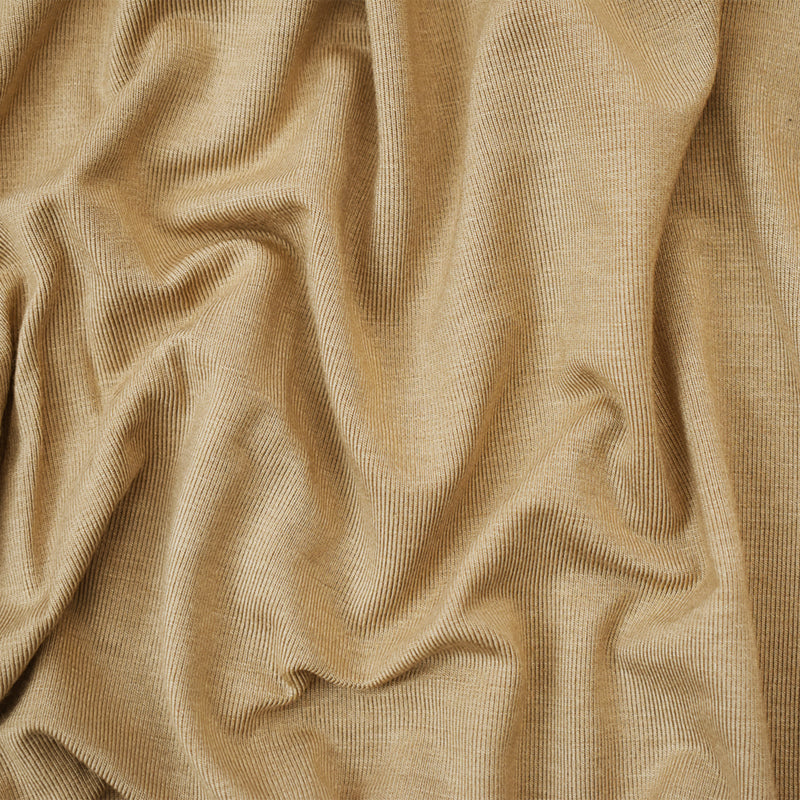
A wavy knit hem is usually stretched, not sewn wrong: the fabric was pulled as it fed, the stitch couldn't move with the knit, or the hem was pressed with too much heat or steam. Diagnose in order — check whether the wave follows the stitch line (feed/stretch problem), appears only after pressing (heat problem), or sits in the fabric itself before sewing (cut off-grain or over-handled edge).
You need a scrap of the same knit, cut the same direction as the hem, wide enough to fold and stitch a short test hem. Change one variable at a time and compare each test against the untreated scrap.
Step 1: Sort the symptom
Wave follows the stitch line evenly. The fabric stretched under the presser foot or the stitch is holding the knit in an extended state. Start with the feed test.
Wave appeared only after pressing. Heat or steam is the prime suspect. Leave this branch to the pressing protocol linked below, but note which iron setting and how much steam you used — that is your evidence.
Wave is in the fabric before any sewing. The edge may have been cut off the grain or stretched during handling, cutting or storage. Skip to the stop rule; machine settings cannot repair an edge that is already distorted.
Wave shows mainly at curves. A curved hem edge is longer or shorter than the fold it is stitched to. Ease distribution, not pressure, is usually the issue there.
Step 2: The unstretched scrap test
Fold the scrap to the same hem depth as the garment. Sew it without pulling or pushing the fabric — let the feed dogs move it — and keep your hands behind and in front only as guides. Compare the test hem with your project hem.
If the scrap lies flat while the garment waves, your fabric and stitch can work; the difference was handling. Knits stretch almost invisibly under a guiding hand, and a hem sewn under even slight tension relaxes into ripples the moment it leaves the machine. Re-sew the garment hem with the same hands-off feeding.
If the scrap waves the same way, continue to the machine branches.
Step 3: Feed branch — pressure and even feed
Repeat the test with a walking foot or your machine's even-feed setting engaged, and, if your machine allows it, with slightly reduced presser-foot pressure. A standard foot can push the top layer of a knit ahead of the bottom layer, stretching the hem as it goes. If the even-feed test lies flatter, feed mechanics were the cause: hem the garment the same way, and support the fabric's weight so it does not drag off the table and stretch the edge.
Step 4: Stitch branch — can the stitch move?
A straight stitch locks every stitch point, so a knit that wants to recover will ripple against it. Test a narrow zigzag, a stretch stitch, or a twin needle (commonly 2.5–4.0 mm spacing) with a ballpoint or stretch needle. If the stretch-capable stitch lies flat on the scrap, change the garment hem to it. A twin needle gives two parallel rows on top with a zigzag underneath, which is why it is a common T-shirt finish — but test first, because tunnelling between the two rows is its own defect on some knits.
Step 5: Stabilizer branch
If feeding and stitch are right and the edge still ripples, the knit itself may be too lively to hold a folded edge. Test a narrow strip of wash-away stabilizer tape or lightweight fusible tricot inside the hem fold on the scrap. Keep stabilizers as categories here: match any specific product to the fiber and care of your fabric rather than assuming one tape suits every knit. If the stabilized test is flat, apply the same support to the garment hem.
Step 6: The pressing branch and the stop rule
When the wave began at the iron, follow the pressing, heat and moisture check for knit hems before re-sewing anything. Gentle steaming relaxes mild waves on some knits and sets them on others, so treat recovery as a scrap test, never a promise.
The stop rule: if the unsewn edge is already wavy — cut off-grain, stretched on the roll, or pulled during cutting — do not keep changing machine settings. Trim back to stable fabric or re-cut the piece on grain. Sewing cannot un-stretch an edge.
Once hems are under control, the same knit behaviour matters even more under an embroidery hoop; see embroidery stabilizer choices for knit T-shirts. More diagnostics live in the Sewing Problems Solved hub.
Jerseys that make the test worthwhile
Compare knit fabrics in the knit fabrics collection. The three jerseys below span the usual wavy-hem cases:
- Brown Bamboo Solid Stretch Jersey Knit Fabric ($1.25) — a bamboo stretch jersey, the typical drapey case where feed control decides the hem.
- Pink Cotton Solid Stretch Spandex Jersey Knit Fabric ($0.82) — cotton/spandex jersey whose strong recovery makes any stretched sewing show immediately.
- Beige-Black-White Poly Slub Jersey Knit Fabric ($1.25) — a lightweight poly slub jersey, the hardest of the three to keep flat.


