
Table of Contents
- Understanding King-Size Quilt Dimensions
- Calculating Your Scale Factor
- How Many Quilt Blocks for a King-Size Quilt
- Adjusting Cut Pieces and Seam Allowances
- Using a Quilt Pattern Size Calculator
- Calculating King-Size Quilt Fabric Yardage
- Scaling Blocks Versus Adding Borders or Extra Blocks
- Common Mistakes to Avoid When Scaling
- Frequently Asked Questions
Last Updated: October 13, 2026
Understanding King-Size Quilt Dimensions
A king-size quilt covers a 76" × 80" mattress plus extra fabric to drape over the sides and tuck under pillows, the mattress drop. Learning how to scale quilt patterns king size ensures your finished quilt reaches the dimensions you want.
A typical drop adds 12 to 16 inches per side, giving a finished quilt of roughly 100"-108" wide by 100"-108" long. Some prefer an 8- to 10-inch drop for a tailored look; others want 18 inches for a flowing appearance.
Decide your mattress drop first, it changes everything about how you scale your pattern.
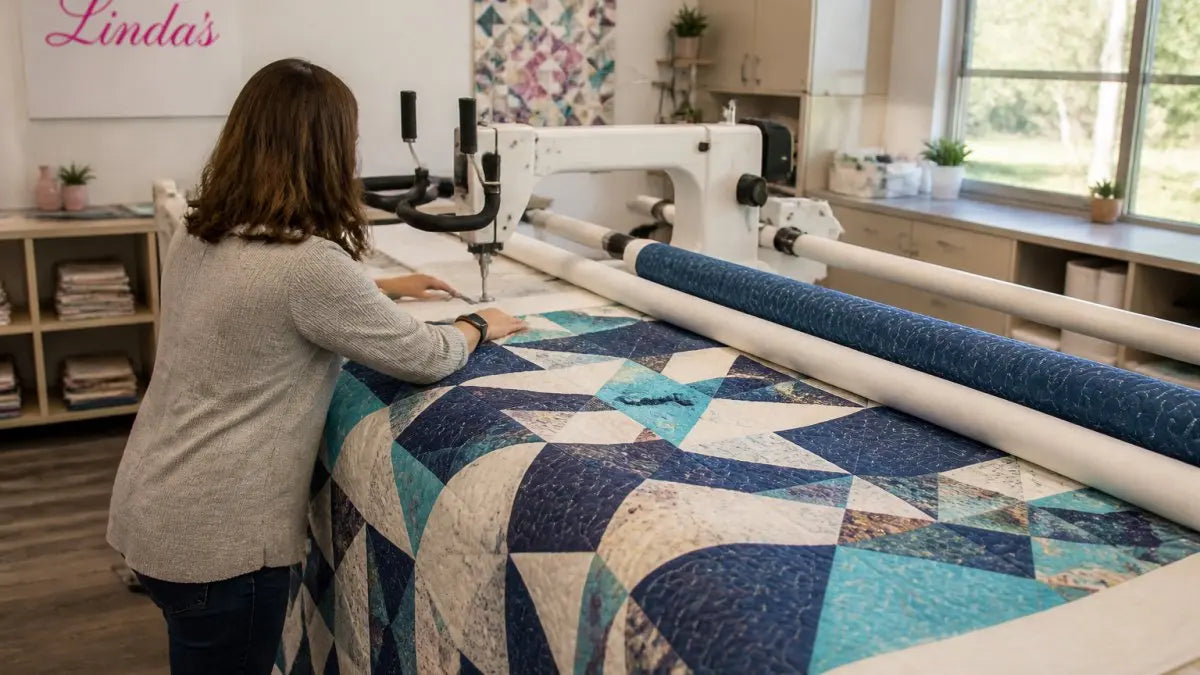
King-size quilts require more fabric, batting, thread, and time, so scaling correctly from the start saves frustration. At Linda's Electric Quilters, we offer the right supplies and guidance to help quilters tackle large projects.
Calculating Your Scale Factor
Your scale factor tells you how much bigger to make each block.
Finding Your Original Block Size
Your pattern instructions should state the finished block size, the size after sewing, excluding seam allowances. Common finished block sizes are 6, 8, 10, and 12 inches. If your pattern doesn't list it, measure a block or count grid squares, where each square usually equals 1 inch of finished size.
Working Out the Math
Here's the formula:
Scale Factor = Desired Block Size ÷ Original Block Size
Say your original blocks are 8 inches and you want 12-inch blocks: 12 ÷ 8 = 1.5. Every measurement gets multiplied by 1.5, so a 2-inch piece becomes 3 inches.
Write down every scaled measurement before cutting; a spreadsheet prevents mistakes.
How Many Quilt Blocks for a King-Size Quilt
A king mattress is 76" × 80", but a quilt finishing at exactly that size won't cover the sides or tuck under pillows. Building in a drop and tuck changes your block count.
Setting a Realistic King-Size Target
Use this quick reference to pick your finished dimensions before you calculate block counts:
| Look | Mattress Drop (per side) | Pillow Tuck | Typical Finished Size |
|---|---|---|---|
| Tailored / modern | 8-10 inches | 10 inches | 96" × 100" |
| Standard | 12-16 inches | 10-12 inches | 100"-108" × 100"-108" |
| Generous / traditional | 18 inches | 12-15 inches | 112" × 112" or larger |
Measure your own bed, a low-profile platform bed needs less drop than a traditional frame with a box spring. Write your target width and length at the top of your worksheet.
Working Backward from Target to Block Count
Divide each target dimension by your scaled block size, round down to a whole block, then make up the difference.
Example: target 104" × 104", scaled blocks finish at 12".
- 104 ÷ 12 = 8.67 → 8 blocks across
- 104 ÷ 12 = 8.67 → 8 blocks down
- 8 × 8 = 64 blocks, finishing at 96" × 96"
- The 8-inch shortfall on each side is closed with borders (see below)
| Scaled Block Size | Blocks Across | Blocks Down | Total Blocks | Finished Size (no borders) |
|---|---|---|---|---|
| 10 inches | 10 | 10 | 100 | 100" × 100" |
| 12 inches | 8 | 8 | 64 | 96" × 96" |
| 14 inches | 7 | 7 | 49 | 98" × 98" |
| 16 inches | 6 | 6 | 36 | 96" × 96" |
For a rectangular quilt, say 104" × 120", arrange 8 blocks across and 10 down at 12" each: 80 blocks and a 96" × 120" top before borders.
Four Ways to Reach King Size (and When to Use Each)
You are not locked into scaling every block.
1. Scale every block uniformly. Best when you love the original design and want the same proportions.
2. Keep blocks original size and add borders. Fastest route, no recalculation, a wide or pieced border becomes the design feature that reaches king size.
3. Keep blocks original size and add more blocks. A 4 × 4 layout becomes 6 × 6. Best for simple blocks and quilters who enjoy repetition.
4. Mix scaled blocks with original-size sashing or borders. Scale the main blocks, keep sashing at standard width, ideal for sampler-style quilts.
Verify Before You Cut
Run the final math again. A 10 × 10 layout of 10-inch blocks finishes at 100" × 100"; a 4-inch border adds 8 inches each way for 108" × 108". Confirm it matches your target before cutting.
Adjusting Cut Pieces and Seam Allowances
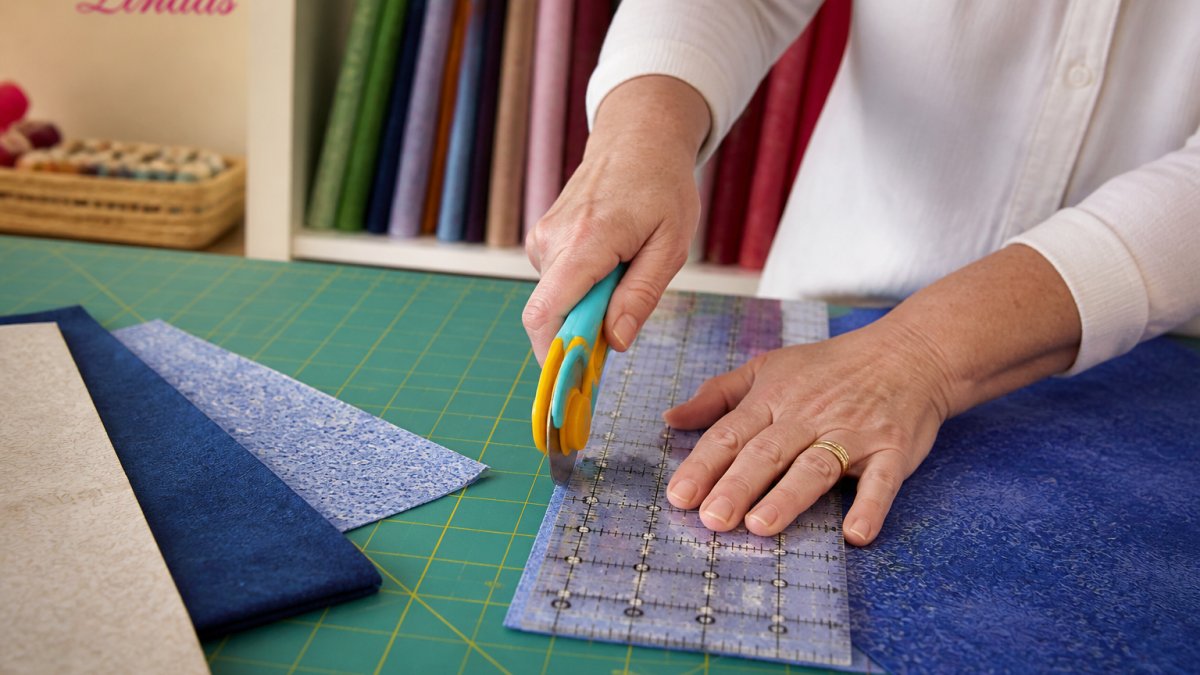
Scaling a block scales each piece's finished size, but cutting size includes seam allowances. Most quilts use a quarter-inch seam allowance, so add half an inch to each finished measurement:
- Calculate your scaled finished size for each piece
- Add half an inch for seam allowances
- Cut to that larger measurement
Example: a piece cut at 2 inches becomes 2.5 inches with a quarter-inch seam allowance. Scaled by 1.5, the finished size is 3 inches and the cut size is 3.5 inches.
Many quilters forget that scaled patterns require scaled seam allowances too. The math is the same: add half an inch to every finished measurement.
Rotary cutters and clear rulers make this faster and more accurate than scissors.
Some patterns use different seam allowances, foundation paper piecing sometimes uses smaller ones, and half-square triangles may need different math. Check your instructions before cutting.
Using a Quilt Pattern Size Calculator
A quilt pattern size calculator takes your original and desired finished block sizes and returns a scale factor plus adjusted cut measurements.
What a Calculator Actually Does
At minimum, a block-size calculator:
- Divides desired finished size by original finished size for the scale factor
- Multiplies every finished piece measurement by that factor
- Adds the seam allowance back to produce a cut size
Some calculators stop at step 1 with a single number; others produce a full cutting chart. The second type is far more useful for king-size projects, where one arithmetic slip compounds across dozens of pieces.
Software Options Worth Knowing
BlockBase Plus (from Electric Quilt) is the most established desktop option for traditional blocks, printing blocks at any finished size with scaled rotary-cutting instructions, templates, or foundation patterns, plus a cutting chart and yardage estimate.

Electric Quilt (EQ8) is a broader design program: draw or import a block, resize it, and the software recalculates piece dimensions and fabric requirements, handling complex layouts, sashing, and borders in one place.
Free online block calculators suit simple geometric blocks, four-patch, nine-patch, half-square triangles, snowball.
Spreadsheet templates are the most flexible option: columns for piece name, original finished size, scale factor, scaled finished size, and cut size (scaled finished + 0.5"). Change the scale factor and every row updates.
Where Calculators Break Down
Calculators assume uniform scaling works for every piece, which fails in several common situations:
- Appliqué shapes. Enlarging a template changes curve geometry, a gentle arc can become an awkward sweep. Redraw at the new size.
- Paper piecing and foundation piecing. Numbered sections and seam lines are tied to the printed foundation, so reprint it at the new size.
- Curved piecing. Drunkard's Path, New York Beauty, and similar blocks have curves calibrated to a specific size; doubling can make them too shallow to piece cleanly. Test one block first.
- Blocks with fixed-size components. Pre-cuts like a 2.5" strip, 5" charm square, or specific ruler may no longer fit. Abandon the pre-cut or redesign that portion.
- Y-seams and set-in pieces. Already fiddly at original size; scaling up usually helps, but scaling down can make them nearly impossible.
A calculator gives you numbers. It does not tell you whether the enlarged block will piece cleanly. Always sew one test block at the new size before cutting fabric for the full king-size quilt.
Rounding Rules That Keep You Out of Trouble
Calculators often return fractions like 6.75" or 5.33". Handle them like this:
- Round to the nearest quarter-inch for most pieced blocks, quarter-inch increments match standard rotary rulers.
- Round at the end, not at each step. Rounding the scale factor and each piece stacks errors. Multiply first, then round the final cut size.
- Prefer clean scale factors. 1.5, 2, and 1.25 are friendly; 1.33 (4 ÷ 3) generates repeating decimals. If your target allows, adjust the block size slightly to land on a clean factor.
- Check the block's finished size after rounding. An eighth-inch shift across 10 blocks drifts the quilt by 1.25 inches, so confirm final dimensions still match your target.
The Bottom Line on Tools
Use a calculator or spreadsheet for the arithmetic, but treat the output as a draft. Verify the scale factor, confirm rounding, and test one block, for king-size quilts, a wrong calculation costs yards of fabric.
Calculating King-Size Quilt Fabric Yardage
Scaled blocks need more fabric, so recalculate yardage for pieced blocks, borders, backing, and batting.
Start with your pattern's yardage requirements, or estimate from the number and size of each fabric piece.
Multiply original yardage by your scale factor squared, since area grows faster than linear measurements.
Batting typically comes in precut king packages, usually 120" × 120".
At Linda's Electric Quilters, we carry batting in rolls, packages, and by-the-yard options.
Scaling Blocks Versus Adding Borders or Extra Blocks
Not every king-size quilt requires scaling every block.
Option 1: Scale all blocks uniformly. Works when you love the original design and want it bigger with the same proportions.
Option 3: Keep blocks the same size and add more blocks. A 6-block quilt becomes 9 or 16 blocks, more complexity, familiar design.
Option 4: Mix scaled and original-size blocks. Scale the main blocks but keep sashing at standard size to reduce fabric while enlarging the overall design.
The choice depends on your design, time, and skill level: scaling is most flexible, borders are fastest, adding blocks is the middle ground.
Common Mistakes to Avoid When Scaling
Mistake 1: Forgetting to scale seam allowances. Cutting measurements must include seam allowances; scaling only the finished size leaves blocks too small.
Mistake 2: Rounding too early. Do all math first, then round at the end, rounding each step compounds errors.
Mistake 3: Not accounting for fabric shrinkage. Fabric shrinks when washed.
Mistake 4: Ignoring pattern complexity. Simple geometric blocks scale easily; curves, appliqué, and irregular shapes may not. Test one block first.
Mistake 5: Choosing an awkward scale factor. 1.33 (4 ÷ 3) creates measurements like 5.33 inches that are hard to cut precisely.
Frequently Asked Questions
What size should a king-size quilt be?
A standard king-size quilt finished size is 120 inches wide by 120 inches long. This accounts for a 16- to 20-inch drop on all sides when placed on a king mattress. If you prefer more overhang or a pillow tuck, you may want to add 4 to 8 inches to the length. Always check your target finished size before calculating your scale factor to ensure proper proportions and design balance.
How do I resize a quilt pattern for a king-size bed using a scale factor?
Divide your target finished quilt size by the original pattern's finished size to get your scale factor. For example, if your original pattern finishes at 60 inches and you want 120 inches, your scale factor is 2.0. Multiply every measurement in the pattern (block size, cut pieces, borders, sashing) by this factor. Round to the nearest quarter inch.
How many quilt blocks do I need for a king-size quilt?
The number of blocks depends on your scaled block size and quilt design. If you scale 6-inch blocks to 12 inches and want a 120-by-120-inch quilt, you'll need 10 by 10 blocks (100 total). Alternatively, you can keep original block sizes and add more blocks, or use a combination of enlarged blocks and sashing or borders to reach your target dimensions without scaling every single block.
Should I enlarge quilt blocks or add borders and extra blocks to make a king-size quilt?
Uniform scaling works well for balanced, repeating designs, but it's not always the best choice. If your pattern relies on intricate piecing or small details, scaling can make seams difficult to manage. Adding borders, sashing, or extra blocks preserves the original block design. Consider your construction method, thread tension, and the complexity of your pattern before deciding whether to scale uniformly or build size through borders and additional blocks.


