
Last Updated: October 25, 2026
Quick Summary
A hand sewing needle is a small, pointed metal tool with an eye at one end that carries thread through fabric by hand. Choose your needle by matching its size to fabric weight, selecting the type for your task (sharps for general sewing, betweens for quilting, embroidery needles for decorative work), and ensuring the eye fits your thread without fraying.
- Hand sewing needles are sized 1 (largest) to 12 (finest), with larger numbers indicating smaller needles.
- Betweens are the shortest needles at 1.5 to 1.75 inches, designed for hand quilting with sizes 8 and 9 being most popular.
- Embroidery needles have a larger, elongated eye to hold multiple strands of floss without splitting them.
- A needle too thick for delicate fabric leaves visible holes, while one too thin bends or breaks under pressure.
- Thread should pass through the eye with slight resistance but no drag to prevent fraying and uneven tension.
Table of Contents
- Understanding Hand Sewing Needle Anatomy and Function
- Types of Hand Sewing Needles and Their Best Uses
- Hand Sewing Needle Sizes Explained
- Hand Quilting Needles: Choosing for Precision and Comfort
- Embroidery Needles for Fine Detail Work
- Matching Your Hand Sewing Needle to Fabric Weight and Thread
- Threading, Storage, and Needle Care Essentials
- Start Your Hand Sewing Project With Confidence
- Frequently Asked Questions
Understanding Hand Sewing Needle Anatomy and Function
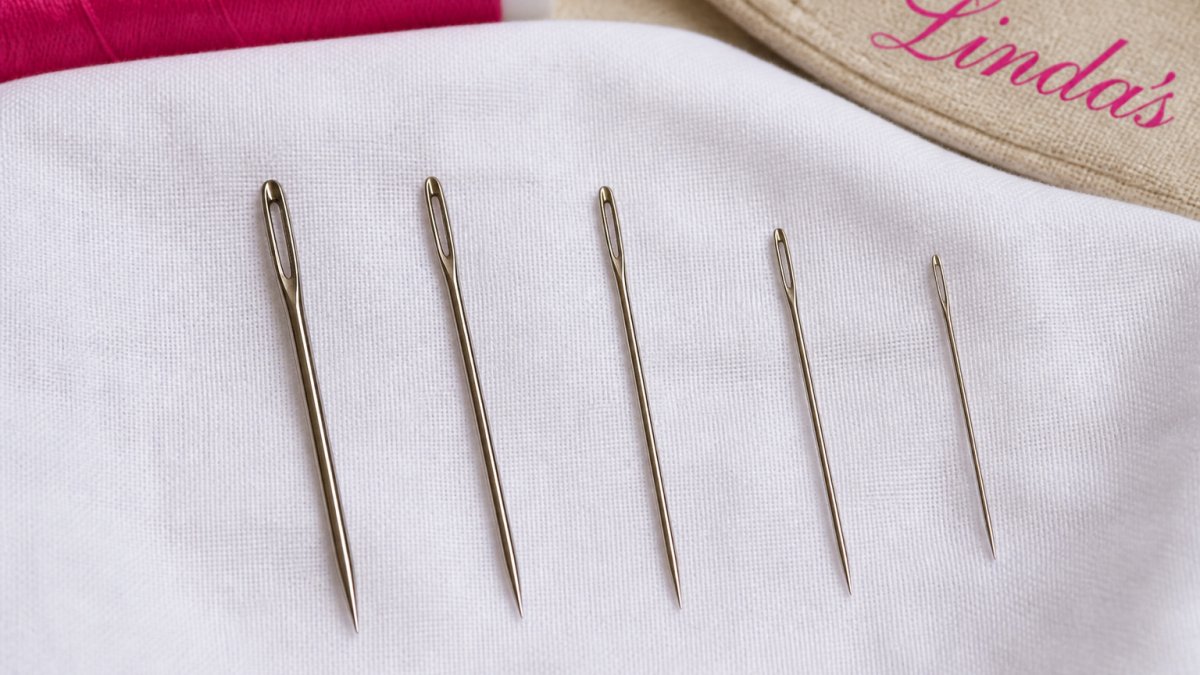
A hand sewing needle is a small, pointed metal tool with an eye at one end that carries thread through fabric by hand.
Types of Hand Sewing Needles and Their Best Uses
Hand sewing needles come in distinct types: sharps for general sewing, betweens for quilting, embroidery needles for decorative thread work, and specialty needles like beading and leather.
Sharps are the workhorse of hand sewing, medium length with a small, round eye and a sharp point.
The wrong needle causes skipped stitches, thread shredding, and breakage mid-project; a matched needle keeps hands comfortable and results clean.
Hand Sewing Needle Sizes Explained
Hand sewing needles are sized 1 (largest) to 12 (finest), larger numbers mean smaller needles, consistent across manufacturers.
Sizes 1-4 are heavy-duty needles for thick fabrics, leather, and canvas. Sizes 5-8 work well for medium-weight fabrics like cotton quilting fabric and linen. Sizes 9-12 are fine needles suited to delicate fabrics, detailed embroidery, and precision work where small stitches matter. The needle eye grows proportionally smaller as the needle size increases, which affects thread compatibility.
Correct size depends on fabric weight and thread thickness: a size 8 handles standard embroidery floss but struggles with heavier thread, while a size 4 feels clumsy for tiny stitches in silk dupioni.
According to needle sizing standards established by major sewing notions manufacturers, the relationship between needle size, fabric weight, and thread diameter is the foundation of successful hand sewing.
Hand Quilting Needles: Choosing for Precision and Comfort
Hand quilting needles, also called betweens, are the shortest needles available at 1.5 to 1.75 inches.
Betweens come in sizes 7-12, with size 8 and 9 being the most popular for hand quilting. Smaller sizes (10-12) create finer stitches but require more hand strength to push through dense layers. Larger sizes (7-8) are easier on hands during long quilting sessions and work well for beginners or those with arthritis or limited hand strength.
The short length is the defining advantage: you rock the needle through fabric in one efficient motion, building rhythm and speed, while longer needles force repeated repositioning that slows work and increases fatigue.
Learn more about why specialized quilting needles matter and explore batting options that pair perfectly with hand quilting to maximize your project's success.
Embroidery Needles for Fine Detail Work
Embroidery needles are longer than sharps with a larger, elongated eye that holds multiple strands of floss without splitting them; the thicker body adds stability and the sharp point pierces even-weave fabrics cleanly.
Embroidery needles typically range from size 1 to size 10, with sizes 7-9 being standard for most embroidery work. The larger eye distinguishes them from sharps, a sharp's tiny eye won't accommodate even two strands of standard floss without fraying the thread. When you're working crewel embroidery, cross-stitch, or surface embroidery on cotton or linen, an embroidery needle is essential.
Their key advantage is handling the thicker, multi-strand threads that create bold stitches; a sharp or between forces you to split floss into single strands, defeating embroidery's visual impact.
Understanding thread selection for embroidery projects ensures your needle and thread work together harmoniously, creating professional results.
Matching Your Hand Sewing Needle to Fabric Weight and Thread
Successful needle selection is a three-way negotiation between fabric weight, thread diameter, and eye size. The practical decisions happen at the intersections, a heavy thread meeting a fine needle, or a tightly woven fabric meeting a too-blunt point. The matrix below consolidates the fabric-to-needle relationship.
| Fabric category | Examples | Recommended needle type | Recommended size | Eye consideration |
|---|---|---|---|---|
| Ultralight / sheer | Silk chiffon, batiste, voile, organza | Sharps or embroidery | 10-12 | Small round eye; fine 60-100 wt thread only |
| Lightweight woven | Cotton lawn, lining fabrics, lightweight linen | Sharps | 8-10 | Standard eye; all-purpose 50 wt thread |
| Medium woven | Quilting cotton, poplin, mid-weight linen, wool suiting | Sharps or betweens | 6-8 | Standard eye; 40-50 wt thread |
| Heavy woven | Denim, canvas, duck, upholstery | Sharps (heavy) or leather | 1-5 | Larger eye for heavier 30 wt or topstitching thread |
| Knit / stretch | Jersey, interlock, rib knit | Ball-point sharps | 6-10 | Standard eye; avoid sharp points that snag loops |
| Even-weave for counted work | Aida, linen for cross-stitch | Tapestry (blunt) or embroidery | 22-26 tapestry / 5-9 embroidery | Blunt point passes between threads; large eye for floss |
| Beading | Seed beads, bugle beads | Beading | 10-15 | Extra-long tiny eye; must pass through bead hole twice |
| Leather / dense non-woven | Garment leather, suede, vinyl | Leather (cutting point) or glover | 1-7 | Wedge point slices rather than parts fibers |
The thread-to-eye relationship
Eye size is the most overlooked variable. The eye must fit the thread's diameter plus clearance for friction; if the thread fills it completely, every stitch abrades against the eye's edges.
Sure Guide Needle Threader FAB50036 Sewline #1 →
Thread weight works inversely to number: 30-weight is thicker than 60-weight. Heavier decorative threads, topstitching threads, and pearl cotton need proportionally larger eyes, often a chenille or tapestry needle.
Point shape as a fabric decision
Point shape is not cosmetic. Sharp points (sharps, betweens, embroidery) separate woven fibers cleanly for tightly woven fabrics. Ball points push knit loops aside, preventing runs in jersey and interlock. Wedge or cutting points (leather needles) slice a small slit in non-wovens so thread passes without tearing. Tapestry needles are blunt on purpose, they slip between even-weave threads without splitting them, which is why they dominate counted cross-stitch and needlepoint.
When the triangle is mismatched
Three failure signatures point to a needle-fabric-thread mismatch. Visible puncture holes that don't close after washing mean the needle is too thick, drop two sizes. Thread shredding at the eye means the eye is too small or too sharp, move to a larger or smoother eye. Skipped or uneven stitches mean the needle is too fine to carry the thread smoothly.
Understanding how sewing notions work together as a system helps you treat needle, thread, and fabric as one decision rather than three.
Threading, Storage, and Needle Care Essentials
Threading, storage, and care are where hand sewing needles most often fail users, not because the needle is wrong for the fabric, but because the eye is clogged, the needle is bent, or the tool is inaccessible. Here's how to thread difficult eyes, choose ergonomic options, spot a worn needle, and store needles safely.
Threading difficult eyes
A needle threader is the standard workaround for fine eyes, but the mechanism matters. Groove-and-pin threaders, like the Sure Guide Needle Threader FAB50036 Sewline #1, hold the needle in a shaped seat and direct thread through the eye with a pin, avoiding wire fatigue and working well for sizes 9-12. Multi-slot tools such as The Gypsy Quilter 3 In 1 Needle Threader with Cutter offer different slot depths plus a built-in cutter.


For very fine needles, two low-tech habits help. First, cut the thread end at an angle with sharp scissors rather than biting or breaking it, a clean diagonal tip passes through an eye more reliably than a frayed end. Second, dampen the thread tip slightly; moisture stiffens natural fibers and reduces the fuzz that catches on the eye's edge.
Ergonomic and accessibility options
Standard sharps and betweens assume full vision and dexterity. Self-threading (calyx-eye) needles have a slotted eye that accepts thread pushed down from the top, useful for low vision but not for heavy fabrics, since the slot weakens the eye. Large-eye sharps and embroidery needles trade precision for easier threading, easy-grip needles add a textured or larger shank for reduced pinch strength, and longer milliner's needles give more shaft to grip.
Identifying a worn or damaged needle
Needles fail in ways that are easy to miss. A bent needle is obvious, but a dull point only produces a faint pulling sensation and slightly enlarged holes. A burred eye shreds thread at the eye, rust appears as dark speckling and increases friction, and lost plating shows as a dull gray patch that drags. Any of these means replacement, needles are consumables.
Storage and safe handling
Loose needles in a drawer are a puncture and bending hazard. Store them in a dedicated needle case, a closed pin cushion, or on a magnetic strip, and keep the original packet or a labeled envelope per size, stamped size numbers are often too faint to read once in use. Store needles dry; moisture causes rust and accelerates corrosion at the eye, so a small silica packet is a low-cost safeguard in humid climates.
Proper care extends needle life and protects your hands. For a broader look at thread selection for embroidery projects and how thread and needle interact, see the related guide.
Start Your Hand Sewing Project With Confidence
Selecting the right hand sewing needle transforms your experience. Match needle size to fabric weight, choose the type that suits your task, and ensure your thread fits the eye without fraying, then stitches improve, hands stay comfortable, and projects progress smoothly.
Linda's Electric Quilters offers over 50,000 quilting, sewing, and embroidery products, including premium batting, fabrics, threads, and essential notions from top industry brands. Our 700+ educational videos and expert resources offer educational resources for quilting and sewing.
Frequently Asked Questions
What are the different sizes of hand sewing needles?
Hand sewing needles range from size 1 (largest) to size 12 (smallest), with specialty sizes like 13-16 for fine work. General-purpose needles typically fall between sizes 5-10. The size number indicates the needle's thickness and eye diameter, higher numbers mean thinner needles with smaller eyes, ideal for fine fabrics and delicate thread. Lower numbers work better for heavier fabrics and thicker threads. Your needle size should match both your fabric weight and thread thickness for smooth stitching.
How do I choose the right hand sewing needle for my project?
Match your needle to three factors: fabric weight, thread type, and stitch type. Use smaller, sharper needles (sizes 9-12) for lightweight fabrics and fine embroidery thread. Choose larger needles (sizes 1-5) for heavy fabrics like denim or canvas. For hand quilting, select quilting needles specifically, they're shorter and stronger. Always ensure the thread passes smoothly through the needle eye without friction. When in doubt, test on scrap fabric first to confirm the needle glides easily without pulling or snagging.
What is the difference between a quilting needle and a regular sewing needle?
Hand quilting needles are shorter and stronger than general-purpose needles, designed to push through multiple fabric layers and batting without bending. They have a small, reinforced eye and a sharp point for precise stitching through dense material. Regular hand sewing needles are longer and more flexible, suited for single-layer stitching on clothing or soft projects. If you attempt quilting with a regular needle, it may bend under pressure or break, compromising your stitch quality and project durability.
Can I use a sewing machine needle for hand sewing?
No, sewing machine needles and hand sewing needles are fundamentally different. Machine needles have a flat shank designed to fit into a machine's needle clamp, while hand needles are round and designed for manual threading. Machine needles are also too thick and have eyes shaped differently for machine tension systems. Using a machine needle by hand will be uncomfortable to grip, difficult to thread, and may cause hand fatigue or injury. Always use needles designed specifically for hand sewing.
What tools make threading hand sewing needles easier?
The Sure Guide Needle Threader threads very fine needles (sizes 9-12) with a shaped pin that directs thread through the eye. The Gypsy Quilter 3-in-1 Needle Threader with Cutter offers three needle threaders and nine spots for cutting thread. The Hemostat Needle Gripper has gripper teeth and locking handles for tough hand sewing.
Choosing the right needle is the foundation of successful hand sewing. Start with our complete selection of hand sewing needles and threading tools and experience how the correct needle elevates your work from frustrating to fluid. Our Crafters Roundtable podcast features quilters and embroidery artists discussing their favorite needles and techniques, listen in for insider insights that improve your projects.



