Hi Bestie,
Ever finish a section of quilting, step back, and think…
“Why doesn’t this look quite like I pictured it?”
Before you blame the design, or your quilting, take a look at your stitch length.
Stitch Length Changes More Than You Think
Stitch length affects more than how many stitches fit into an inch. It can change how the quilting line looks, how much definition you see, and how the design works with your thread and quilt sandwich.
That’s why a stitch length that looks beautiful on one project may feel completely different on the next.
Where Should You Start?
For general quilting, 8–10 stitches per inch (about 2.5–3.5 mm) is a useful starting point.
But think of it as exactly that: a starting point, not a rule.
Your design, thread, batting, and fabric can all influence what looks best.
Why Stitch Length Changes the Look of the Same Design
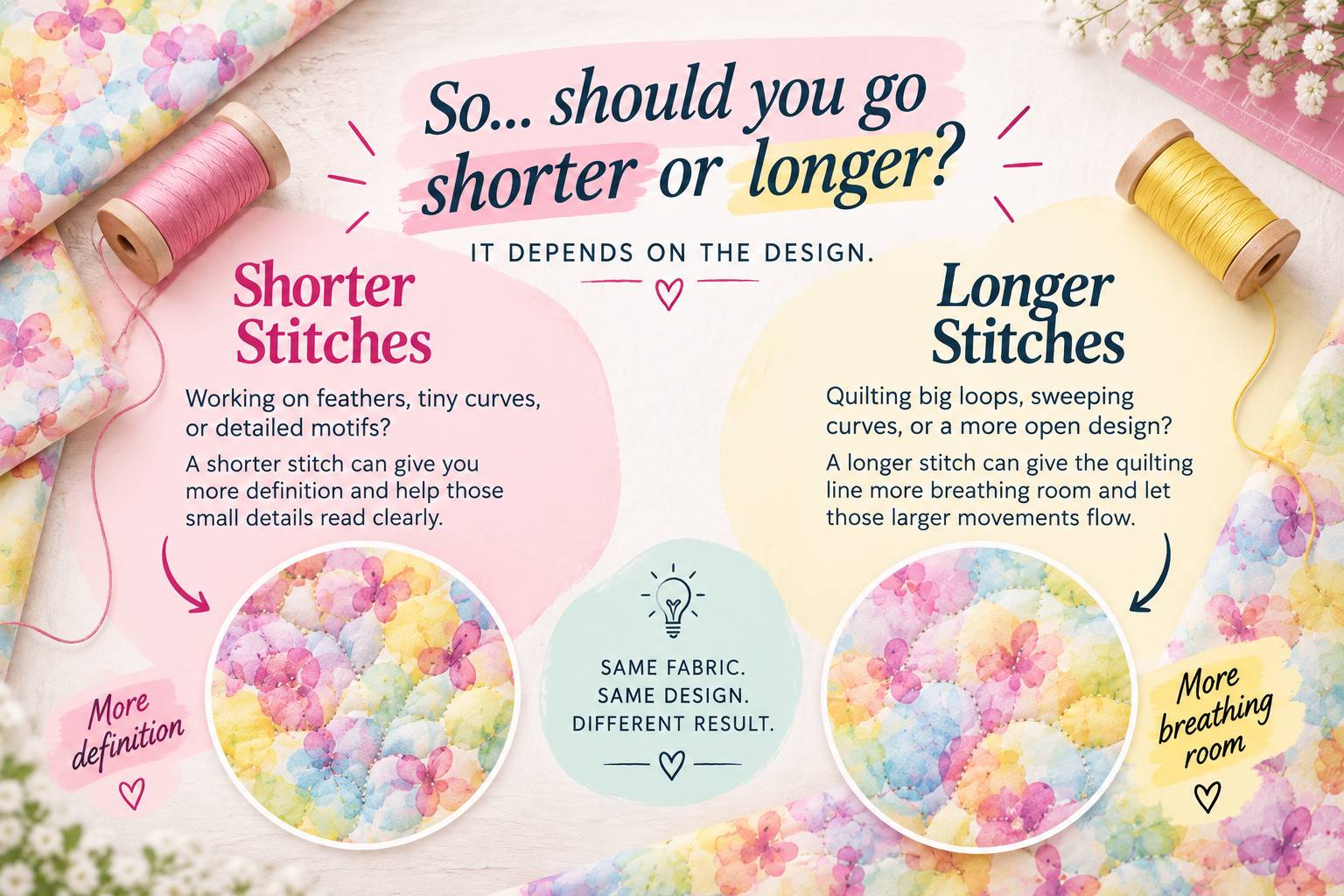
Here’s what’s actually happening, Bestie. Every stitch is a tiny straight line. On gentle curves and long straight lines, longer stitches read smooth and clean. But on tight curves, pebbles, and small detailed motifs, those same long stitches start to show as little flat segments — so a round curve looks choppy or angular.
Shorter stitches put more thread into the line. That gives you more definition and smoother curves, but it also makes the line look heavier, especially with a thicker thread. Go too short and the stitches can pile up, look beady, and perforate your fabric more than you’d like.
Your batting plays a part too. A loftier batting lets each stitch sink in and puff up between stitches, so a slightly longer stitch shows off more texture. A flatter batting keeps the line crisp and close to the surface. That’s exactly why one setting can give the same quilting design a totally different personality from one quilt to the next. If you want to go deeper, my complete guide to machine quilting stitch length walks through it step by step.
Remember, Test It First
Test it before committing to the whole quilt, make a small sample using the same fabric, batting, backing, and thread. Try a few stitch lengths side by side. You might be surprised by how much changing one small setting changes the personality of the exact same quilting design.
And if something still looks off after you’ve dialed in your stitch length, check your tension next — here’s the tension fix that creates another problem, plus what those needle numbers actually mean.
Happy Quilting!
From Corey.
Stock Up on Notions This Week
Bestie, notions are on sale right now at Linda’s — the perfect time to grab the thread, needles, and little tools that make testing stitch length easy. Shop the Notions Sale or browse our full Glide thread collection.
Frequently Asked Questions
What is the best stitch length for machine quilting?
For most general machine and longarm quilting, 8–10 stitches per inch is a reliable starting point. Treat it as a baseline, not a rule: small, detailed designs and tight curves usually look better toward the shorter end, while large, open edge-to-edge designs can look great a little longer. See the complete stitch length guide for more.
How do I convert stitches per inch to millimeters?
Divide 25.4 (the number of millimeters in an inch) by your stitches per inch. So 10 stitches per inch is about 2.5 mm per stitch, 8 stitches per inch is about 3.2 mm, and 12 stitches per inch is about 2.1 mm. The fewer stitches per inch, the longer each stitch.
Why do my quilted curves look choppy or pointy?
Your stitches are probably too long for the size of the curve. Each stitch is a short straight line, so on tight curves and pebbles, long stitches show as flat segments. Shortening your stitch length (more stitches per inch) smooths the curve out. Also check that your motif isn’t too small for your thread weight.
Does thread weight affect which stitch length I should use?
Yes. A heavier thread with very short stitches can look bulky and beady, while a fine thread like a 40 wt polyester can handle shorter stitches and still look smooth. It also changes how much thread you’ll go through — see the thread math every quilter should know and our guide to quilting with Glide polyester thread.
Does batting change how my stitches look?
It does. Loftier batting lets stitches sink and puff between them, adding texture and dimension, while flatter batting keeps quilting lines crisp and close to the surface. Always test on a sample with the same batting you’ll use in the quilt. Learn more in our guide to selecting batting for quilting and why 100% cotton isn’t always the answer.