
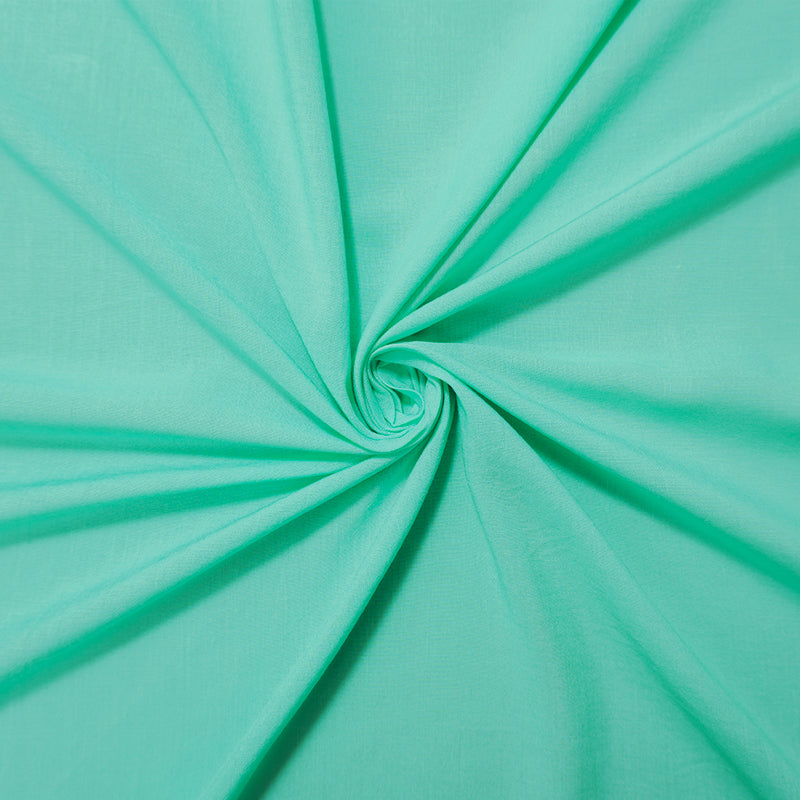
Prepare rayon challis before you cut it, in this order: test a measured swatch first, then wash and dry the whole cut exactly the way you will wash the finished garment, then let it rest, press it gently, and re-check the grain before any pattern piece touches it. Rayon and viscose challis relax and shrink in water — mostly along the length — so a garment cut from unwashed challis can come out of its first wash shorter, narrower across the seams, and twisted off grain. Thirty to forty-five minutes of preparation removes that risk.

Why challis moves in water
Rayon and viscose are regenerated cellulose fibres. Dry, the yarns in a challis plain weave are held under slight tension from weaving and finishing. In water the fibres swell, that tension releases, and the cloth relaxes to a slightly smaller size. Three consequences follow:
- Shrinkage is directional. Length (the warp direction, parallel to the selvedges) usually shrinks more than width. A dress cut to length in unwashed challis is the garment most likely to come back from the wash too short.
- The first wash does most of it. The bulk of relaxation shrinkage happens the first time the fabric is wetted and dried. A second cycle may add a little more, which is why the test below washes the swatch the way the garment will be washed — and why a fabric you plan to machine-dry must be machine-dried in the test, not line-dried to be safe.
- Wet challis is fragile. Rayon loses strength when wet and this is a lightweight, semi-sheer weave. Handle a wet cut supported and flat, never wrung out or lifted by one corner, or it can distort and tear at stressed points.
What you need
- Your full challis cut, plus a 12 × 12 inch test piece cut from one end (keep the selvedge on one edge so you can tell length from width).
- A ruler or tape, a fabric marker or fine pen, and pins.
- Mild detergent, cool water, and a mesh laundry bag if you machine-wash.
- Flat drying space or a line, a cool-to-warm iron, and a press cloth.
- Your pattern's required yardage and finished garment length, for the adjustment maths in step 3.
Step 1: Run the measured swatch test
- On the dry test piece, mark a precise 10 × 10 inch square with the marker: one side parallel to the selvedge (length), one side across (width). Write an L beside the length marks so you cannot mix the directions up later.
- Wash the swatch exactly as the finished garment will be washed — same water temperature, same cycle, same mild detergent. If the garment will be hand-washed and line-dried for its whole life, test that way; if it will go in the machine, test in the machine, inside a mesh bag.
- Dry it the same way too, then press it lightly with a press cloth, without stretching it back to size.
- Measure the marked square again and record both numbers. That pair of measurements — not a rule of thumb — is your fabric's shrinkage.
While the swatch is wet, run the colourfastness check at the same time: press a damp white cloth against a printed or saturated area for a minute. Colour on the white cloth means wash that fabric separately, in cool water, for the life of the garment — and do not pair it with pale linings until you have confirmed the dye settles after a rinse or two.
Step 2: Read the result — a worked example
Shrinkage percentage is simple: (before − after) ÷ before × 100, worked separately for length and width.
Worked example: your 10-inch length mark measures 9½ inches after washing and drying, and the width mark measures 9⅞ inches. Length shrinkage is (10 − 9.5) ÷ 10 = 5%; width shrinkage is (10 − 9.875) ÷ 10 = 1.25%. That pattern — length moving several times more than width — is typical of rayon challis.
Use the length figure to adjust yardage before you buy or cut: required length ÷ (1 − shrinkage). If a pattern needs 3 yards of finished length and your test shows 5% length shrinkage, you need 3 ÷ 0.95 = 3.16 yards — buy 3¼ yards so the cut still fits the layout after it is washed. If you already own the fabric and it comes up short after washing, the honest options are a shorter hem, a smaller size, or a different pattern — never cut first and hope.
Edge cases: if either direction shrinks more than about 8%, wash and dry the swatch a second time and re-measure; if it is still moving, pre-wash the whole cut twice before cutting, because the garment will keep shrinking in its early washes. If the swatch barely moves (under 1%), still wash the whole cut — finishes and sizing wash out too, and the fabric you cut should feel and drape the way the finished garment will.
Step 3: Wash and dry the whole cut
- Fold the cut loosely or place it in a mesh bag; wash in cool water with mild detergent on a gentle cycle, or hand-wash by supporting the fabric in the water and pressing the suds through — no wringing, no twisting.
- Rinse until the water runs clear. Lift the wet fabric out supported in both arms, and press water out between towels rather than hanging it dripping, which stretches a wet challis under its own weight.
- Dry flat or on a line out of direct sun, matching your test method. If the garment will be tumble-dried, tumble the cut on low — accepting that machine drying usually adds shrinkage compared with line drying, which your swatch test has already priced in.
- Let the dried fabric rest flat for several hours, ideally overnight. Challis continues to relax after drying, and cutting a just-dried, still-settling cut is how off-grain pieces happen.
Step 4: Press and re-true the grain
Press on the wrong side with a cool-to-warm iron and a press cloth, working along the length, lifting and placing the iron rather than dragging it — dragging a lightweight semi-sheer weave can stretch and shine it. Then check the grain before layout: fold the fabric lengthwise, selvedges together. If the crosswise cut end hangs at an angle instead of lining up, the fabric is off grain; ease it back by gently pulling on the bias in the direction that squares the fold, then press again. Cut only when the fold hangs straight and the end lines up — every later step in this module, from layout to hemming, assumes a true grain.
When not to wash
- Dry-clean-only plans. If the finished garment will genuinely be dry-cleaned every time — a lined jacket, for example — pre-treat the fabric the same way: have the cut dry-cleaned, or steam it thoroughly, before cutting. Mixing methods (wash the fabric, dry-clean the garment) leaves shrinkage still to come out later.
- Metallic or coated prints. A challis with a metallic stripe or surface print can lose its finish in water. Test the swatch first; if the finish changes, switch the whole plan to the gentlest method that leaves the swatch unchanged, and tell the garment's future owner that is the care method.
- One-off occasion wear that will be spot-cleaned only: a thorough steam and rest still helps the fabric relax before cutting, and carries none of the water risks.
Verified challis options at Linda's
The main collection for this module is the rayon challis collection. All four fabrics below were verified live in the store for this guide — active, in stock, and each one a fabric this routine applies to:
- Light Green Rayon Solid Challis Woven Fabric — 100% rayon, 55 inches wide, Light, Semi-Sheer. The pale solid: pre-wash it, and plan the lining or camisole its transparency needs at the same time.
- Aegean Blue Rayon Solid Challis Woven Fabric — 100% rayon, 54 inches wide, Light, Semi-Sheer. The saturated solid: run the damp-white-cloth colour test on this one before washing it with anything else.
- Pink Rayon Stripe Slub Challis Woven Fabric — 100% rayon, 58 inches wide, Light, Semi-Sheer, matte. The widest option here: stripes make off-grain cutting obvious, so the step-4 grain check matters most on this fabric.
- Black-White Famous Designer Viscose Daisy Printed Challis Fabric — 100% viscose, 56 inches wide, Light, Semi-Sheer, matte. Viscose is the same fibre family as rayon and shrinks the same way; the print is the colourfastness test case.
Prices in this collection are per fractional-yard cut, so check the product page for the exact cut increments — and add your test-derived shrinkage allowance before you settle the quantity.
Care and limitations
Follow the care guidance on the specific product page first; it overrides general advice. In general, rayon and viscose challis are washed gently in cool water and dried flat or on a line, and pressing is cool-to-warm with a cloth. This guide describes a preparation procedure for you to run on your own fabric: no fabric was washed, measured or photographed for it, and the worked example uses round numbers to show the maths — your swatch measurements are the ones to cut by. If a product page and this guide ever differ on a specific fabric, the product page wins.
Keep reading
More from Apparel Fabric School. Start one step earlier with how to choose rayon challis by weight, opacity and season, and the module's foundation, which garments suit challis's structure and drape. Once your cut is washed, rested and true, convert width to yardage with the fabric yardage guide, and keep seams and edge finishes for rayon challis open for when construction starts.


