
Last Updated: October 23, 2026
Quick Summary
Needles for heavy upholstery work best in size 100/16 or 110/18, with jeans needles preferred for woven fabrics like canvas and denim, and leather needles for vinyl or faux leather. Match needle size to thread weight: Tex 40-50 thread requires size 100/16, while Tex 60-70 requires size 110/18, and verify your home machine accepts the needle size before use.
- A size 110/18 jeans needle is the workhorse for heavy upholstery on home machines, resisting deflection through multiple layers and accommodating Tex 60-70 threads.
- Thread weight and needle size must match: heavier threads need larger needle eyes to prevent friction that breaks thread mid-stitch.
- Test every needle, thread, and tension combination on fabric scraps matching your project before committing to the final piece.
- Replace needles every 8-12 hours of sewing or every 2-3 projects on heavy upholstery, as dense fabrics dull needles faster than light ones.
- Most home machines accept needles up to size 110/18 and thread up to Tex 60-70; exceeding these limits risks needle breakage and machine damage.
Table of Contents
- Understanding Needle Basics for Heavy Upholstery Fabric
- Sewing Machine Needle Sizes for Upholstery Projects
- Needle Types: Universal, Heavy-Duty, Denim, and Specialty Options
- Needles for Canvas and Denim on Home Machines
- Needles for Vinyl Upholstery and Faux Leather
- Sewing Thick Fabric Without Skipped Stitches: Technique and Setup
- Home Machine Limits: When to Replace Your Needle and When to Stop
- Step-by-Step: Selecting and Installing the Right Needle
- Frequently Asked Questions
Understanding Needle Basics for Heavy Upholstery Fabric
A needle is a small metal tool with a pointed tip and an eye that holds thread.
Most sewists grab a "universal" needle and move on.
The real problem is mismatch: thread weight must align with needle size, point shape must suit the weave, and home machines have hard limits industrial setups don't.
We break down how needle size and point shape affect results, and why thread weight and needle size must work together.
How needle size and point shape affect upholstery results
Needle size is marked with two numbers separated by a slash, 90/14, 100/16, 110/18. The first is metric (hundredths of a millimeter), the second American. A larger number means a thicker, stronger needle with a bigger eye.
Point shape matters equally. A universal needle has a slightly rounded point. A sharp point (or Microtex needle) pierces dense weaves cleanly.
On canvas, a universal needle produces inconsistent penetration, some stitches catch, others skip.
Needle deflection, the sideways flex under pressure, increases with fabric thickness. A size 90/14 bends noticeably through multiple layers of denim; a size 110/18 resists deflection better, keeping stitches straight.
Why thread weight and needle size must match
Thread weight is measured in Tex size: Tex 30 is lighter than Tex 40, which is lighter than Tex 70.
A common mistake is pairing heavy bonded nylon or polyester thread with a size 90/14 needle. The thread doesn't fit cleanly in the eye, friction builds, and it frays or snaps within a few stitches.
According to sewing guidance from Trivantage's Sewing Guide for Upholstery, Marine Fabric, and Canvas, a home machine can handle thread up to V-69 weight (roughly Tex 70), but that thread requires a needle most home machines cannot accommodate.
The sewing discussion on PatternReview recommends matching thread weight to needle size deliberately: lighter threads (Tex 30-40) pair with size 90/14 or 100/16 needles; heavier upholstery threads (Tex 60-70) require size 110/18 needles and careful tension adjustment.
Sewing Machine Needle Sizes for Upholstery Projects
Needle size controls whether your home machine can handle upholstery work. Too small, and the needle bends or breaks under pressure. Too large, and the clamp won't hold it securely.
Size 100/16 and 110/18 for most home machine work
For most home sewists, a size 100/16 needle is the practical starting point.
A size 110/18 needle is the workhorse for heavy upholstery on home machines.
The trade-off: a 110/18 requires stronger presser foot pressure and careful tension adjustment. Jumping to it without adjusting other settings will snap needles or skip stitches.
When to use size 90/14 versus heavier options
A size 90/14 needle is too light for serious upholstery work. Designed for quilting cotton and lightweight apparel, it deflects under pressure on canvas or denim, producing skipped stitches and bent needles.
Use a 90/14 only for a single layer of light upholstery fabric (like linen or lightweight faux leather) with lightweight thread. For anything thicker or multi-layered, move to 100/16 or 110/18.
Needle Types: Universal, Heavy-Duty, Denim, and Specialty Options
The needle type shapes how the needle interacts with your fabric; different point shapes and shaft designs handle different materials.
Universal needles versus specialized needle systems
A universal needle has a slightly rounded point and medium-strength shaft, working across cotton, blends, and light synthetics.
Specialized needles are engineered for specific challenges. A denim needle has a reinforced shaft and acute point that resists deflection on dense wovens.
For upholstery on home machines, specialized needles outperform universal ones because upholstery fabrics demand precision and strength universal designs don't provide.
Heavy-duty and jeans needles for thick materials
A jeans needle (also called a denim needle) in size 100/16 or 110/18 is the best choice for heavy woven upholstery fabrics on home machines.
A heavy-duty needle is marketed as a catch-all for thick fabrics, but the term is vague: some are simply universal needles in larger sizes, others are specialized designs.
For canvas, denim, and tweed, a jeans needle outperforms a generic heavy-duty needle because the reinforced shaft directly addresses deflection.
| Needle Type | Best For | Thread Weight | Size Range |
|---|---|---|---|
| Universal | Light-medium fabrics, blends | Tex 30-40 | 80/12-100/16 |
| Jeans/Denim | Canvas, denim, tweed, heavy wovens | Tex 40-70 | 100/16-110/18 |
| Microtex/Sharp | Precision work, dense non-wovens | Tex 30-50 | 80/12-100/16 |
| Leather | Vinyl, faux leather, coated fabrics | Tex 40-60 | 90/14-110/18 |
Needles for Canvas and Denim on Home Machines
Canvas and denim are tightly woven, densely constructed fabrics. They demand needles that can penetrate without deflecting or breaking.
Denim and jeans needles for dense woven fabrics
A denim needle (size 100/16 or 110/18) is purpose-built for canvas and denim.
Canvas is so tightly woven that a universal needle struggles to penetrate evenly, some stitches catch, others skip.
For home machines, a size 110/18 denim needle with bonded nylon thread (Tex 60-70) is the standard setup for canvas upholstery, handling multiple layers without breakage or deflection.
Microtex and sharp point needles for precision
A Microtex needle (also called a sharp needle) has the finest, most acute point available for home sewing, excelling on non-wovens, densely constructed materials, and precision work where stitch quality matters more than speed.
Microtex needles come in smaller sizes (80/12, 90/14) and suit lighter upholstery or single-layer work.
Needles for Vinyl Upholstery and Faux Leather
Vinyl and faux leather are coated materials, not woven fabrics. A standard needle pierces the coating, creating holes that enlarge and weaken over time.
For vinyl upholstery on home machines, use a leather needle in size 90/14 or 100/16 with bonded nylon or polyester thread in Tex 40-60 weight.
A common mistake is using a denim needle on vinyl. Its acute point is designed to pierce, not cut.
Sewing Thick Fabric Without Skipped Stitches: Technique and Setup
Choosing the right needle is half the battle. The other half is setup: tension, presser foot pressure, testing, and technique. A perfect needle on wrong settings still produces skipped stitches.
Testing on fabric scraps before committing to your project
Before sewing your final project, test your needle, thread, and tension on a scrap that matches your project fabric.
This catches problems early: if your needle bends, breaks, or produces inconsistent stitches on a scrap, you'll know before investing hours on your project.
Test on at least two layers to simulate real thickness; single-layer testing can hide deflection problems that appear only under load.
Adjusting tension and presser foot pressure
Tension controls how tightly the needle and bobbin threads interlock. On heavy fabric, most home machines need tension increased one or two settings.
Presser foot pressure controls how firmly the fabric is held.
A common mistake is adjusting only tension without touching presser foot pressure. Both work together: correct tension alone won't prevent skipped stitches if pressure is too light.
Managing multiple layers and needle deflection
Multiple layers increase needle deflection: a needle through four layers of canvas flexes more sideways than through two, causing skipped stitches and bent needles.
Reduce deflection by:
- Using a larger needle size (110/18 instead of 100/16)
- Sewing more slowly, give the needle time to penetrate without bending
- Reinforcing seams with a walking foot if your machine has one
A walking foot is especially valuable for thick fabrics. It feeds fabric evenly from above and below, reducing the pressure imbalance that causes deflection.
Home Machine Limits: When to Replace Your Needle and When to Stop
Home sewing machines have hard limits; knowing them prevents costly damage and frustration.
Maximum thread weight and needle size your home machine can handle
Most home machines accept needles up to size 110/18 and thread up to Tex 60-70; some max out at size 100/16. Check your manual for the maximum needle size.
Exceeding these limits risks:
- Needle breakage (the machine cannot hold or move a larger needle)
- Thread breakage (the needle eye is too small for heavier thread)
- Machine damage (forcing a too-large needle into the clamp can crack it or bend the needle bar)
If your project requires thread heavier than Tex 70 or a needle larger than 110/18, your home machine has reached its limit; an industrial upholstery machine is the next step.
Signs of needle damage and when to replace
Replace your needle if:
- It bends or develops a hook at the tip
- It catches on fabric during sewing (a sign the point is damaged)
- Stitches skip or break even after tension adjustment
A bent or dulled needle cannot penetrate cleanly; it causes skipped stitches, thread breakage, and machine damage. Replace it immediately rather than pushing through.
For heavy upholstery, replace your needle every 8-12 hours of sewing or every 2-3 projects, whichever comes first. Heavy fabrics dull needles faster than light ones.
Troubleshooting broken needles and skipped stitches
If needles keep breaking:
- Check that your needle is inserted correctly (consult your manual for angle and depth)
- Verify the needle size matches your machine's maximum capacity
- Reduce sewing speed, fast sewing on thick fabric increases deflection
If stitches skip:
- Replace the needle (it may be bent or dulled)
- Increase needle size to reduce deflection
- Adjust tension upward one or two settings
If thread breaks:
- Verify the needle eye is large enough for your thread weight
- Check that thread is wound evenly on the bobbin
- Reduce sewing speed to reduce friction
Step-by-Step: Selecting and Installing the Right Needle
Selecting the right needle requires matching three variables: fabric type, thread weight, and your machine's capacity. Installation requires care to ensure the needle is secure and positioned correctly.
Matching needle type, size, and thread weight to your fabric
For woven upholstery fabrics (canvas, denim, tweed, corduroy), choose a jeans needle in size 100/16 or 110/18.
For coated materials (vinyl, faux leather), choose a leather needle in size 90/14 or 100/16.
For non-woven or densely constructed fabrics, choose a Microtex or sharp needle in size 90/14 or 100/16.
Finally, confirm your machine can handle the needle size.
Installing the needle correctly and checking machine compatibility
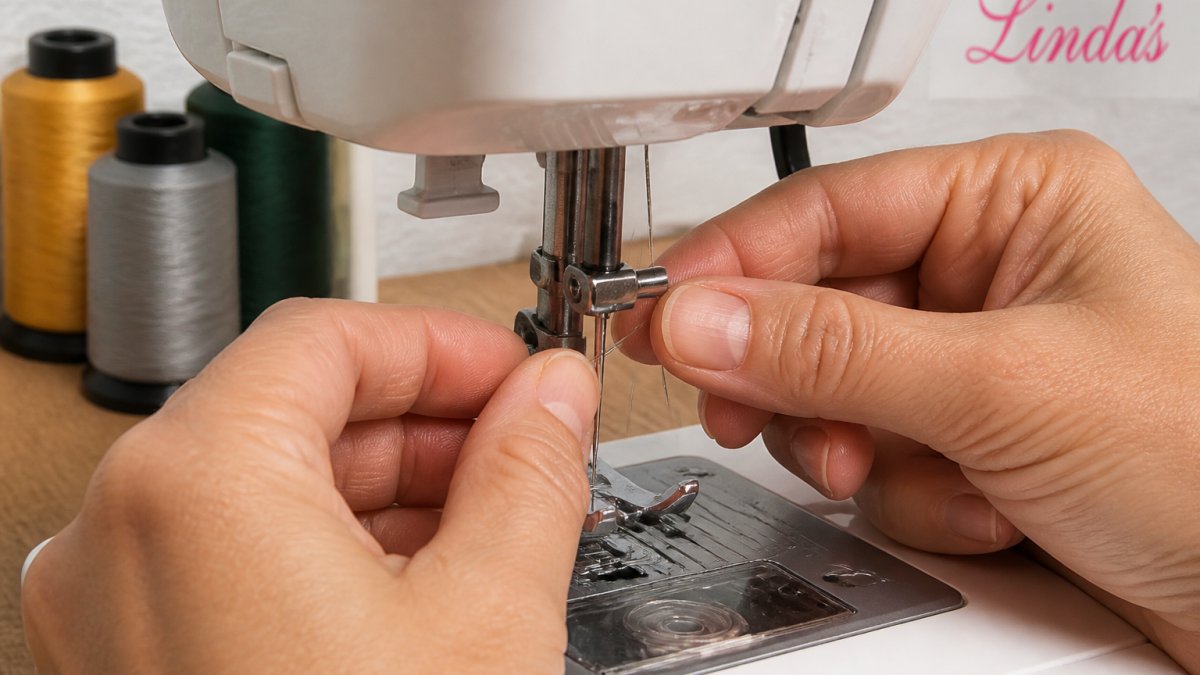
Power off your machine before inserting or removing needles.
Locate the needle clamp, the metal piece that holds the needle.
Loosen the clamp screw just enough to slide the needle in and out; you don't need to remove it completely.
Tighten the clamp screw firmly but don't over-tighten, just enough that the needle doesn't wiggle.
Rethread the machine completely with the presser foot down (this opens the tension discs and ensures thread sits properly).
Test on a fabric scrap before sewing your project.
Selecting the best needles for heavy upholstery fabric on home machines comes down to matching three variables: needle type and size to fabric weight, thread weight to needle eye size, and your machine's capacity to your project. A size 100/16 or 110/18 jeans needle with appropriate thread handles most upholstery work on home machines. Test every setup on scraps, adjust tension and presser foot pressure carefully, and replace needles frequently, heavy fabrics dull needles fast. Linda's Electric Quilters offers a wide selection of needles, threads, and upholstery supplies to support your projects. Shop our needle and thread selection to find the right combination for your next upholstery piece, and explore our machine tension guide for detailed setup instructions tailored to thick fabrics.
Frequently Asked Questions
What needle should I use for heavy upholstery fabric?
Use a size 100/16 or 110/18 heavy-duty, denim, or jeans needle for most upholstery work on home machines. Match the needle to both your fabric weight and thread weight. Heavy-duty needles have a reinforced shaft to penetrate dense materials like canvas, denim, and upholstery-weight fabrics without bending or breaking. Always test on a fabric scrap first to ensure stitch quality before starting your project.
Why does my sewing machine skip stitches on thick fabric?
Skipped stitches on heavy fabrics usually result from needle deflection, a dull needle, or mismatched needle and thread sizes. When the needle bends slightly under pressure from thick material, it misses the bobbin thread. Replace your needle after 8-10 hours of sewing or immediately if it catches on fabric. Increase presser foot pressure if your machine allows, and verify your needle size matches your thread weight. Test on a scrap to confirm the fix before resuming.
Can a home sewing machine sew heavy upholstery fabric?
Yes, most home machines can sew upholstery fabric if you use the correct needle and thread. However, home machines have limits: bonded polyester or bonded nylon thread (the heaviest suitable for domestic machines) requires a size 110/18 needle, and most home machines cannot accommodate needles larger than 110/18. For work beyond these limits, an industrial upholstery setup is necessary. Know your machine's specifications before starting a heavy project.
What thread should I use with a heavy upholstery needle?
Match your thread weight to your needle size. Size 100/16 needles pair with medium-weight upholstery thread; size 110/18 needles handle bonded polyester or bonded nylon thread. Never use thread heavier than your machine and needle can accommodate, as this causes tension problems, broken needles, and skipped stitches. Consult your machine's manual for maximum thread weight specifications, and always test on a fabric scrap to confirm the needle-thread pairing works for your upholstery material.



