
Hi Bestie,
Here’s what makes echo quilting tricky:
Your eye isn’t only following the stitched line.
It’s also seeing the ribbon of empty space beside it.
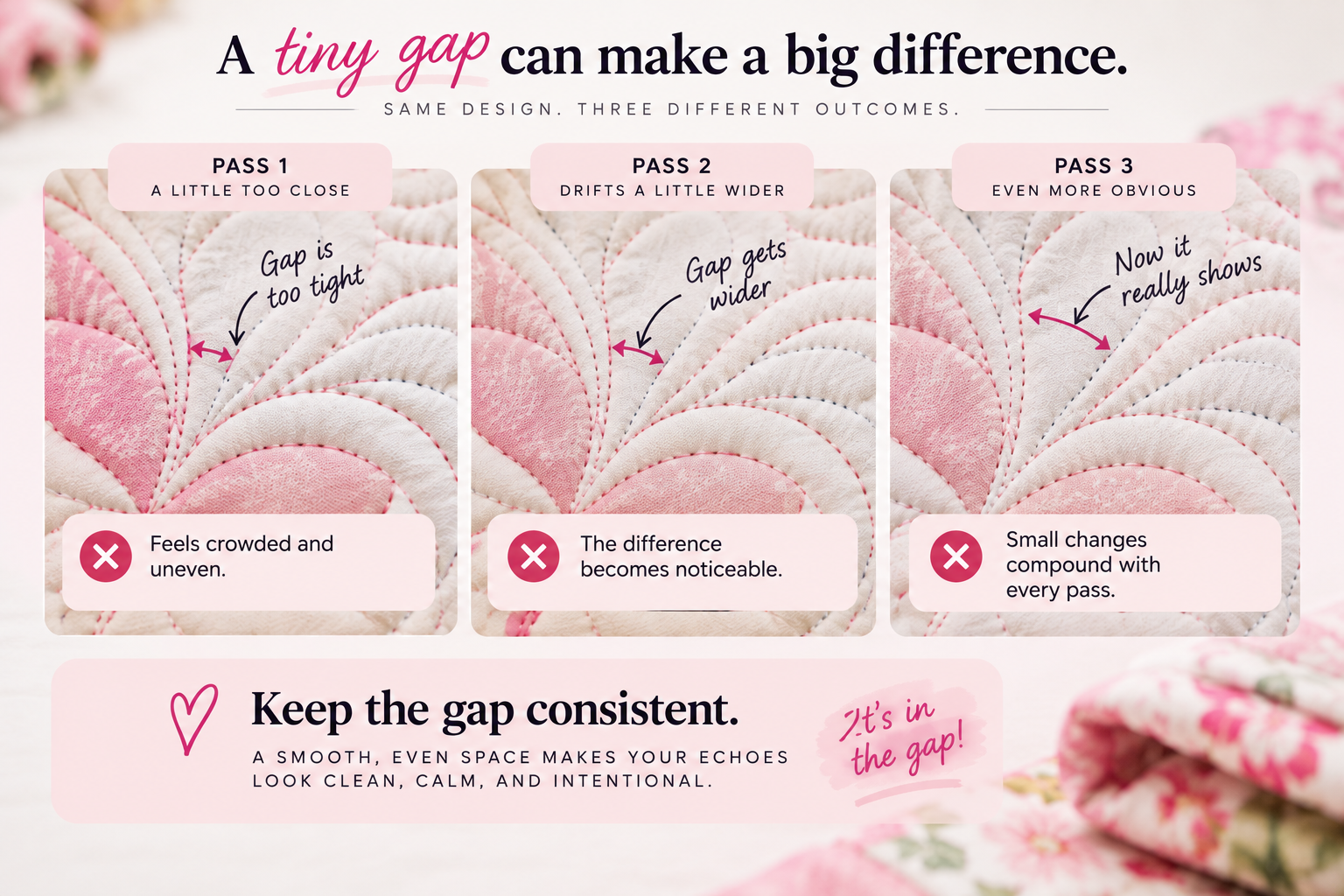
So your stitching can be beautifully smooth, but if that ribbon starts narrow, grows wider, then tightens again, the whole echo can feel uneven.
A Tiny Gap Can Make a Big Difference
And there’s another catch:
A tiny spacing change can become more noticeable with every pass.
Follow an inconsistent first echo with a second… then a third…
…and suddenly that little variation has become part of the whole design.
Before Starting Your Next Pass, Stop for a Second
Instead of asking:
“Is my stitched line perfect?”
Try asking:
“Does the space between my lines feel consistent?”
Sometimes that tiny shift in focus is all it takes to see what’s really happening.
Why the Space Matters More Than the Stitch
Here’s the why behind it, Bestie. When you look at echo quilting, your eye isn’t judging each line on its own — it’s comparing each line to its neighbor. A gentle wobble in a single line is easy to miss, but a gap that pinches from 1/4" down to 1/8" shows up right away, because that ribbon of negative space is its own shape sitting right next to a nearly identical one.
And every echo uses the line before it as its guide. So when one pass drifts, the next pass faithfully follows the drift, and the one after follows that. The error doesn’t stay put — it gets copied outward, ring after ring. It’s the same compounding problem as the cutting mistake that gets worse with every block, just in thread instead of fabric.
Give Your Eye a Little Help
Around curves and detailed motifs, judging the same distance by eye can get surprisingly difficult.
A quilting ruler or template gives you a consistent reference, so you can spend less time second-guessing the gap and more time enjoying the quilting. (If you’re new to quilting with rulers, my guide to quilting templates and rulers is a great place to start — and don’t miss why your ruler may be fooling you.)
Remember,
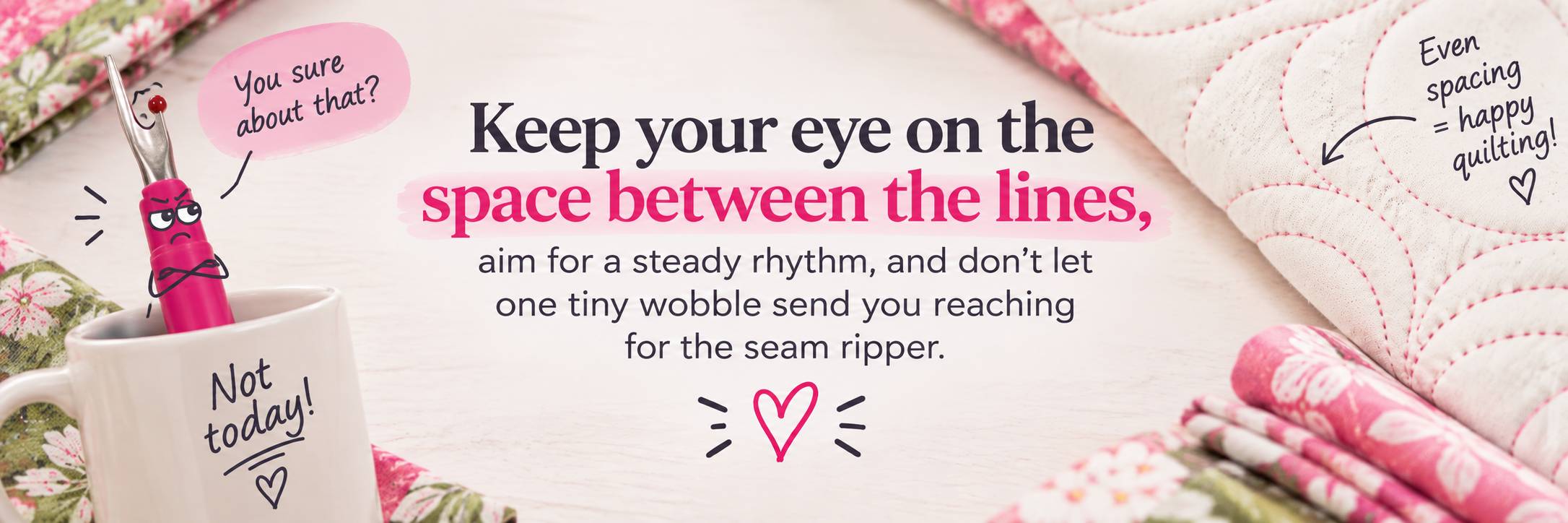
Your echoes don’t have to be perfectly perfect to look beautiful. Keep your eye on the space between the lines, aim for a steady rhythm, and don’t let one tiny wobble send you reaching for the seam ripper. A little consistency goes a long way.
Happy Quilting!
From Corey.
Ready to Quilt Steadier Echoes?
Browse our longarm quilting templates and rulers to find a guide that fits your favorite motifs, then check today’s sales and deals before you stock up.
Frequently Asked Questions
What is echo quilting?
Echo quilting is a quilting design where you stitch lines that follow the outline of a shape — an appliqué, a feather, a block motif — and then repeat that outline outward at an even distance, like ripples spreading on water. It’s a classic way to make a motif stand out. Feathers are especially popular for echoing; see our feather templates guide for ideas.
How far apart should echo quilting lines be?
Many quilters echo somewhere around 1/4" to 1/2" apart, with wider spacing for a softer, faster look and tighter spacing for more texture. The exact distance matters far less than keeping it consistent. A quilting ruler or template with a known width makes that consistency much easier.
How do I keep echo quilting spacing even around curves?
Slow down on tight curves, pause before each new pass to look at the gap rather than the stitched line, and use a guide instead of eyeballing. On many longarms the edge of the hopping foot or a ruler can serve as a steady reference. Curved templates help too — see curved cross-hatching with arch templates for a curve-friendly approach.
Do I need to rip out an uneven echo line?
Usually not. One small wobble rarely shows once the quilt is finished, and you can often ease the spacing back to even over your next pass. Save the seam ripper for spacing that’s clearly off across a large area — and remember, your seam ripper isn’t a sign of failure when you do need it.
Why does a small spacing mistake get worse with each echo?
Each echo uses the previous line as its guide, so any drift in one pass gets copied into the next and the next. By the third or fourth pass, a tiny variation has become part of the design. Checking the gap before every pass — and using a ruler or template for a fixed reference — keeps small errors from compounding, much like small cutting errors that grow with every block.