
Hi Bestie,
You line up your fabric.
You line up your ruler.
You make what looks like a perfectly straight cut.
Then you open up your strip and,
it widens into a “V.”
Frustrating? Yes.
Random? Not necessarily.
Here's what's happening
When you’re making a long rotary cut, a tiny change in alignment can become much more noticeable over distance.
Think about drawing a line at a slight angle.
For the first inch, it looks almost perfectly straight.
Keep extending that same line…
…and suddenly you can see just how far it has wandered.
Your fabric can do the same thing.
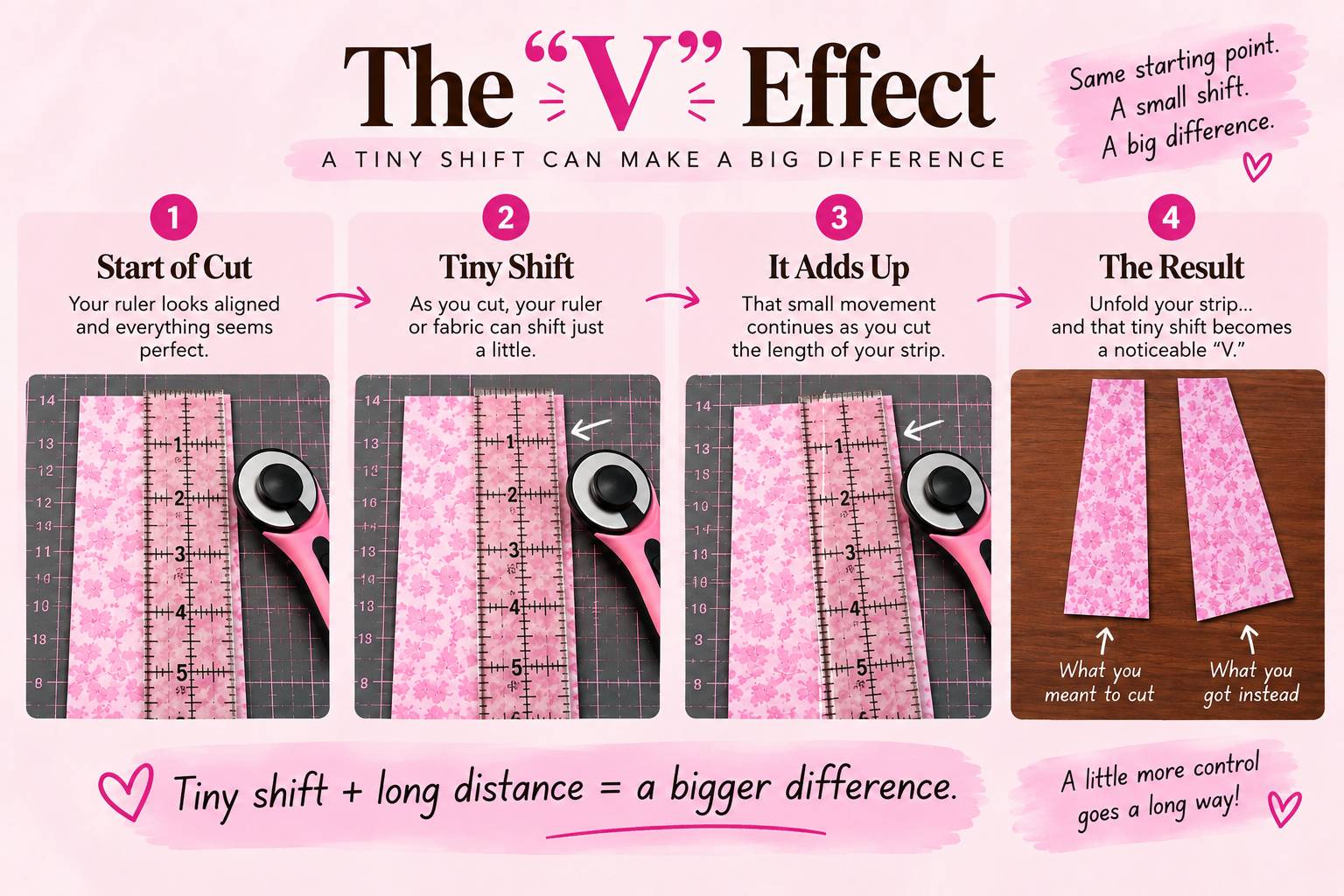
Why the “V” shows up when you unfold
Most strips are cut through folded fabric. If your ruler drifts even a hair off the grain over 20-plus inches, the cut edge ends up at a slight angle to the fold. Open the strip and that angle gets mirrored on both halves, so a strip that’s a touch wider at one end becomes a bend right at the fold line. That’s the “V.” It isn’t the fabric misbehaving; it’s a small drift, doubled. I covered the fold-and-grain side of this in The Cutting Mistake That Gets Worse With Every Block, and if you suspect the ruler itself is the culprit, start with Your Ruler May Be Fooling You.
So, how do you help prevent it?
Before your next long cut, don't just think about getting your ruler straight.
Think about keeping everything stable while you cut.
Keep your fabric flat. Maintain steady pressure on your ruler. And as your rotary cutter travels, be careful not to let your hand movement push the ruler away from its original position.
A few things that make “stable” easier:
- A ruler that grips. A non-slip ruler like the Quilters Select 6.5" x 24" resists the sideways nudge that starts the drift.
- A sharp blade. A dull blade makes you press harder and push forward, and that push is exactly what shoves the ruler. Sharpen or swap your blade before a long cutting session.
- A mat that lies flat. A warped or undersized cutting mat lets fabric shift underneath you. If you’re cutting from the mat lines instead of the ruler, read Are You Cutting With The Ruler—or The Mat? first.
- Walk your hand. On a cut longer than your hand span, stop the cutter, slide your ruler hand up, re-press, then continue. The ruler shouldn’t move; only your hand should.
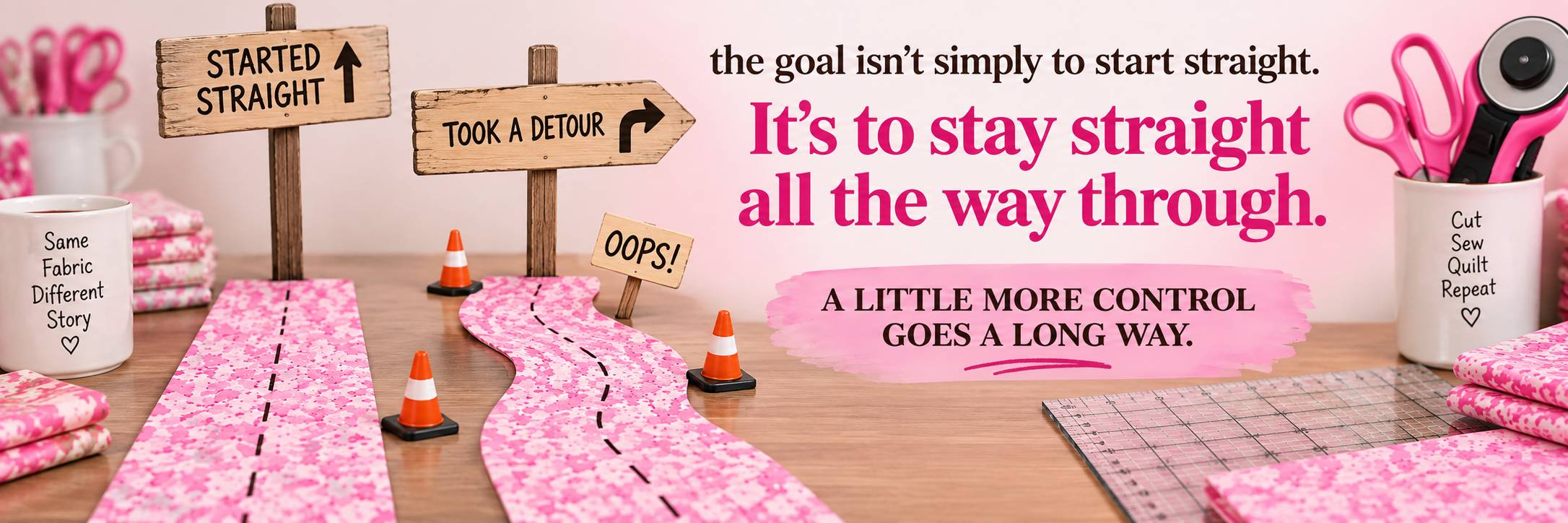
Because the goal isn't simply to start straight.
It’s to stay straight all the way through.
Remember,
A straight cut isn’t just about starting in the right place, it’s about staying steady all the way through. Keep your fabric flat, your ruler secure, and your pressure consistent as you cut. Those tiny adjustments can be the difference between a surprise “V” and a beautifully straight strip.
Happy Quilting!
From Corey.
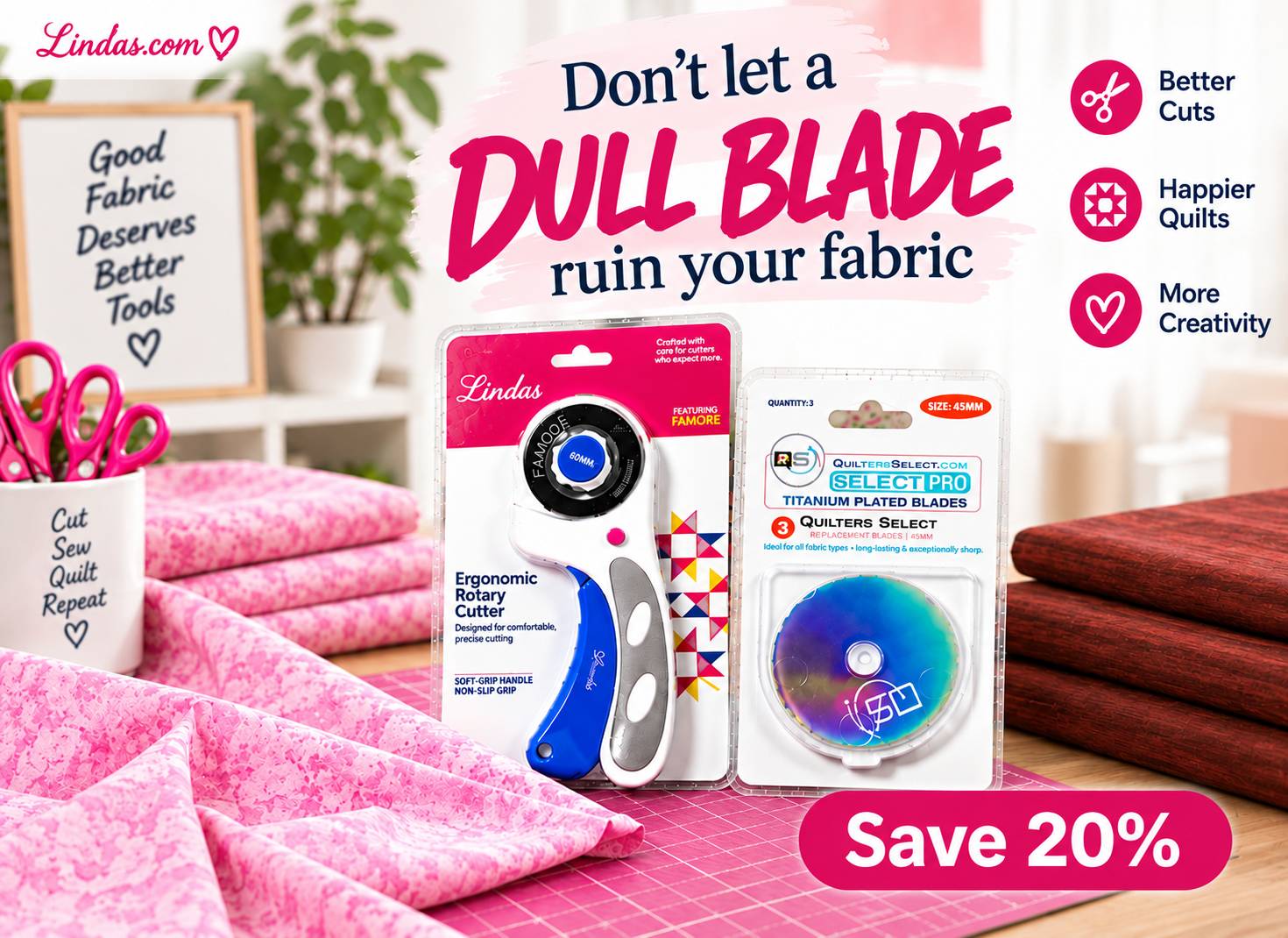
A fresh blade is the cheapest fix for a wandering cut. Shop rotary cutters and replacement blades, or see what to look for in A Quilter’s Guide to Rotary Cutters.
Frequently Asked Questions
Why does my fabric strip have a V or bend in the middle after cutting?
The V appears because the strip was cut through folded fabric and the cut edge wasn’t perfectly perpendicular to the fold. Even a slight angle gets mirrored across the fold when you open the strip, creating a bend. Re-square your fabric edge to the fold before each cut, and check that your ruler is aligned to the fold, not to the selvage or the mat lines.
How do I keep my ruler from slipping when rotary cutting?
Spread your fingers wide on the ruler, keep your pinky off the edge so it anchors the far side, and press straight down rather than forward. A non-slip ruler with a gripping surface helps most. On long cuts, stop and “walk” your hand up the ruler instead of stretching, because a stretched hand is what pushes the ruler sideways.
Should I cut long strips with the fabric folded or single layer?
Folded is faster and standard for width-of-fabric strips, but it doubles any alignment error. If you keep getting V-shaped strips, try one of two fixes: fold selvage-to-selvage and then fold again so the cut is shorter, or cut single layer on a large cutting mat so there’s no fold to mirror the error. A big mat like the Quilters Select 36" x 60" makes single-layer cutting practical.
Does a dull rotary blade cause crooked cuts?
Yes. A dull blade skips and drags, so you compensate by pressing harder and pushing forward, and that forward push is what shifts the ruler off its line. If your cuts wander or you’re seeing skipped threads, sharpen or replace the blade before adjusting anything else. Fresh blades are in the rotary cutters and blades collection.
How often should I re-square my fabric when cutting strips?
Every three to four strips is a good rule. Each cut can introduce a tiny drift, and those drifts stack. Fold the fabric as you did originally, line the ruler up to the fold, and trim a sliver off the cut edge to bring it back to true. This is the same habit that prevents the compounding error in The Cutting Mistake That Gets Worse With Every Block, and using the right side of your mat keeps the surface from adding drift of its own.