
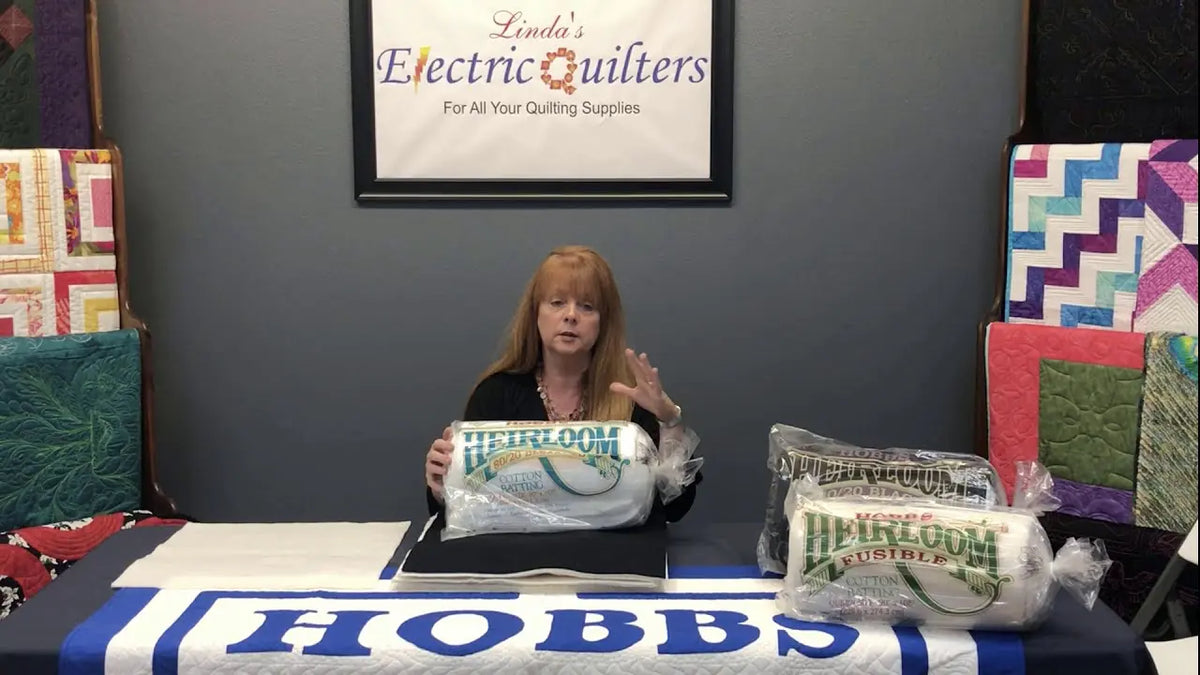
Hi Bestie! Heirloom 80/20 is the batting we sell more of than anything else, by roll, by board and by package. Most quilters know the natural version. Fewer know it comes in four, or that the fusible one has a rule that will ruin it if you don't know it. Stephanie Hackney from Hobbs Bonded Fibers covers all four in six minutes, including the exact press-and-test steps for fusible basting. Everything is below with the products linked.
Key Takeaways
- Heirloom 80/20 is 80% cotton, 20% polyester with a light binder for stability. The polyester fibers are blended through the batting, not laid on top as a scrim.
- Quilt it up to 4" apart. It shrinks 3–5% on the first wash (that's the soft, crinkled traditional look), is machine washable and can be lightly dried on delicate. It's one of Hobbs' two charity-program battings.
- Natural is the default. Bleached is the same batting in bleached cotton for white, pastel and sheer fabrics. Black uses dye-fast black cotton for dark fabrics and leaves no light lint on your quilt.
- Fusible 80/20 is coated both sides with a water-soluble fusing medium, so you press the sandwich together instead of pin or spray basting. The medium washes out the first time the quilt is laundered.
- The fusible rule: never spritz it with water or hit it with a steam iron before fusing. Water dissolves the medium and it won't stick. Let it loft flat for a few hours to lose wrinkles.
- Fuse-basting: dry iron set for your fabrics, press (don't iron) 7–10 seconds, lift and test adhesion, continue across the top; let cool, flip, and fix any creases by lifting and re-pressing. It will re-stick two or three times.
In This Video
What 80/20 Actually Is
The original Heirloom 80/20 is 80% cotton and 20% polyester with a binder that adds stability. Stephanie's point about construction matters: the polyester is blended throughout, not a scrim layer sitting on top of cotton. That's why it behaves like one even fabric rather than two layers that can separate.
It's Hobbs' best seller because it works for nearly every quilt and doesn't demand the careful washing that wool or silk do. Quilt it up to 4 inches apart. Expect 3 to 5 percent shrinkage on the first wash, which is what gives a quilt that softly crinkled, traditional look. Machine wash, light dry on delicate. It's also one of the two battings in the Hobbs charity program, alongside Poly-Down.
Bleached: For Whites and Pastels
Same batting, made with bleached cotton. Use it under white quilts and any light fabrics: light pink, light blue, yellow, turquoise, anything pale. Stephanie's specific example is a memory quilt made from dress shirts, where fabrics are thin and light enough for natural batting to dull them. Bleached keeps those colors bright. It sometimes looks a little fluffier and less smooth than natural; that's the bleaching process, not a defect.
Black: For Darks, and No Lint
Black 80/20 is made with dye-fast black cotton blended with polyester, tested to stay colorfast through washing once it's inside a quilt. Use it under black, dark brown, dark blue, dark green, purple and navy. Beyond keeping darks dark, its real everyday benefit is that it leaves none of the pale lint natural batting sheds. You finish quilting and go straight to the washing machine, no lint roller. Same loft as natural.
Fusible: Skip the Basting, Learn the One Rule
Fusible 80/20 is the same batting with a double-sided, water-soluble fusing medium sprayed onto both faces. It replaces spray or pin basting: you build top, batting and backing in one step and press them together. Out of the bag it feels slightly stiff and tacky, which is correct; that's the medium. After the quilt's first wash the medium is gone and it feels like ordinary 80/20.
The rule: keep it dry until it's fused. Most Heirloom battings come out of the package wrinkled, and the usual fix is a light spritz of water and a few minutes in a cool dryer. Do not do that with fusible. Water dissolves the medium, and so does a steam iron, and then it won't stick. Lay it flat and let the wrinkles loft out on their own, usually a few hours.
How to Fuse-Baste a Quilt With Hobbs Fusible 80/20: Step by Step
- Set a dry iron. Set your iron to the right temperature for your fabrics (cotton for cotton top and backing). No steam.
- Build the sandwich. Layer backing, fusible batting and top, smoothing each layer flat.
- Press, don't iron. Press straight down for 7 to 10 seconds, then lift. Sliding the iron shifts the layers.
- Test and adjust. Lift a corner to check that both sides have adhered. If not, add a little more time per press.
- Work across the whole top. Repeat section by section until the entire quilt top is fused, then let it cool.
- Flip and fix the back. Turn the quilt over. Where the backing has a crease or wrinkle, put a hand on the batting, gently lift the fabric, lay it back down and re-press. You can re-fuse an area two or three times before it stops sticking.
Products Featured in This Video
- Hobbs Heirloom 80/20 Batting Package — the natural original, in bed-size packages
- Hobbs Heirloom 80/20 96" Roll (30 yd) — the longarm studio staple
- Hobbs Heirloom 80/20 96" 15-Yard Board — half-roll quantity for smaller studios
- Hobbs Heirloom 80/20 120" Roll — king-width natural
- Hobbs Heirloom Bleached 80/20 Batting Package — for white, pastel and sheer fabrics
- Hobbs Heirloom Bleached 80/20 108" Roll — bleached by the roll
- Hobbs Heirloom Black 80/20 Batting Package — for dark fabrics; no light lint
- Hobbs Heirloom Black 80/20 108" Roll — black by the roll
- Hobbs Heirloom 80/20 Fusible Batting Package — press-to-baste; keep it dry until fused
- Hobbs 80/20 Package Deal — our current bundle pricing on Heirloom 80/20 packages
Keep Learning
- How to Choose the Right Quilt Batting: Hobbs' 5 Questions (video)
- The 80/20 Batting Showdown: Hobbs, Quilters Dream, Pellon, Bliss, and Linda's Deluxe Compared
- Hobbs Heirloom 80/20 Batting Package Guide
- The Quilt Batting Buyer's Guide
- Hobbs Polyester Batting Explained (video)
If you only ever stock one batting, this is the one, and the video is the fastest way to understand why four versions exist. Grab the fusible if basting is the part of quilting you put off, and remember: dry until fused.
Happy Quilting! From Corey.
Frequently Asked Questions
How far apart can you quilt Hobbs Heirloom 80/20?
Up to 4 inches apart, for all four versions (Natural, Bleached, Black and Fusible). It is machine washable, can be lightly dried on a delicate cycle, and shrinks about 3 to 5 percent on the first wash, which produces the soft, crinkled look of a traditional quilt.
What is the difference between Hobbs Heirloom 80/20 Natural, Bleached and Black?
They are the same 80% cotton, 20% polyester batting made with different cotton. Natural is unbleached and suits most fabrics. Bleached uses bleached cotton so white, pastel and sheer fabrics stay bright. Black uses dye-fast black cotton so dark fabrics stay dark and the quilt sheds no light lint during quilting. Loft is the same; Bleached can look slightly fluffier.
How do you use Hobbs fusible batting?
Layer backing, fusible batting and top, then press with a dry iron set for your fabrics for 7 to 10 seconds per spot. Lift and check that both sides adhered; add time if needed. Work across the whole top, let it cool, flip, and re-press any creases on the back after gently lifting the fabric. An area can be re-fused two or three times. Never use steam or spritz the batting with water first; the water-soluble medium will dissolve and won't stick.
Does the fusible medium stay in the quilt?
No. The fusing medium on Hobbs Fusible 80/20 is water-soluble. It holds the layers while you quilt, then washes out the first time the finished quilt is laundered, leaving ordinary Heirloom 80/20. That is also why the batting must stay dry until it is fused.
Is 80/20 batting good for charity quilts and gifts?
It is Hobbs' top recommendation for them. Heirloom 80/20 holds up to any washer and dryer, so it is safe for recipients who won't follow special care instructions, and it is one of the two battings in the Hobbs charity batting program. Use Natural for most quilts, Bleached under light fabrics and Black under dark ones.
Read the full transcript
[0:00] hi there my name is Stephanie Hackney and the director of sales and marketing for Hobbs Bonded Fibers you probably know us better as Hobbs batting and we're going to talk a little bit about our different products today and the next group up is the 80/20 line which is a product that most people are familiar with it's the product we sell the most of and is the most common used in long-arm studios in quilt shops who sell batting by the yard so we're going to talk about the four different types of 80/20 and then how to use it and then the pros and cons of this product the first one we're going to talk about is our original this is the heirloom 80/20 it's 80% cotton 20% poly it does have a binder in it which gives it some extra stability and the 20% polyester fibers are blended throughout the product it's not like a scrim so it's not cotton with scrim polyester laid on top they're actually all blended in together and the reason this is such a great all-around batting and the reason we sell so much of it is that it's great for pretty much every kind of use and you do not have to worry about the washing of it as much as you might with some of the other fibers like maybe a wool or a silk so this is part of our charity batting program this is one of the two products that we make available the Poly-Down being the other one and this product you're going to stitch four inches apart it will shrink
[1:19] about three to five percent and you can wash it in a machine and then lightly dry it in a delicate cycle dryer as well so this is the natural and let me show you this is the loft on that and it's a very very lightweight soft nice batting again will give you the very traditional quilt look okay then we make other versions of it so the first version that we make is a bleached version and the bleached version is basically the same exact product it's just made with bleached cotton and this is ideal for white quilts or any light fabric quilts think about if you're making a memory quilt with maybe men's t-shirts or men's shirts dress shirts maybe a memory quilt will have thinner and thicker fabrics and this might be a really good choice if you have a light up a lot of light colors in that if you're going to be using things like light pink light blue yellow turquoise any kind of very pale or pastel colors this would also be a really good choice because it'll keep those colors nice and bright and not dull them okay so that's a good choice for those and then if you're going to be using black or dark fabrics
[2:37] so black dark brown dark blue dark green purple navy blue this would be a good choice and this is our black 80/20 this is made with a dyed black cotton and then the polyester mixed in with it the cotton is dye-fast so you don't have to worry about the black running this has been very well tested to make sure that it would be colorfast once it's inside of a quilt in the quilt is washed so this would be a really good choice and probably the biggest benefit of this one besides the fact that it'll keep your darks real dark is that this won't leave that all that light lint all over your quilt so when you get done with your quilting all you have to do is throw it in the washing machine and get to use in it and then the last one is our fusible okay and our fusible is again 80/20 but this is a double-sided water-soluble fusible and its primary benefit is that it's going to save you a lot of time so if you're used to spray basting your quilts right now we've already done that work for you on this batting so that fusible medium is sprayed on the top and the bottom of both sides of this batting and then you're going to be able to do your top and your back and your batting together in the sandwich all in one step so let's say that your top fabric is
[3:55] cotton and your bottom fabric is cotton you're going to set your iron to the appropriate temperature for that and you're going to go ahead and make your sandwich and then you're going to press in place for seven to ten seconds lift up and then test your fabric if your fabrics adhere do you know that's enough time if it's not quite adhered on both sides yet then you may want to add a little bit more time and again you're pressing not ironing and you're going to go around the whole top of your quilt and when you get all done let it cool and then flip it over if you have any creases or wrinkles someplace where it got a little messy on the backside you can gently put your lift the fabric up after putting your hand on the batting you're just going to gently lift it up put it back down and then you can reapply it you can do that two to three times before this won't stick anymore now a couple things to know about this first of all for most of our Heirloom battings they're going to be a little bit wrinkled out of the packaging and now most of them you can go ahead and spritz them very lightly with water throw them in a cool dryer for a few minutes and that'll knock the wrinkles out of it you do not want to do that with this batting again this is water-soluble so the medium is there to help you baste your quilt together but then once you finish your quilt and you put it in and wash the fusing medium is going to wash out so if you spritz it with water or if you use a steam iron
[5:12] and you get it too wet this will not stick right so you want to make sure that if to get the wrinkles out of this product you want to just lay it flat let them naturally loft out and then you'll be able to use it and usually just takes a few hours so this is our final 80/20 product let's look at a sample of each of these so we started with the natural that's this one here this is the black and again it's going to be about the same loft as the natural this is the bleached and sometimes this will appear a little bit fluffier than the other ones and not quite as smooth and that's just from the bleaching process and then this is the fusible one and the fusible one will always feel a little bit stiff and sticky and that's the way it should feel that means that the medium is all over it and then it'll help it to stick when you're doing your basting so again we've got our 80/20 product you're gonna stitch it four inches apart it's machine washable and it's going to shrink three to five percent it's ideal for most any kind of quilt comes in four versions natural bleached black and the double sided fusible thanks so much for joining us
[6:31] and if you have any questions please reach out to Linda's Electric Quilters or you can reach out to us at [Music]


