
Hi Bestie,
You've finished quilting the main design. Everything looks balanced, the layers are secure, and the quilt is coming together beautifully.
But then comes that familiar thought:
Should I fill in those empty spaces? Add another border design? Maybe a little more texture?
Before you make another pass, consider this: Every additional line of quilting changes how your finished quilt looks, feels, and drapes.
And sometimes, those extra stitches take away more than they add.
The 3-Question Check Before Your Next Pass
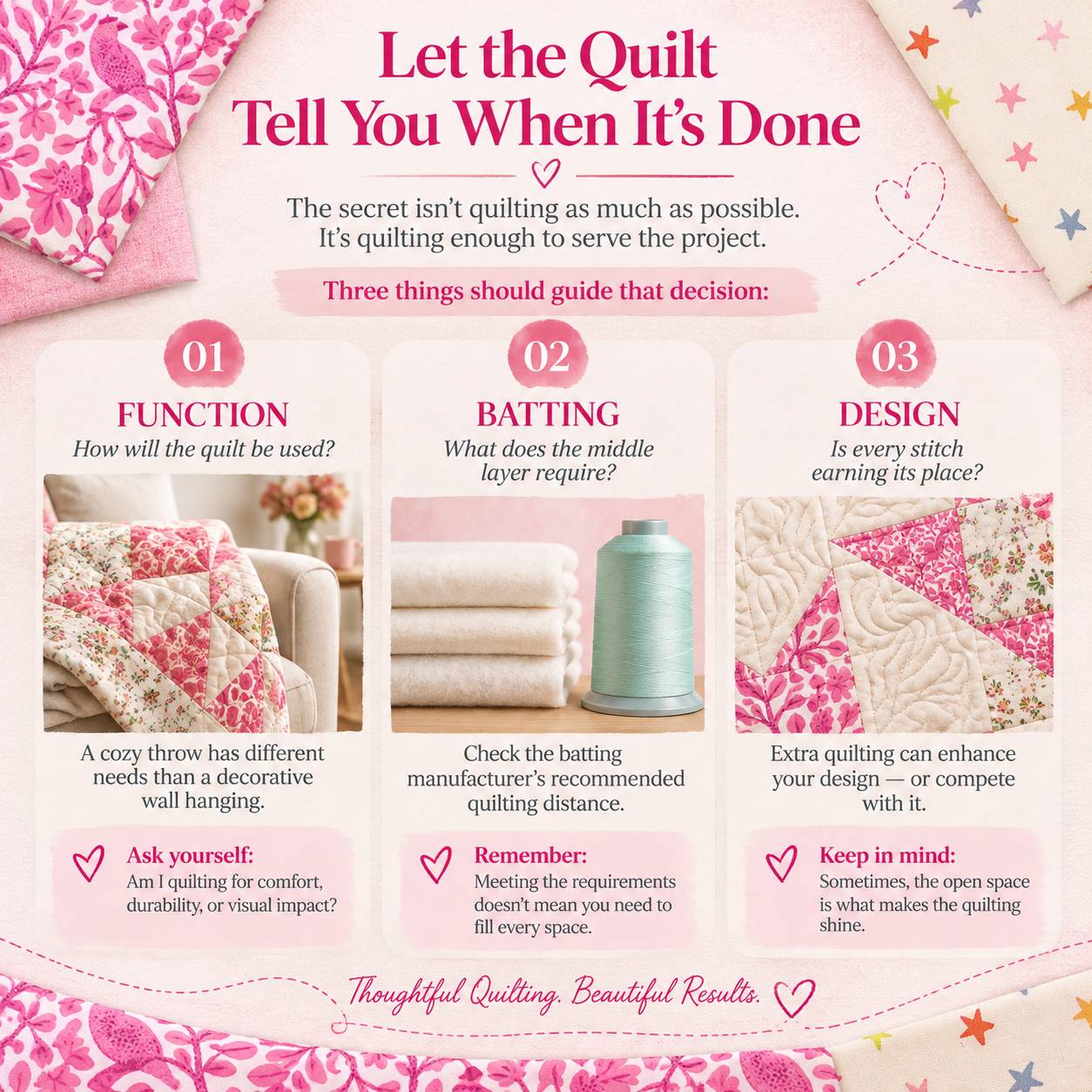
Before adding more stitches, stop and ask:
- Is the batting adequately secured? Check the recommended spacing and any areas that still need stitching.
- Does the quilt feel the way I want it to? Consider its softness, flexibility, and intended use.
- Will this next line improve the design? Or am I simply filling space because it's there?
If the quilt meets its structural needs, feels right, and looks balanced, you may already be finished.
Why More Quilting Changes How a Quilt Feels
Every line of stitching pins the three layers together at that spot, so the batting can't loft there. Add enough lines and the whole quilt gets flatter, stiffer, and heavier in the hand; the drape you loved on the frame turns into something closer to a placemat. That's why a cozy throw usually wants less quilting than a wall hanging that needs to hang flat and square. The batting sets the floor, not the ceiling: Hobbs 80/20, for example, can be quilted up to about 4" apart and still hold together through washing, so once you've met that spacing, every additional pass is a design choice, not a requirement. Selecting batting for quilting covers how loft and fiber change that math, and why your batting might be flattening your quilting shows what happens when density and loft fight each other.
Remember,
A beautifully finished quilt isn't measured by how many stitches you add, but by how thoughtfully you place them. When your batting is secure, your quilt feels just right, and your design has room to shine, you've done enough. Sometimes, the most skillful stitch is the one you choose not to make.
If you're second-guessing a design instead of the density, not loving how your quilting looks and why that echo feels wrong are the two to read next.
Happy Quilting!
From Corey.
The question "is my batting secured?" has a specific answer printed on the package, and it's different for every batting. If you're quilting on Hobbs 80/20, the 96" roll and the pre-cut packages are both on special right now: Hobbs 80/20 96" Roll Deal and Hobbs 80/20 Batting Packages Deal. For everything else, start in the Batting collection.
Frequently Asked Questions
How much quilting is enough to hold a quilt together?
Enough that no unquilted area is wider than the batting manufacturer's maximum quilting distance. That figure is printed on the package and ranges from about 2" for some 100% cottons to 8–10" for needle-punched blends and most polyesters. Meet that spacing everywhere and the quilt will survive washing; anything beyond it is for look and feel, not structure. The Hobbs batting guide lists the spacing for each Hobbs product.
Can you over-quilt a quilt?
Yes. Each line of stitching compresses the batting at that spot, so very dense quilting makes a quilt flatter, stiffer, and heavier, and it can cause the top to draw up unevenly or pucker between heavily and lightly quilted areas. For a bed quilt or throw, that stiffness is usually unwelcome; for a wall hanging or art quilt it may be exactly what you want. Decide based on how the quilt will be used, and see the batting question we don't ask enough for the loft side of that trade-off.
Does dense quilting make a quilt stiff?
It does, and the effect is bigger with low-loft cotton than with wool or a high-loft polyester. Cotton battings compress and stay compressed, so dense stitching on cotton reads as a stiff, flat quilt; wool and poly blends spring back between lines, so they keep more drape at the same density. If you want heavy custom quilting and a soft quilt, pick the batting for that goal before you load the top.
Should I fill in the empty spaces on my quilt?
Only if the empty space is wider than your batting allows, or if leaving it open hurts the design. Open areas are often what make the quilted motifs read: a feather needs quiet space around it to look like a feather. Before filling, look at the quilt from across the room and ask whether the eye is being drawn where you want it. Borders that look pinched are a common sign that a fill was added for coverage rather than design.
What's the recommended quilting distance for Hobbs 80/20?
Hobbs Heirloom 80/20 can be quilted up to 4" apart. In practice most longarmers run edge-to-edge designs at 1"–3" spacing on it, which is comfortably inside the limit, so with 80/20 the "is it secured?" question is almost always already answered by the time the main design is done. The Hobbs 80/20 package guide has the full spec; the 96" roll is the longarm-friendly format.


